Iris in Perfumery: The Root That Costs Twenty Lakh Per Kilogram
Transparency: we formulate DOPE ONE Emerald Moss. Every fragrance here, including ours, is judged on the same criteria: Indian heat performance, fabric longevity, and fidelity to the original's character. Where ours falls short, we say so.
Iris is the most expensive thing in perfumery and the hardest to use well. A single kilogram of iris absolute costs between ₹20 and ₹50 lakh, depending on origin and age. It takes three to five years to produce: one year for the root to grow, three to four additional years for it to age before it is ready for distillation. The yield is 0.2-0.4% of the aged root weight. The molecules that emerge from this process, called irones, smell like cold violet petals dusted with powder and earth. They are unlike anything else in the perfumer's palette and they are almost impossible to replicate synthetically. Not for lack of trying, but because the irone molecule complex combines floral, powdery, woody, and earthy registers in a way that a single synthetic cannot reproduce.
This article covers what iris actually is, the irones molecule family, why the aging process is non-negotiable, how iris behaves on Indian skin, and why no DOPE ONE SKU contains it yet.
What Iris Actually Is in Perfumery
The material known as "iris" or "orris" in perfumery is not derived from the iris flower, which has almost no scent. It comes from the rhizome (underground stem) of two iris species: Iris pallida (sweet iris, pale iris) from Tuscany, Italy, and Iris germanica (German iris, bearded iris) from Morocco and Italy. The rhizomes are harvested by hand, peeled, washed, and left to dry for three to five years. The aging process allows chemical precursors in the fresh root to oxidise and degrade into the aroma molecules responsible for the iris character. Fresh iris root has a green, vegetable-like smell. Aged orris root smells like violet, cold powder, and rain on warm earth.
The primary aroma molecules are the irones: alpha-irone (CAS 79-69-6), beta-irone (CAS 79-70-1), and gamma-irone (CAS 493-01-6). Alpha-irone provides the violet-floral character. Beta-irone adds the earthy-root dimension. Gamma-irone contributes the powdery, woody undertone. The total irone content in aged orris root is typically 0.1-0.3%, of which roughly 60-75% is alpha-irone. Synthetics like methylionone and alpha-isomethylionone attempt to replicate this profile and succeed in the violet-powdery register, but they cannot reproduce the complexity of the natural irones. Iris absolute costs ₹20-50 lakh per kilogram. Methylionone costs ₹2,000-5,000 per kilogram. Both are used widely. Only one tells the truth about what it contains.
Iris is the note that feels expensive. It does not announce itself the way rose does. It does not warm the room the way amber does. It establishes a register of cold elegance that makes everything around it feel more refined. If rose is the person everyone wants to sit next to and leather is the one in the corner you keep glancing at, iris is the person across the room who you notice is missing only when they leave.
Why Iris Costs More Than Gold
Orris root has been used in perfumery for at least 2,000 years. The ancient Greeks and Romans used powdered orris root as a perfume and medicine. It appears in the Materia Medica of Dioscorides. By the Renaissance, orris powder was used to scent laundry, wigs, and gloves.
The modern iris industry is concentrated in Tuscany (Iris pallida) and Morocco (Iris germanica). The process from planting to oil takes seven to nine years. Planting, 1 year of growth, harvest, peeling, and three to five years of aging. The entire cycle is done by hand. There are no mechanical harvesters for orris root. There is no way to accelerate the aging. The price reflects time that cannot be shortened.
| Source Material | Ageing Required | Yield | Cost/kg |
|---|---|---|---|
| Iris Absolute (Iris pallida) | 3-5 years | 0.2-0.4% | ₹30-50 lakh |
| Iris Concrete | 3-5 years | 0.5-1.5% | ₹15-25 lakh |
| Orris Butter (Steam-distilled) | 3-5 years | 0.05-0.1% | ₹40-60 lakh |
| Methylionone (Synthetic) | None | N/A | ₹2,000-5,000 |
India does not produce iris. The plant is native to Southern Europe and the Mediterranean. Kashmir's Iris kashmiriana grows in the Himalayas but has not been developed for perfumery. The Mughals brought iris to Kashmir's gardens, where it blooms every spring in Shalimar Bagh and Nishat Bagh, but the flowers are ornamental, not aromatic. The root that costs ₹30-50 lakh per kilogram comes from Tuscany. The flower that blooms in a Srinagar garden is a different species with a different economic story.
If Iris Is Out of Reach
| Alternative | What You Get | What You Lose |
|---|---|---|
| Methylionone | The primary synthetic irone replacer. Violet-powdery character with good diffusivity. Used in 90% of commercial iris accords. | No earthy or woody depth. Methylionone is the powder without the root. Smells correct in the top note, flat in the base. |
| Alpha-Isomethylionone | A cleaner, more floral version of methylionone. Used in fine fragrance as the primary iris synthetic. | Even less earthy character than methylionone. Alpha-isomethylionone is iris's reflection, not its body. |
| Violet Leaf Absolute | The green, metallic floral that pairs with iris naturally. Violet leaf provides the floral register that iris occupies. | No powder. Violet leaf is green and metallic, not dusty and cold. Useful as a companion, not a substitute. |
| Hedione + Ionones | A transparent, jasmine-violet hybrid that creates the effect of iris diffusion without the cost. | No iris character at all. The effect is floral radiance, not the cold powdery elegance of iris. |
How Iris Behaves on Indian Skin
Iris is unusual among perfume materials in that it performs better in heat than in cold. The powdery, violet-tinged character of irones becomes more legible at higher temperatures, where heavier notes like vanilla and amber can become cloying. Iris stays cool, clear, and precise.
| Season | What Iris Does | Verdict |
|---|---|---|
| Summer (35-45°C) | Iris's powdery character becomes more prominent. The cool, violet-like quality stands out against heavier notes. One of the few notes that benefits from Indian summer heat. | Excellent. Iris is one of the best notes for Indian summer. |
| Monsoon (80%+ RH) | Humidity softens the powdery edges. Iris becomes rounder, more floral. The earthy orris character recedes. | Good. Iris is comfortable in monsoon. |
| Winter (5-20°C) | Full iris performance. The cold, powdery character matches winter air perfectly. The most elegant winter note in the palette. | Excellent. Iris's natural climate in every sense. |
The Indian rule for iris: it is one of the few notes that works well in every Indian season. Its cold, powdery character is comfortable in summer, elegant in winter, and refined in monsoon. If you can afford iris, you can wear it year-round.
Who Iris Is For
Iris attracts the wearer who wants to smell expensive without smelling of anything in particular. It is the note for someone who has figured out that the best compliment is not "you smell nice" but "what are you wearing?" Iris wearers tend to be people who have worn enough fragrance to understand that complexity beats projection. They are not attempting to fill a room. They are attempting to be remembered.
| Who It Is For | Why It Works |
|---|---|
| Year-round wearers | Iris is one of the few notes that performs well in all Indian seasons. Summer, monsoon, winter, evening, morning. |
| Wearers who dislike sweet fragrances | Iris has no sweetness. It is powdery, earthy, cold. If you avoid vanilla and amber, iris is the elegant option. |
| Formal and professional settings | Iris is the most formal note in the palette. It does not invite. It commands attention quietly. |
| Who It Is Not For | Why It Fails |
|---|---|
| Wearers who want projection | Iris does not project. It sits close, stays elegant, and rewards proximity. If you want to be noticed from across a room, iris is the wrong choice. |
| Wearers who associate powder with "old lady" | Iris's powdery character reads as vintage to some noses. Modern iris compositions (iris-ambrette, iris-incense) break this, but the association persists. |
| Budget-conscious wearers | Real iris absolute is prohibitively expensive. Even iris accords built on synthetics cost more than other floral alternatives. Iris is not for the budget-conscious formula. |
What Iris Plays Well With
Iris is one of the most versatile floral-base notes in perfumery. Its powdery, earthy character pairs with almost everything because the irones chemistry is compatible with most molecule families.
Iris and violet leaf is the natural pairing. Both share the irones chemistry. Violet leaf adds a green, metallic freshness that iris's powder balances. The result is the most elegant floral-woody accord in perfumery. That is the architecture that emerald-moss uses, and why iris would be a natural character extension for the SKU's green-floral profile.
Iris and sandalwood is the woody-powdery classic. Sandalwood's creamy warmth rounds iris's cold edges. The pairing is the foundation of Prada Amber Pour Homme and several other modern iris compositions.
Iris and leather is the Cuir de Russie pairing. Iris's powder dries out leather's animalic weight, creating the most elegant leather composition ever produced. Our leather in perfumery guide documents the full architecture.
What Does Not Work With Iris
Iris and heavy gourmand notes (caramel, strong ethyl maltol) clash. The cold elegance of iris fights with the warm cheapness of synthetic candy sweeteners. Iris and strong animalic notes (castoreum, high-dose muscenone) can become muddy.
Five Iris Fragrances Worth Wearing
| Fragrance | Iris Character | Price Band (India) | Heat Performance | Best For |
|---|---|---|---|---|
| Prada Amber Pour Homme | Iris + neroli + amber + sandalwood. The reference modern iris. Powdery, clean, elegant, unmistakable. | ₹7,000-9,000 | Excellent. Neroli top and iris heart handle heat exceptionally well. The most Indian-friendly iris. | Understanding accessible iris. Year-round signature. |
| Dior Homme (Original) | Iris + lavender + cacao. The reference iris-masculine. Powdery, sophisticated, and genre-defining. | ₹8,000-10,000 | Cacao base can be heavy in heat. Iris top handles warmth well. | Understanding iris in a masculine context. The reference. |
| Acqua di Parma Iris | Iris + mandarin + cedar. The cleanest iris composition. Transparent, sunny, Mediterranean. | ₹10,000-13,000 | Excellent in summer. The most heat-tolerant iris fragrance. | Understanding iris as a fresh note. Year-round. |
| Chanel No. 19 | Iris + galbanum + hyacinth. The reference green-iris. Sharp, elegant, uncompromising. | ₹8,000-10,000 | Green top and iris heart handle heat well. The most elegant Indian summer iris. | Understanding iris in a green context. The reference green floral. |
| DOPE ONE Emerald Moss | Sandalwood + violet leaf + lemon. Iris is not present but its powdery-violet character is the closest architectural parallel in the line. | ₹419 / ₹1,319 | The violet leaf-to-sandalwood base shares the same powdery-floral register as iris. | Understanding the closest DOPE ONE architecture to iris. |
Regulatory Considerations
Iris absolute has no significant IFRA restrictions. It is one of the safest natural materials in the palette. The only limitation is cost, not regulation. The reason iris is used sparingly in commercial perfumery is economics, not safety.
Iris: Not Yet, But Close
Iris is not a note in any DOPE ONE SKU. The cost of iris absolute (₹30-50 lakh/kg) makes it commercially unviable at the line's current price point. The synthetic alternatives (methylionone, alpha-isomethylionone) are affordable at ₹2,000-5,000/kg, but building an iris-forward composition around synthetics alone produces a flat, one-dimensional result that the line has chosen to avoid until it can use the real material.
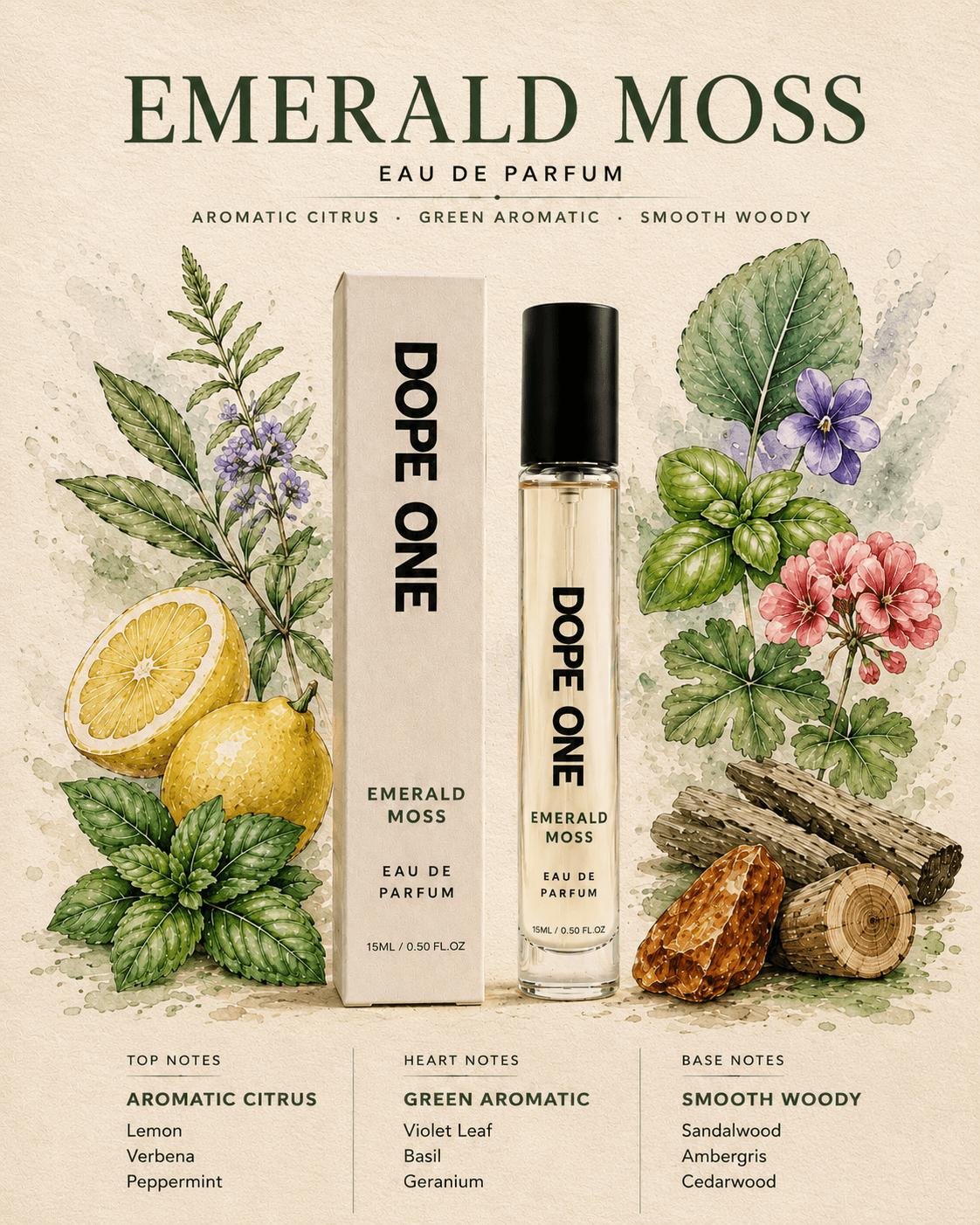
Emerald Moss
The closest DOPE ONE comes to iris. Violet leaf, sandalwood, the same register.
₹419
View →
The closest SKU to iris in the current DOPE ONE line is Emerald Moss. Its violet leaf and sandalwood base shares the powdery-floral-woody register that iris occupies. The irones chemistry of violet leaf is structurally related to the irone chemistry of orris root. Violet leaf is the green, metallic version. Iris would be the powdery, cold version. If iris ever enters the line, it will likely enter through this architecture: a future emerald-moss variant or a limited extrait that can absorb the cost of the raw material. Until then, the note remains aspirational. The root takes three to five years to mature. The SKU can wait.
A breeze catches your shirt outdoors and you suddenly understand why this style has survived for decades. It never announces you. People are simply more comfortable around you, and conversations run smoother, and nobody can say why.
Common Questions About Iris in Perfumery
Is iris in perfume made from the flower?
No. It is made from the root (rhizome) of Iris pallida and Iris germanica. The flower has almost no scent. The root must be aged 3-5 years before the aroma molecules (irones) develop.
Why is iris so expensive?
The root takes 3-5 years to age before distillation. The yield is 0.2-0.4%. The entire process is manual. Iris absolute costs ₹30-50 lakh/kg. Orris butter costs ₹40-60 lakh/kg. The price reflects time, skill, and yield.
What do irones smell like?
Irones (alpha, beta, gamma) smell like violet, cold powder, and earthy root. Alpha-irone provides the violet-floral character. Beta-irone adds the earthy dimension. Gamma-irone contributes the powdery, woody undertone.
Is iris perfume wearable in Indian summer?
Yes. Iris is one of the few notes that performs better in heat. The powdery, cool character does not become cloying. Iris is comfortable in all Indian seasons, which is rare for a floral-base material.
What is the best iris perfume?
Prada Amber Pour Homme (most wearable), Dior Homme (reference masculine), Acqua di Parma Iris (fresh/summer iris), Chanel No. 19 (green iris), DOPE ONE Emerald Moss (closest architectural parallel in the line).
The Note That Asks for Time
Iris costs what it costs because the plant will not be rushed. Three to five years to age a root that yields less than half a percent of oil. No synthetic has matched the complexity of the irone molecule family. India grows iris in Kashmiri gardens but does not process it for perfumery. The material comes from Tuscany, where the same families have grown iris for generations.
Iris is not in any DOPE ONE bottle. It may never be. The cost is a barrier that good engineering cannot always solve. But the root will be there in five years, aged and ready, if the economics ever align. The note that asks for time is the note that teaches patience. That may be its most valuable lesson.
Common questions
- Is iris in perfume made from the flower?
- No. It is from the root (rhizome) of Iris pallida and Iris germanica. The flower has almost no scent. The root must be aged 3-5 years before the irones develop.
- Why is iris so expensive?
- 3-5 year ageing. 0.2-0.4% yield. Entirely manual process. Iris absolute: ₹30-50 lakh/kg. Orris butter: ₹40-60 lakh/kg. Synthetic methylionone: ₹2,000-5,000/kg.
- What do irones smell like?
- Alpha-irone (violet-floral), beta-irone (earthy root), gamma-irone (powdery woody). Together they create the cold, powdery, violet-like character that defines iris.
- Is iris perfume wearable in Indian summer?
- Yes. Iris is one of the few notes that performs better in heat. The powdery, cool character does not become cloying. Comfortable in all Indian seasons.
- What is the best iris perfume?
- Prada Amber Pour Homme (most wearable), Dior Homme (reference masculine), Acqua di Parma Iris (summer), Chanel No. 19 (green iris), DOPE ONE Emerald Moss (closest architectural parallel).