Patchouli in Perfumery: The Most Hated Base Note (and the One You Have Smelled Most)
Transparency: we formulate DOPE ONE Quite Boss. Every fragrance here, including ours, is judged on the same criteria: Indian heat performance, fabric longevity, and fidelity to the original's character. Where ours falls short, we say so.
Patchouli is perfumery's most unappreciated workhorse. It has an image problem. People hear "patchouli" and think of hippie head shops, boho market stalls, and the person who wore too much essential oil at the music festival. And yet patchouli is in roughly 60% of the fragrances on the market. It is in Dior Sauvage, Bleu de Chanel, Aventus, Terre d'Hermès, and nearly every modern masculine composition released in the last fifteen years. It is the secret base note that makes everything else feel grounded, and most wearers have no idea it is there.
This article covers what patchouli actually is in perfumery, the molecule that defines it, why it became the most-used base note of the 2010s, how India's Kannauj attar tradition uses it, and whether it can be worn without smelling like a bohemian souvenir shop.
What Patchouli Actually Is in Perfumery
Patchouli is a steam-distilled essential oil from the dried leaves of Pogostemon cablin, a bushy plant in the mint family native to Southeast Asia. The leaves are harvested, dried in the shade for several days until they turn brown and develop the characteristic earthy-sweet aroma, and then distilled. The drying process is critical. Fresh patchouli leaves have a green, camphoraceous, almost medicinal smell. Properly dried leaves produce a dark, earthy, woody-sweet oil with remarkable persistence.
The key molecule is patchoulol (CAS 5986-55-0), a sesquiterpene alcohol that gives patchouli its character: earthy, woody, slightly sweet, with a camphoraceous undertone. Patchoulol is one of the most chemically stable perfume molecules known. It does not oxidise easily. It does not evaporate quickly. It stays on skin and fabric for sixteen to twenty-four hours at concentrations as low as 1-3% of a formula. This stability is why patchouli became the most-used base note in modern perfumery. It is not the most beautiful smell. It is the most durable.
Other significant molecules include norpatchoulene (CAS 54849-61-9), which contributes the slightly spicy, woody dimension, and alpha-guaiene (CAS 99891-01-5), which adds a woody-cedar nuance. Good-quality Indonesian patchouli oil runs ₹2,500-5,000 per kilogram. Indian patchouli from Kannauj is comparable at similar prices. The material is cheap, stable, and one of the best values in the perfumer's palette.
Patchouli is the note that does the work nobody thanks it for. It is the stagehand who sets up the lights, runs the cables, and cleans up after the show. The audience never sees them. The show does not happen without them. If rose is the person everyone wants to sit next to and musk is the room itself, patchouli is the floor: you only notice it when it is not there.
How Patchouli Became the 2010s' Secret Weapon
Patchouli entered European perfumery in the 19th century through the Indian textile trade. Cashmere shawls and Indian fabrics shipped to Europe were packed with dried patchouli leaves to repel insects. When the shawls arrived, they carried the smell. European consumers began associating patchouli with luxury textiles. Perfumers started using the oil to recreate the character, and patchouli entered the European palette.
Patchouli's modern moment began in 2010. The release of Bleu de Chanel (2010), Dior Sauvage (2015), and Creed Aventus (2010) established a new masculine template built on ambroxan, ISO E Super, and patchouli. These were not patchouli-heavy fragrances. They used patchouli at 5-10% of the concentrate to provide structural depth. The consumer smelled "fresh," "woody," "clean." They did not smell "patchouli." The molecule was doing its best work: providing the base without announcing itself.
By 2020, patchouli was in approximately 60% of all new fragrance launches. It had become the most-used base note in the perfumer's palette, displacing oakmoss and sandalwood as the default structural wood, including in the chypre family that oakmoss once defined. The molecule that people claimed to hate had become the molecule they smelled most.
If Patchouli Is Too Earthy
| Alternative | What You Get | What You Lose |
|---|---|---|
| Vetiver | Earth but dry. Vetiver's rooty, smoky character provides the grounding that patchouli offers, without the sweetness or the hippie association. | No creamy-woody depth. Vetiver is dry where patchouli is sweet. Different register entirely. |
| Cedarwood | Dry wood. A structural base that provides weight without patchouli's earthy complexity. | No earthiness. Cedar is simply woody. It substitutes for patchouli's weight, not its character. |
| Clearwood (Symrise) | A modern synthetic version of patchouli. Cleaner, less earthy, more transparent. No hippie baggage. Used as a direct patchouli replacer in contemporary compositions. | No complexity. Clearwood is patchouli's polite silhouette. Useful when the formula needs patchouli's weight without its identity. |
| Cypriol / Nagarmotha | A woody-amber-earthy note halfway between vetiver and patchouli. Smokier, darker, and increasingly used as a patchouli alternative in niche perfumery. | More smoke, less earth. Cypriol reads as dark incense rather than green plant. |
How Patchouli Behaves on Indian Skin
| Season | What Patchouli Does | Verdict |
|---|---|---|
| Summer (35-45°C) | Patchouli's earthy sweetness becomes significantly more prominent. At high concentrations, it can read as musty or sweaty. At structural levels (5-10%), it persists cleanly. | Good at structural levels. Heavy patchouli (20%+) should be evening-only in summer. |
| Monsoon (80%+ RH) | Humidity activates patchouli's woody dimension. The camphoraceous notes become more prominent. A pleasant pairing with rain on warm earth. | Excellent. Patchouli's best Indian season. |
| Winter (5-20°C) | Full patchouli performance. The molecule's stability means it lasts through the day, through the night, and onto the next morning's collar. A patchouli base in winter is unbeatable. | Excellent. Patchouli persists through everything. |
The Indian rule for patchouli: it is the most persistent base note available. One spray in the morning will survive a full workday, a commute, and a dinner. The next day, the collar of yesterday's shirt still carries the earthy signature. This is patchouli's gift and its curse. It never leaves.
Who Patchouli Is For
Patchouli attracts the wearer who does not care about the reputation of the note. They smell the earth and the wood and the persistence, not the Sixties stereotype. Patchouli wearers tend to be people who wear fragrance for themselves rather than for an audience. They are not looking for compliments. They are looking for presence.
| Who It Is For | Why It Works |
|---|---|
| Wearers who want longevity | Patchouli is the most stable molecule in commercial perfumery. Sixteen hours on skin. Twenty four on fabric. The note that will not quit. |
| Fragrance industry insiders | Anyone who works in perfumery knows that patchouli is the invisible base of the modern era. Wearing patchouli is an insider decision. |
| Wearers who love Aventus-type compositions | If you love Aventus, Bleu de Chanel, or Sauvage, you love patchouli. It is the structural base beneath the top notes you actually smell. |
| Who It Is Not For | Why It Fails |
|---|---|
| Wearers with the "hippie" association | If patchouli reminds you of bohemian markets, head shops, or essential oil stalls, no amount of structural explanation will fix the association. Start with clearwood or cypriol instead. |
| Wearers who want transparent scents | Patchouli is not transparent. It is heavy, persistent, and announces its presence even when used structurally. If you want a scent that evaporates cleanly, patchouli is the wrong base. |
| Wearers who dislike earthy notes | Patchouli is earth. It smells like soil drying after rain, like roots, like the ground itself. This is its identity. If earth is not your register, patchouli will not convert you. |
What Patchouli Plays Well With
Patchouli's defining trait as a base note is that it disappears into compositions it is supporting. It is the most effective structural note in perfumery precisely because it stops being patchouli and starts being "base."
Patchouli and pineapple is the Aventus architecture. Pineapple's bright, juicy top cuts through patchouli's earthy weight. The contrast is the most commercially successful pairing of the modern era. Our pineapple guide covers how that top note is actually built.
Patchouli and vetiver is the Quite Boss base. Vetiver provides the dry, smoky root. Patchouli provides the earthy weight. Together they create a woody base that supports pineapple and cardamom without competing for attention. The vetiver guide maps the full architecture.
Patchouli and cardamom is the spicy-woody pairing. Cardamom lifts patchouli out of its earthiness and gives it aromatic range, the same lift it provides Quite Boss's own pineapple-cardamom-vetiver top and heart above the patchouli base.
What Does Not Work With Patchouli
Patchouli and strong aldehydes clash. The clean, bright, slightly metallic character of aldehydes fights with patchouli's earthy weight. Patchouli and very sweet gourmand notes (high-concentration ethyl maltol, caramel) can become cloying; both are sweet in different registers and together they overshoot.
Five Patchouli Fragrances Worth Wearing
| Fragrance | Patchouli's Role | Price Band (India) | Heat Performance | Best For |
|---|---|---|---|---|
| Creed Aventus | Patchouli provides structural depth beneath pineapple, birch, and vetiver. The reference modern composition. Patchouli is invisible, not absent. | ~₹36,000 | Patchouli base handles heat well. Pineapple top burns off fast. Reapply or accept the base phase. | Understanding how patchouli disappears into a composition. The reference. |
| Dior Sauvage | Patchouli at the base beneath the ambroxan-region top. Structural patchouli that no consumer identifies as patchouli. | ₹7,000-9,000 | Excellent. Sauvage's patchouli-ambroxan base was engineered for heat tolerance. | Understanding invisible patchouli. The most commercially successful patchouli deployment. |
| Chanel Coromandel | Patchouli-labdanum-incense soliflore. The only designer fragrance where patchouli is the named hero. The reference for understanding what patchouli actually smells like. | ₹20,000-25,000 | Evening and winter only. Coromandel is thick and demands cold weather. | Understanding patchouli as a hero note. The reference patchouli fragrance. |
| Lush Karma | Patchouli-orange-lavender. The bohemian patchouli that people think they hate, executed with such skill that it is irresistible. | ₹3,000-5,000 | Orange and lavender lift the patchouli. Good heat tolerance for a patchouli-heavy composition. | Understanding the patchouli you thought you hated. The best hippie-adjacent patchouli. |
| DOPE ONE Quite Boss | Patchouli + pineapple + cardamom + vetiver. The Aventus architecture rebuilt for Indian wear. Patchouli is structural, not named. | ₹419 / ₹1,319 | Cardamom and vetiver balance patchouli. Designed for year-round Indian wear. | Understanding invisible patchouli. The Aventus architecture at an Indian price. |
Regulatory Considerations
Patchouli oil has no significant IFRA restrictions. It is one of the safest fragrance materials in the palette. The only restriction concerns the methanol content in patchouli oil (used as a denaturant in some commercial grades), which is regulated separately from IFRA. Reputable vendors provide methanol-free or low-methanol grades for fine fragrance use.
Quite Boss: The Note That Did Not Need a Name
Quite Boss does not list patchouli as a note. The product pyramid states: pineapple, cardamom, vetiver. No mention of patchouli. And yet patchouli is present at a concentration that would make it the nominated base note in a different composition. The decision to leave patchouli unnamed was intentional. Quite Boss is an Aventus-DNA fragrance, and Aventus does not list patchouli as a note either. The molecule works best when it is not announced.
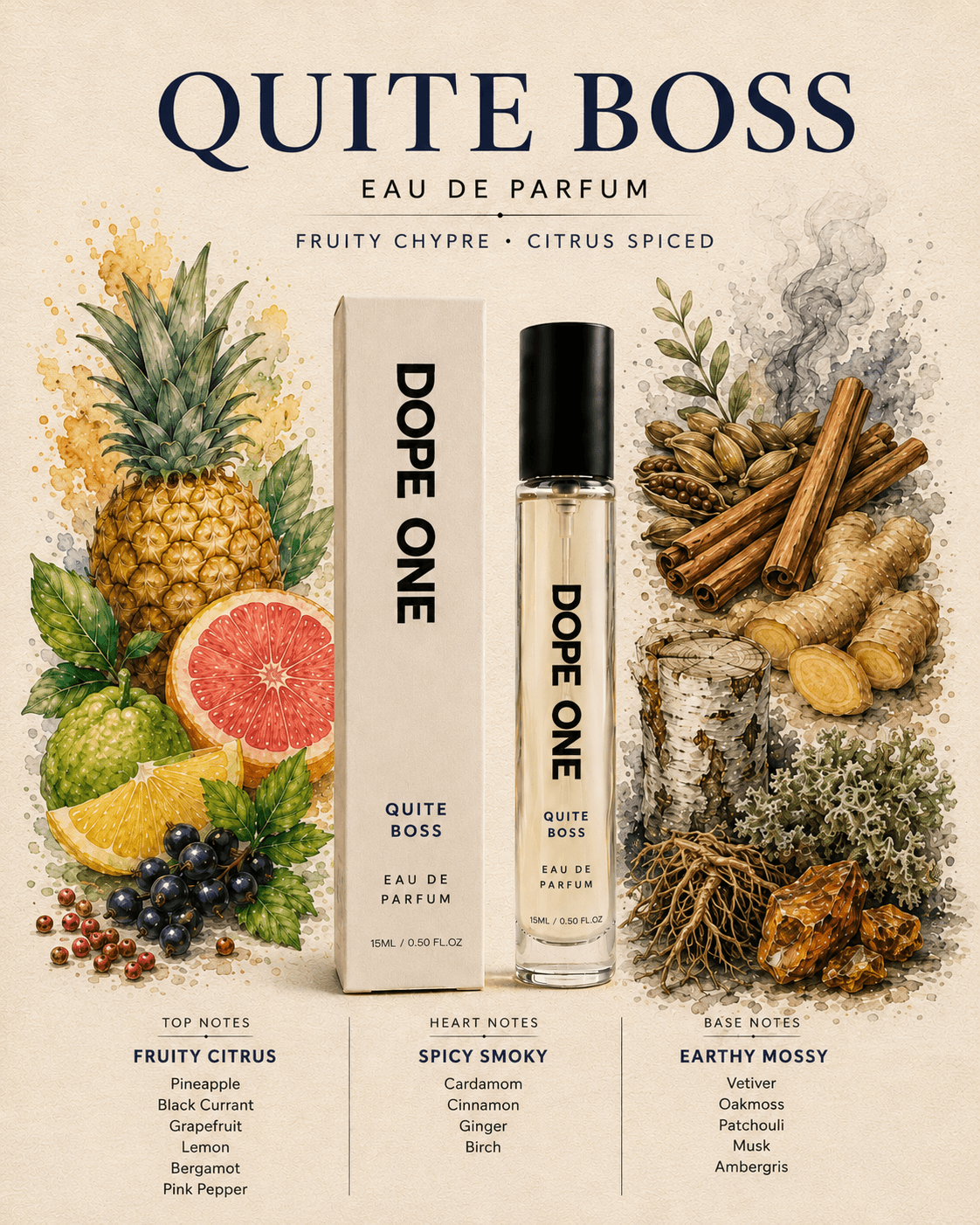
Quite Boss
Pineapple, cardamom, vetiver. Patchouli is not on the box. It is in the bottle.
₹419
View →
Quite Boss uses patchouli at a structural level (roughly 8-10% of the concentrate) combined with vetiver to create a woody base that supports the pineapple and cardamom top without competing for attention. The patchouli does not smell like patchouli. It smells like the bottom of the pyramid: warm, persistent, complete. This is the Aventus architecture and the reason the category works. The note that nobody admits liking is the note that holds the whole composition together.
'What are you wearing?' — asked by people who couldn't name a single fragrance house. That's the whole point of this DNA. Hours two through five are the sweet spot: the opening's energy still present, the loudness gone, everything composed.
Quite Boss is ₹419. The patchouli in it is not named. You will know it is there because the fragrance lasts from morning into the next morning. That is patchouli. Thank it when you reapply.
Common Questions About Patchouli in Perfumery
Why does patchouli have a bad reputation?
Patchouli's association with 1960s counterculture, head shops, and bohemian markets created a stereotype that persists. Most people associate patchouli with strong, cheap essential oils worn at music festivals. The reality is that modern perfumery uses highly refined patchouli at controlled concentrations that bear no resemblance to the bazaar stereotype.
What is patchoulol?
Patchoulol (CAS 5986-55-0) is the primary sesquiterpene alcohol in patchouli oil, accounting for 25-35% of the oil. It provides the characteristic earthy-woody-sweet character. Patchoulol is chemically one of the most stable perfume molecules, which is why patchouli lasts so long on skin and fabric.
Is patchouli perfume wearable in Indian summer?
Patchouli at structural levels (5-10% of concentrate) handles heat well. Heavy patchouli (20%+) can read as musty above 35°C. Monsoon is patchouli's best Indian season: the humidity activates the woody dimension and softens the earthy edge.
What is the best patchouli perfume?
Chanel Coromandel (hero patchouli), Creed Aventus (structural patchouli, invisible), Dior Sauvage (mass-market invisible), Lush Karma (bohemian but well-executed), DOPE ONE Quite Boss (Aventus architecture for Indian wear).
Is patchouli from India?
Patchouli (Pogostemon cablin) is native to Southeast Asia, not India. However, India's Kannauj attar industry has used patchouli extensively for centuries, blending it with oud, sandalwood, and rose to create complex base accords. Indian patchouli oil is comparable in quality to Indonesian.
The Note That Does Not Get the Credit It Deserves
Patchouli is the most-used and least-appreciated base note in modern perfumery. It is in your fragrance. You probably did not know. You probably would not admit it if you did. The molecule does not care. It stays on your skin for sixteen hours, on your collar for twenty-four, and in the memory of everyone who got close enough to smell. It does not need your approval. It has your formula.
Common questions
- Why does patchouli have a bad reputation?
- Association with 1960s counterculture, head shops, and music festivals. Modern refined patchouli at controlled concentrations bears no resemblance to the bazaar stereotype.
- What is patchoulol?
- Patchoulol (CAS 5986-55-0) is the primary sesquiterpene alcohol in patchouli oil (25-35%). It provides the earthy-woody-sweet character and is one of the most chemically stable perfume molecules.
- Is patchouli perfume wearable in Indian summer?
- Structural patchouli (5-10%) handles heat well. Heavy patchouli (20%+) can read as musty above 35°C. Monsoon is patchouli's best Indian season.
- What is the best patchouli perfume?
- Chanel Coromandel (hero), Creed Aventus (structural/disappearing), Dior Sauvage (mass-market invisible), Lush Karma (executed bohemian), DOPE ONE Quite Boss (Aventus architecture for India).
- Is patchouli from India?
- Patchouli is native to Southeast Asia, not India. But Kannauj's attar industry uses it extensively, blended with oud, sandalwood, and rose. Indian patchouli oil is comparable to Indonesian.