Vanilla in Perfumery: The Note Everyone Loves and Nobody Pays For
Transparency: we formulate DOPE ONE Date Night. Every fragrance here, including ours, is judged on the same criteria: Indian heat performance, fabric longevity, and fidelity to the original's character. Where ours falls short, we say so.
Vanilla is the most-loved note in perfumery and the most lied-about. When a fragrance lists "vanilla" on the box, it almost never means vanilla absolute from Madagascar or Mexico. It means vanillin: a synthetic molecule that costs roughly 1/80th of the real thing and smells close enough that most wearers cannot tell the difference. This is not a scandal. It is basic economics. If your ₹3,000 perfume contained real vanilla absolute at the concentration needed to make it the signature note, the vanilla alone would cost more than the bottle.
But vanilla is also India's silent agricultural success story. Kerala, Karnataka, and Tamil Nadu grow high-quality vanilla beans that are exported to the same buyers who purchase Madagascar vanilla, and no Indian consumer knows this. The vanilla in a French niche fragrance may well have been grown in Wayanad. This article covers what vanilla actually is in perfumery, why the synthetic is genuinely better for most purposes, how vanilla behaves in Indian heat, and which fragrances use it honestly.
What Vanilla Actually Is in Perfumery
Real vanilla absolute is solvent-extracted from the cured seed pods of Vanilla planifolia, an orchid native to Mexico and now cultivated in Madagascar, Indonesia, India, and several other tropical regions. The pods are harvested green, cured over months through a process of sweating, drying, and conditioning, and then extracted with ethanol or CO₂. The yield is tiny. It takes roughly 500 kilograms of green vanilla pods to produce one kilogram of absolute. This is why real vanilla absolute costs ₹50,000-70,000 per kilogram; more than some oud oils, more than most rose absolutes, more than nearly any other natural material in a perfumer's palette except orris butter.
Vanillin (CAS 121-33-5) is the primary aroma molecule in vanilla, accounting for roughly 80-95% of the characteristic smell. It is a phenolic aldehyde with a molecular weight of 152.15 g/mol. Natural vanillin is extracted from vanilla pods. Synthetic vanillin is manufactured from lignin (wood pulp byproduct) or guaiacol (petrochemical). The two are chemically identical. The synthetic costs roughly ₹800 per kilogram. Ethyl vanillin (CAS 121-32-4) is a close relative: roughly three times stronger than vanillin, creamier, more gourmand, and costs about ₹1,200 per kilogram. Between vanillin and ethyl vanillin, the entire vanilla fragrance industry operates at roughly 1/80th the cost of using real vanilla absolute.
India grows vanilla in Kerala, Karnataka, and Tamil Nadu. Indian vanilla beans are considered high-quality, with vanillin content comparable to Madagascar bourbon vanilla. Most of the crop is exported. Indian vanilla absolute is available from a handful of producers but is rarely used in Indian fragrances because the cost makes no commercial sense when vanillin exists. The irony: Indian vanilla farmers sell to French fragrance houses while Indian perfume brands use Chinese vanillin.
Vanilla is the friend who makes everyone feel welcome. Not the loudest person in the room, not the most interesting, but the one whose presence makes the room warmer. If oud is the person in the corner you keep glancing at and vetiver is the one leaning against the wall, vanilla is the person who brought dessert and does not expect a thank-you. Everyone likes vanilla. Nobody admits it is their favourite.
How Vanilla Took Over Perfumery
Vanilla's journey into perfumery began with the Aztecs, who used vanilla to flavour chocolate. The Spanish brought it to Europe in the 1500s. For the next three centuries, vanilla was a food flavouring, not a perfume material. The extraction technology to produce vanilla absolute suitable for fine fragrance did not mature until the late 1800s.
The real revolution came in 1874, when German chemists Ferdinand Tiemann and Wilhelm Haarmann synthesised vanillin from coniferin, a compound found in pine bark. For the first time, the smell of vanilla was available without the vanilla orchid. By the early 20th century, synthetic vanillin was industrialised. Guerlain's Shalimar (1925) used vanillin as the backbone of the first great oriental fragrance; vanilla and bergamot and iris and opoponax, wrapped around a core of vanillin that made the whole composition feel edible without being food. Shalimar proved that vanillin could anchor a masterpiece. Every vanilla fragrance since has been standing on its shoulders.
Today, vanilla is the most-used gourmand note in perfumery. It appears in orientals, gourmands, amber florals, woody ambers, and fresh compositions where a trace of vanillin rounds out the base. Vanillin is so universally deployed that it is almost invisible; a fragrance without any vanillin in the base feels incomplete, like a room without a floor. The molecule is not a trend. It is the default setting for warmth in modern perfumery, and the reason it anchors nearly every list of best gourmand perfumes in India.
If Vanilla Is Too Sweet
| Alternative | What You Get | What You Lose |
|---|---|---|
| Tonka Bean | Warm, almond-coumarin, less sweet. Vanilla's grown-up sibling who prefers black coffee to dessert. | No creamy body. Drier, more tobacco-adjacent. |
| Benzoin | Resinous, balsamic warmth. Vanilla's earthier, more complex cousin. | Less recognisably "vanilla." More medicinal at high doses. |
| Peru Balsam | Sweet, cinnamon-woody, rich. Vanilla-adjacent warmth with spice. | Heavier. Can dominate a composition if not restrained. |
| Maltol / Ethyl Maltol | Caramelised sugar, cotton candy. The synthetic gourmand alternative. | No vanilla character. Pure sweetness without depth. |
How Vanilla Behaves in Indian Heat
Vanilla is a base note. It emerges slowly, typically thirty to forty minutes after application, and stays for hours. On fabric, vanillin can persist for eighteen to twenty-four hours. On skin in Indian heat, vanilla's behaviour changes: it becomes louder, sweeter, and more food-like. At 35°C and above, vanilla-heavy compositions can turn from warm and inviting to cloying and oppressive within two hours. This is the vanilla-in-summer problem that no marketing copy acknowledges.
| Season | What Vanilla Does | Verdict |
|---|---|---|
| Summer (35-45°C) | Sweetness amplifies. Gourmand dimension becomes aggressive. Two hours of warmth, then cloying. | Evening only. One spray maximum. AC environments preferred. |
| Monsoon (80%+ RH) | Humidity softens the sweetness. Vanilla becomes rounder, more atmospheric. Best paired with spice or wood. | Very good. Vanilla's best Indian season. |
| Winter (5-20°C) | Full performance. Warm, enveloping, stays close. The vanilla you bought, behaving as expected. | Excellent. Vanilla's natural climate. |
The solution for Indian vanilla wearers is not to avoid vanilla. It is to choose vanilla compositions balanced by spice, wood, or citrus; notes that cut the sweetness rather than amplifying it. Ginger, cardamom, cedarwood, and bergamot all perform this function. A vanilla-ginger fragrance works in Indian summer. A vanilla-vanilla fragrance does not.
India Grows Vanilla. Nobody Knows.
Kerala, Karnataka, and Tamil Nadu grow vanilla beans that are exported to European fragrance houses and sold as "Madagascar Bourbon" grade. The Wayanad district of Kerala alone produces several tonnes of cured vanilla annually. The quality is high; vanillin content typically 1.8-2.5%, comparable to the best Madagascar origins. The beans are cured using the traditional Bourbon method: killing, sweating, slow drying, conditioning. It takes four to six months from harvest to cured pod.
The Indian vanilla industry nearly collapsed in the early 2000s when global vanilla prices crashed from $500/kg to under $20/kg after Madagascar recovered from a cyclone. Thousands of Kerala farmers ripped out their vanilla vines and replanted with rubber and pepper. The industry has slowly rebuilt, but Indian vanilla remains an export commodity rather than a domestic value-added product. No major Indian perfume brand uses Indian vanilla absolute. The economics do not work: Indian vanilla absolute costs roughly ₹60,000/kg. The same aromatic effect from vanillin costs ₹800/kg. The Indian perfume consumer who buys an entry-priced bottle is not buying real vanilla. They are buying vanillin. And that is fine. The question is whether the brand is honest about it.
In Indian kitchens, vanilla is a relatively recent arrival; a baking ingredient associated with cakes, custard, and Western desserts. It does not have the deep cultural roots of cardamom or vetiver. But in Indian perfumery, vanilla is increasingly central to the gourmand and amber categories. The Indian consumer who discovers vanilla through a perfume rather than a cake is part of a generational shift in how the note is understood.
Who Vanilla Is For
Vanilla attracts the wearer who wants to smell warm, approachable, and put-together. It is the note for someone who has decided that being liked is more important than being interesting. Vanilla wearers tend to receive compliments because vanilla is the most universally liked smell in existence; it triggers the same neural pathways as comfort, safety, and childhood. It is not challenging. It is not polarising. It is the olfactory equivalent of a warm blanket and a cup of something sweet.
The people who do not get along with vanilla usually have one complaint: it is everywhere. Vanillin is so ubiquitous in modern perfumery that avoiding it requires active effort. For the wearer who wants to smell distinctive, vanilla is the wrong tool. It is the most democratic note in perfumery and the most generic. If you want your fragrance to signal that you have unusual taste, vanilla will not help. It makes the same promise to everyone and keeps it.
What Vanilla Plays Well With
Vanilla's defining trait is that it makes everything around it feel more complete. It is the best finishing note in perfumery; a soft focus lens that smooths rough edges and extends the emotional life of whatever it touches.
Vanilla and tonka is the classic gourmand pairing. Tonka's almond-coumarin warmth meets vanilla's creamy sweetness. The result is dessert without food; warmth without weight. Our forthcoming tonka guide will map the full range.
Vanilla and benzoin is the resinous variation. Benzoin's balsamic depth adds complexity to vanilla's simplicity. The pairing anchors oriental compositions and gives them body beyond sweetness. The benzoin guide documents that architecture in full.
Vanilla and ginger is the heat-calibrated pairing. Ginger's sharpness cuts vanilla's sweetness; vanilla's warmth softens ginger's bite. This is the engine behind Date Night and the reason the composition works in Indian evenings when a straight vanilla would become cloying. Our ginger guide will explore the mechanics in full.
Five Vanilla Fragrances Worth Wearing
| Fragrance | Vanilla's Role | Price Band (India) | Heat Performance | Best For |
|---|---|---|---|---|
| Guerlain Shalimar | The original vanillin masterpiece. Vanilla wrapped in bergamot, iris, and opoponax. The reference since 1925. | ₹7,000-9,500 | Classic oriental structure handles warmth gracefully. Vanillin backbone holds. | Evening, winter, owning a piece of perfumery history. |
| Diptyque Eau Duelle | Vanilla split into two personalities: green-spicy and warm-balsamic. The reference vanilla soliflore. | ₹17,000-19,000 | Green opening handles heat better than most vanillas. Spice cuts sweetness. | Daytime vanilla, year-round, the thinking person's vanilla. |
| Tom Ford Tobacco Vanille | Vanilla wrapped in tobacco and dried fruit. The most famous vanilla-gourmand in the world. | ₹20,000-28,000 | Tobacco note can become heavy in humidity. Winter and evening only at Indian temperatures. | Winter evenings, making an impression, date night. |
| Lush Vanillary | Natural vanilla absolute with tonka. The closest most people will get to real vanilla in a bottle. | ₹3,500-5,000 | Natural vanilla absolute behaves differently from vanillin; softer, less aggressive in heat. | Casual vanilla, everyday wear, understanding real vanilla. |
| DOPE ONE Date Night | Bourbon vanilla with ginger and woody notes. Heat-calibrated gourmand built for Indian evenings. | ₹419 (15ml) / ₹1,319 (50ml) | Ginger cuts the sweetness. Designed to stay warm without becoming cloying at 38°C. | Indian evenings, monsoon, winter, year-round gourmand wear. |
Date Night: Vanilla That Knows When to Stop
The problem with vanilla in Indian heat is that it does not know when to stop. At 38°C, vanilla's sweetness amplifies into aggression; what was warm and inviting at 7 PM becomes cloying and oppressive by 9 PM. Date Night solves this with ginger. Ginger's sharpness cuts vanilla's sweetness at exactly the point where a straight vanilla would tip over into too much. The result is a gourmand that stays warm without becoming dessert.
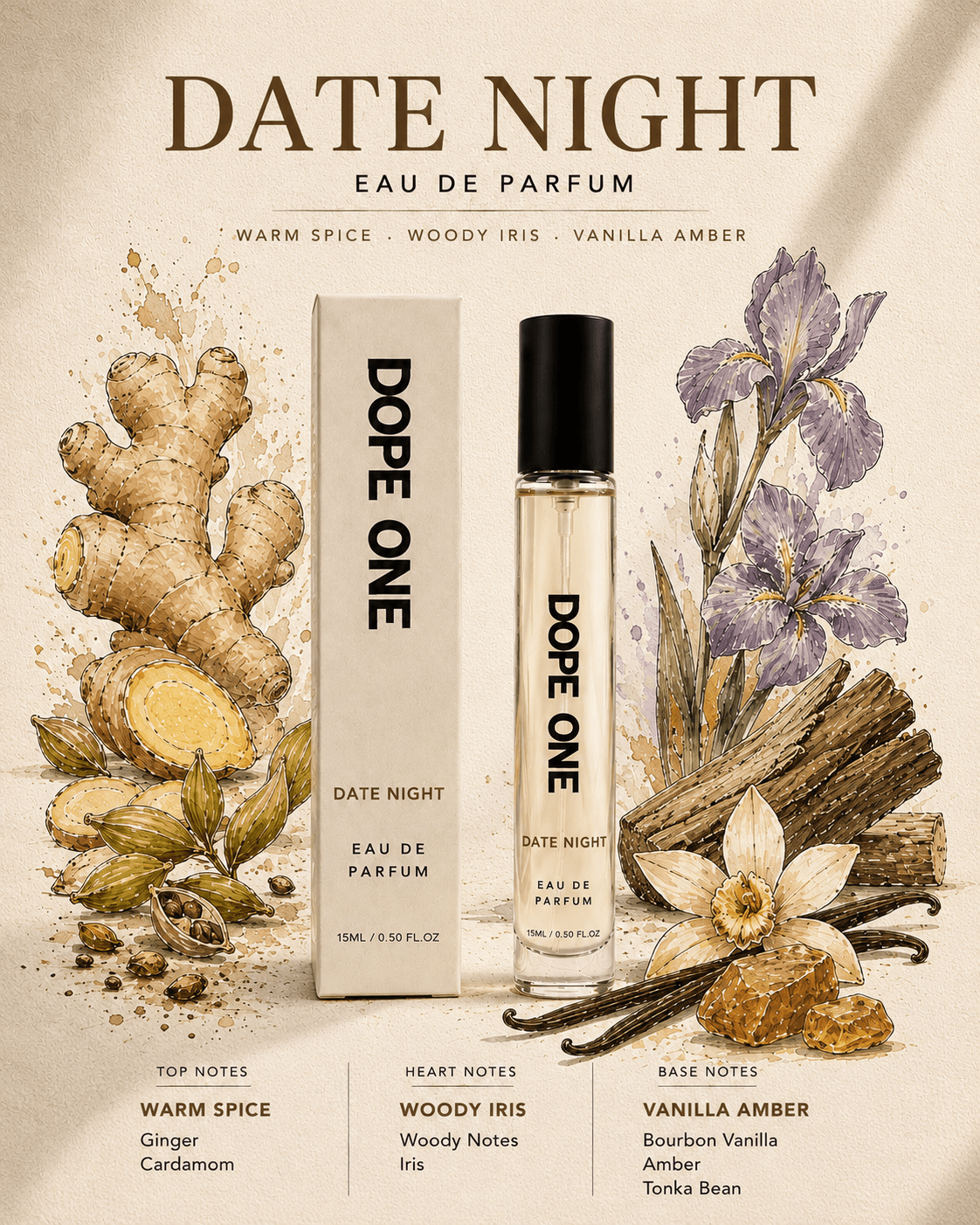
Date Night
Ginger, woody notes, bourbon vanilla. Heat-calibrated gourmand for Indian evenings.
₹419
View →
Date Night is not a summer-afternoon fragrance and will not pretend to be. Sundown is its territory, and the later the evening runs, the better it performs. Warmth makes it more inviting rather than louder, a distinction that took multiple versions to calibrate. The early drafts tipped too sweet or too sharp. The version that shipped found the line and held it.
I caught myself smelling my own sleeve through the evening, mid-conversation, more than once. That's the entire review. Warmth makes it more inviting, not louder — and the later the evening runs, the better it gets.
Date Night is ₹419 for 15ml, ₹1,319 for 50ml. It knows exactly one mood, and you do not need an actual date to want it. The name sets the scene. The confidence is the product.
Common Questions About Vanilla in Perfumery
Is vanilla in perfume real vanilla?
Almost never. Real vanilla absolute costs ₹50,000-70,000 per kilogram. What you smell in 99% of vanilla fragrances is vanillin (₹800/kg) or ethyl vanillin (₹1,200/kg), synthetic molecules chemically identical to the primary aroma compound in real vanilla. This is not a secret. It is basic economics. A ₹3,000 fragrance cannot contain meaningful amounts of real vanilla absolute and still be sold at ₹3,000.
What is the difference between vanillin and ethyl vanillin?
Vanillin (CAS 121-33-5) is the primary aroma molecule in vanilla. Ethyl vanillin (CAS 121-32-4) is a close structural relative: roughly three times stronger, creamier, and more gourmand. Most vanilla fragrances use a blend of both. Pure vanillin reads as "vanilla extract." Ethyl vanillin reads as "vanilla frosting."
Does vanilla perfume work in Indian summer?
Straight vanilla becomes cloying in Indian summer heat. At 35°C and above, vanilla's sweetness amplifies and can turn from warm to oppressive within two hours. The solution is vanilla compositions balanced by spice, wood, or citrus; notes that cut the sweetness. Ginger, cardamom, and cedarwood are the most effective. Vanilla-ginger works in summer. Vanilla alone does not.
Which is the best vanilla perfume?
Guerlain Shalimar is the reference vanilla since 1925. Diptyque Eau Duelle is the best vanilla soliflore. Tom Ford Tobacco Vanille is the most famous vanilla-gourmand. Lush Vanillary uses real vanilla absolute at an accessible price. For Indian evenings, DOPE ONE Date Night pairs bourbon vanilla with ginger to stay warm without becoming cloying at 38°C.
Does India grow vanilla?
Yes. Kerala, Karnataka, and Tamil Nadu grow high-quality vanilla beans exported to European fragrance houses. Indian vanilla absolute is available but rarely used in Indian fragrances because vanillin is 1/80th the cost. Most Indian vanilla farmers sell to French brands while Indian perfume houses use Chinese vanillin.
The Note That Makes Everything Feel Complete
Vanilla is not challenging. It is not polarising. It does not make a statement or signal unusual taste. What it does is make the wearer feel warm, and the people around them feel welcome. It has done this for a century, in ₹30,000 niche extraits and in a ₹419 DOPE ONE bottle sourced and blended for Indian evenings. The molecule is the same. The honesty about what is in the bottle is what separates a good vanilla from a lazy one.
India grows vanilla. The world buys it. Most vanilla perfumes contain none of it. And everyone, everywhere, still reaches for the bottle. Buying it for someone else rather than yourself raises a different set of questions, covered in our perfume gift guide.
Common questions
- Is vanilla in perfume real vanilla?
- Almost never. Real vanilla absolute costs ₹50,000-70,000/kg. Most vanilla fragrances use vanillin (₹800/kg) or ethyl vanillin (₹1,200/kg). The molecules are chemically identical to the primary aroma compound in real vanilla. Economics, not deception.
- What is the difference between vanillin and ethyl vanillin?
- Vanillin (CAS 121-33-5) is the primary vanilla molecule. Ethyl vanillin (CAS 121-32-4) is three times stronger, creamier, more gourmand. Most vanilla fragrances blend both. Vanillin reads as extract; ethyl vanillin reads as frosting.
- Does vanilla perfume work in Indian summer?
- Straight vanilla becomes cloying above 35°C. The fix: vanilla balanced by ginger, cardamom, or cedarwood. These spice/wood notes cut the sweetness. Vanilla-ginger works in summer. Vanilla alone does not.
- Which is the best vanilla perfume?
- Guerlain Shalimar (reference since 1925), Diptyque Eau Duelle (best soliflore), Tom Ford Tobacco Vanille (most famous gourmand), Lush Vanillary (real vanilla absolute at accessible price), DOPE ONE Date Night (vanilla-ginger built for Indian evenings).
- Does India grow vanilla?
- Yes. Kerala, Karnataka, and Tamil Nadu grow high-quality vanilla exported to European fragrance houses. Indian vanilla absolute is available but rarely used in Indian fragrances; vanillin is 1/80th the cost. Indian farmers sell to French brands while Indian perfume houses use Chinese vanillin.