Bergamot in Perfumery: The Citrus That Starts Every Conversation
Transparency: we formulate DOPE ONE I Am A Jin. Every fragrance here, including ours, is judged on the same criteria: Indian heat performance, fabric longevity, and fidelity to the original's character. Where ours falls short, we say so.
If you have sprayed a fragrance in your life, there is a roughly 40% chance the first thing you smelled was bergamot. It is the most-used top note in perfumery by an enormous margin, the sparkling, bittersweet citrus that opens everything from Dior Sauvage to Chanel No. 5 to the bottle of 4711 your grandfather kept in the bathroom cabinet. Bergamot is not a discovery. It is the opening act you have been hearing your entire life without ever asking who was singing.
But bergamot is also a story of near-total geographic monopoly, synthetic substitution at industrial scale, and a citrus note that vanishes faster in Indian heat than any other. This article covers what bergamot actually is, why it comes from one tiny region of Italy, how it behaves on Indian skin, and which fragrances use it best.
What Bergamot Actually Is
Bergamot essential oil is cold-pressed from the peel of Citrus bergamia, a hybrid of bitter orange and lemon believed to have originated in Calabria, the toe of Italy's boot. The fruit itself is inedible, sour, bitter, and shaped like a misshapen lime. The oil is what matters. It is pale green to yellow-green, intensely aromatic, and contains roughly 30-45% linalyl acetate and 20-30% linalool, the same two molecules that give lavender its floral freshness. The difference is context: in lavender, linalyl acetate reads as floral-herbal. In bergamot, surrounded by limonene and γ-terpinene, it reads as sparkling citrus with a faint floral lift.
Natural bergamot oil costs roughly ₹8,000-12,000 per kilogram. Synthetic bergamot, built from linalyl acetate and limonene with trace amounts of bergapten-free fractions, costs roughly a tenth of that. Most commercial fragrances use a blend: natural oil for the opening sparkle, synthetic accord to extend the mid-phase. Pure synthetic bergamot is detectable within seconds, it lacks the bitter-green complexity of the real peel and reads as "lemon cleaning product" if not carefully blended.
IFRA restricts bergamot oil specifically because of bergapten, a naturally occurring furanocoumarin that causes phototoxicity. Bergapten-free (FCF) bergamot oil, where the bergapten has been distilled out, is unrestricted. Most commercial fragrances use FCF bergamot. The cost difference is negligible, the performance difference is barely detectable. This is one of the few IFRA restrictions that the industry solved cleanly.
Bergamot is the friend who walks in, says something sharp and charming, and leaves before you have time to get tired of them. It does not stay. It was never meant to. It opens the door, hands you a drink, and disappears into the party. If cardamom is a nod across the table and oud is the person in the corner you keep glancing at, bergamot is the host who made sure you arrived and then had other guests to greet.
Where Bergamot Comes From, and Why It Only Comes From There
Ninety percent of the world's bergamot grows in a narrow coastal strip of Calabria, southern Italy, between the Ionian and Tyrrhenian seas. The soil is volcanic, the microclimate is Mediterranean-subtropical, and the bergamot that grows there has a chemical profile that cannot be replicated elsewhere. Attempts have been made in Ivory Coast, Argentina, Brazil, and Turkey. None produce oil with the same linalyl acetate-to-linalool ratio or the same bitter-green complexity. Bergamot is not like vetiver, which grows successfully in Haiti, Java, and India. It is like champagne: the name is the place, and the place is the product.
Bergamot's entry into Western perfumery is inseparable from the original Eau de Cologne. In 1709, Giovanni Maria Farina, an Italian perfumer living in Cologne, Germany, created a blend of bergamot, lemon, orange, neroli, and lavender in alcohol. He named it after his adopted city. For the next three centuries, "cologne" meant citrus aromatics built on a bergamot opening. Napoleon went through a bottle a day. The formula is still sold today as 4711, largely unchanged after 300 years.
Bergamot's signature moment in modern perfumery came with the fougère structure, Fougère Royale (1882) used bergamot as the opening spark above lavender, oakmoss, and coumarin. From there, bergamot became the default opening for masculine fragrance. Today, bergamot is in Chanel No. 5, Dior Sauvage, Bleu de Chanel, Acqua di Gio, Aventus, and roughly 40% of all fragrances in production. It is not a trend. It is infrastructure.
India does not grow bergamot commercially. The climate is theoretically suitable, the Western Ghats and parts of the Northeast have the humidity and temperature range. But the Calabrian monopoly has held for three centuries, and no Indian plantation has produced bergamot oil at a quality and price that competes. Every drop of bergamot in an Indian perfume arrives in a shipping container from Gioia Tauro. This is not a criticism of Indian agriculture. It is a statement about how thoroughly one region of Italy owns this material.
If Bergamot Is Not Your Note
| Alternative | What You Get | What You Lose |
|---|---|---|
| Lemon | Sharper, brighter, more aggressive citrus. The high-frequency alternative. | No floral lift. No bitterness. More cleaning-product risk. |
| Neroli | Bitter orange blossom, bergamot's floral sibling. Green, honeyed, sophisticated. | Less sharp. Less sparkling. Heavier. |
| Petitgrain | Distilled from the leaves and twigs of the bitter orange tree. Woody-citrus, greener than bergamot. | Lacks the juicy-peel character. More herbal, less bright. |
| Yuzu | Japanese citrus, bergamot's sharper, more exotic cousin. Grapefruit-meets-mandarin. | Harder to find. More expensive. Different bitterness profile. |
How Bergamot Behaves Through the Day
Bergamot is the fastest-moving note in perfumery. It opens within seconds of spraying, peaks within the first five minutes, and begins fading by minute fifteen. This is not a defect. It is a physical property: bergamot's primary molecules, linalyl acetate and limonene, have molecular weights under 200 g/mol and vapour pressures high enough that they evaporate at room temperature within minutes. Bergamot is designed by physics to be the first thing you smell and the first thing you lose.
| Season | What Bergamot Does | Verdict |
|---|---|---|
| Summer (35-45°C) | Opens brilliantly, vanishes fast. Five to eight minutes of sparkle, then the heart notes take over. Heat accelerates evaporation, nothing can stop this. | Accept the brevity. Bergamot does not owe you a second act. |
| Monsoon (80%+ RH) | Humidity slows evaporation slightly. Opening extends to ten or twelve minutes. The floral-linalool dimension is more noticeable in damp air. | Bergamot's best Indian season. Slightly longer, softer. |
| Winter (5-20°C) | Lower temperature slows evaporation further. Bergamot holds for fifteen to twenty minutes before fading. More of the bitter-green dimension comes through. | Good. The opening you paid for, delivered at a readable pace. |
The wearer who complains that bergamot "doesn't last" is asking the wrong question. Bergamot's job is opening the door. The heart and base notes are supposed to do the rest of the evening. If your fragrance disappears after the bergamot fades, the problem is not the bergamot. It is everything that was supposed to come after it.
Bergamot and the Tea Connection
Most Indians have never seen a fresh bergamot fruit. The citrus does not grow here and is not sold in mandis. But Indians have tasted bergamot thousands of times without knowing it, in Earl Grey tea. The distinctive citrus-floral note in Earl Grey is bergamot oil sprayed onto black tea leaves during processing. The tea that British colonials drank in the afternoon in Calcutta and Shimla and the tea that is now served in five-star hotel lobbies across India is flavoured with an oil from a fruit grown in a strip of Italy narrower than the distance from Delhi to Jaipur.
This bergamot-tea connection is deeply colonial. Earl Grey was allegedly a gift from a Chinese mandarin to Charles Grey, the British Prime Minister, in the 1830s. The bergamot was added to offset the lime content of the water at Howick Hall, the Grey family estate. The tea became an emblem of British refinement, then a global commodity, then the default "posh tea" in Indian hotels. The bergamot in your Taj hotel chai travelled further than most people in the room.
In Indian perfumery, bergamot is present in attar form; bergamot attar from Kannauj distilleries, distilled over sandalwood oil as a base. It is lighter and less complex than the Calabrian essential oil but has a following among attar enthusiasts who prefer its softer, woodier profile. Most commercial Indian fragrances use imported bergamot oil or synthetic bergamot accords, the attar tradition is a separate lineage with a separate audience.
Who Bergamot Is For, and Who Finds It Invisible
Bergamot is for the wearer who wants to smell put-together without smelling like they tried. It is the note for someone who has figured out that freshness is not the absence of personality, it is the presence of clarity. Bergamot wearers tend to be the person who arrives early, leaves on time, and never needs to be the loudest person in the room. The note's speed is not a limitation for them. It is the point.
The people who do not get excited about bergamot are the people who want their fragrance to do more than open the door. If you wear fragrance for the dry-down, if the first ten minutes are something you tolerate to get to hour three; if you want a note that stays and deepens, bergamot is not your material. It gives you its best work in the first breath and asks nothing of the hours that follow. Some wearers find that generous. Others find it insufficient. Neither is wrong.
There is also the Earl Grey problem. Some Indian noses, once they have identified bergamot as "the Earl Grey smell," cannot unsmell the association. A fragrance built on bergamot reads as a cup of tea, not as a perfume. This is the same phenomenon as cardamom's chai problem, a note that is too culturally legible stops being a fragrance note and becomes a memory. If bergamot smells like a five-star lobby to you, own that. If it smells like perfume, own that too.
What Bergamot Plays Well With
Bergamot is the best team player among citrus notes. It opens for everyone: fougères, chypres, orientals, aquatics, woods, two of which are worth their own dedicated reading on how they actually differ. No other top note has its range, and no other citrus has its ability to make whatever comes after it smell more refined.
Bergamot and vetiver is a classic, bright citrus lift over earthy roots, the opening of Guerlain Vetiver and dozens of others.
Bergamot and ginger is the spice-citrus variation, bergamot's bitterness and ginger's heat amplify each other. This pairing drives several modern fresh-oriental compositions. Our ginger guide maps the territory.
Bergamot and black tea is the Earl Grey connection made deliberate, bergamot's floral-citrus lift over black tea's tannic depth. This is the spine of DOPE ONE I Am A Jin, and our tea guide explores both sides of that leaf in full.
Five Bergamot Fragrances Worth Wearing
| Fragrance | Bergamot's Role | Price Band (India) | Heat Performance | Best For |
|---|---|---|---|---|
| Le Labo Bergamote 22 | Bergamot as the star, not the opening act. A full bergamot-centric composition with vetiver and musk underneath. | ₹25,000-27,000 | Fades faster in heat. Reapply at the 3-4 hour mark in Indian summer. | Summer daytime, clean signature, bergamot purists. |
| Acqua di Parma Bergamotto di Calabria | The reference bergamot soliflore. Natural Calabrian oil, minimal composition. Bergamot as documentary. | ₹8,000-10,000 | Lightest concentration. Thirty minutes of brilliance, then memory. | Hot summer days, layering, bergamot in its purest form. |
| Chanel Bleu de Chanel | Bergamot opens, grapefruit and ginger follow. The most commercially successful bergamot opening in modern perfumery. | ₹8,500-12,000 | Holds better than most bergamot fragrances due to the dense base. | Office, evening, year-round signature. |
| Jo Malone Oud & Bergamot | Bergamot cuts oud's darkness. The contrast drives the entire composition. | ₹16,900 | Oud amplifies in heat, bergamot vanishes. Uneven performance in summer. | Winter, monsoon, evening. The thinking person's oud-citrus. |
| DOPE ONE I Am A Jin | Calabrian bergamot opens, Tunisian neroli and Chinese black tea build the heart. Citrus-tea architecture built for Indian subtropical heat. | ₹419 | Built for 38°C. Bergamot opening holds longer through calibrated base support. | Year-round Indian wear, citrus that stays for the morning meeting. |
I Am A Jin: Bergamot Opens. Tea Finishes the Thought.
The bergamot-tea architecture is not new, Earl Grey has been doing it since the 1830s. What is new is building that architecture to hold its structure in Indian subtropical heat, where bergamot normally vanishes in minutes. At DOPE ONE, I Am A Jin pairs Calabrian bergamot with Tunisian neroli and Chinese black tea in a composition where the bergamot opening is supported by a base calibrated for Indian conditions.
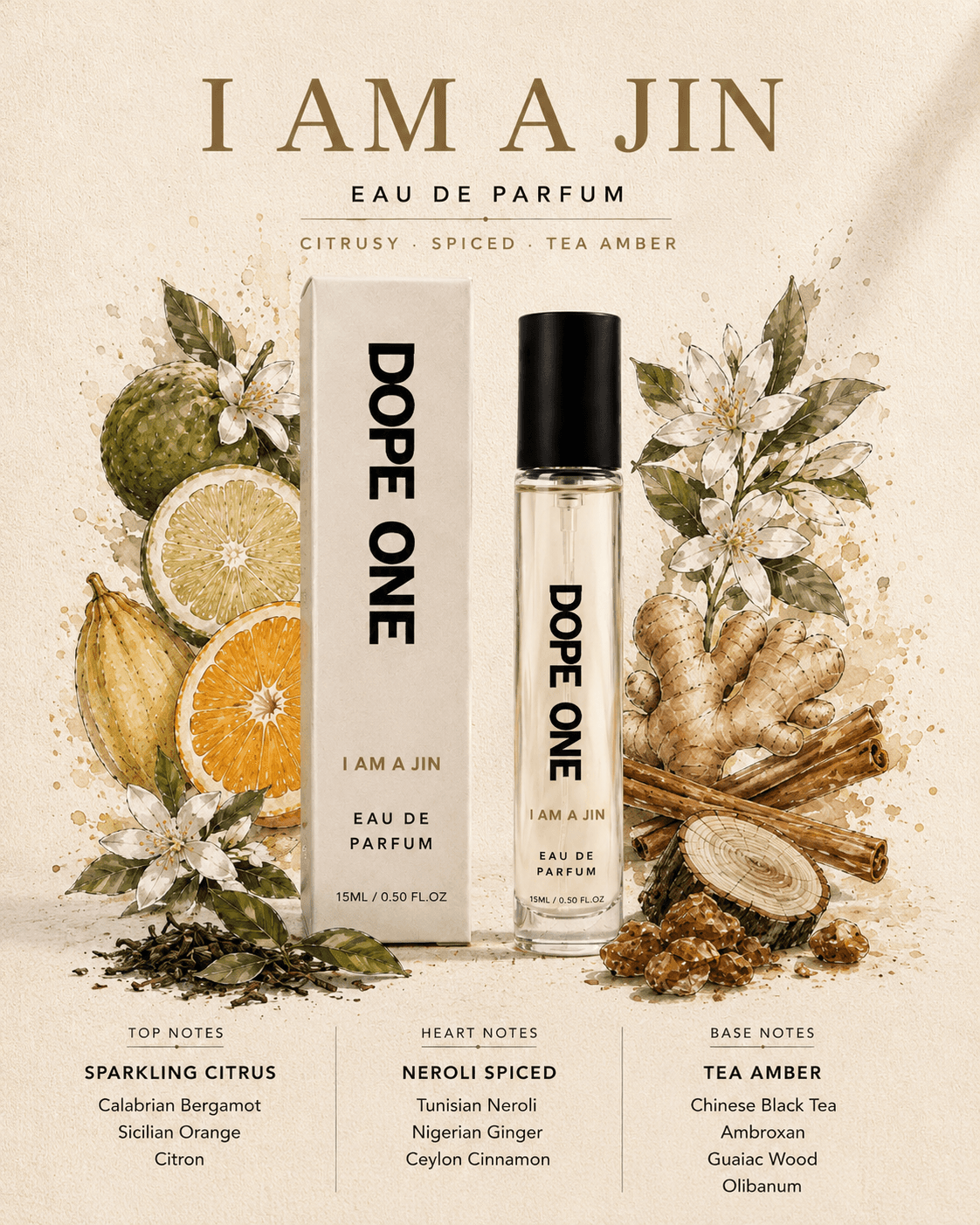
I Am A Jin
Calabrian bergamot, Tunisian neroli, Chinese black tea. Built for Indian subtropical heat.
₹419
View →
The challenge with bergamot in India is that the opening is the best part and also the fastest to go. I Am A Jin extends the bergamot window by anchoring it in a tea-neroli heart that hits before the bergamot has fully faded. The result is a citrus opening that transitions rather than disappears, carrying bergamot's brightness into the mid-phase through the neroli and tea rather than asking it to stand alone against 38°C air.
Nobody in India compliments a fragrance. They register it — a second glance, a face that changes as you pass. I've stopped waiting for the sentence and learned to read the pause. By dinner this sits on the skin; next morning it's still on yesterday's tee when I pull it on.
I Am A Jin is a desk fragrance. Not a gym fragrance, not a club fragrance, not a statement. It is for arriving at work smelling put-together, and for the bergamot that greets you when you pull yesterday's shirt over your head the next morning. That last part was not in the brief. It stayed anyway.
I Am A Jin is ₹419. It opens with bergamot. It closes with black tea. What happens in between is the reason it took multiple versions to get right.
Common Questions About Bergamot in Perfumery
What is bergamot and what does it smell like?
Bergamot is the essential oil cold-pressed from the peel of Citrus bergamia, a hybrid grown almost exclusively in Calabria, Italy. It smells sparkling, bittersweet, and slightly floral; think lemon peel with the sharpness removed and a faint lavender-like lift added. It is the opening note in roughly 40% of all fragrances, including Chanel No. 5, Dior Sauvage, and the original Eau de Cologne from 1709.
Why does bergamot not last long?
Bergamot's primary molecules, linalyl acetate and limonene, are small and volatile. They evaporate at room temperature within minutes. This is physics, not a formulation flaw. Bergamot is built to open, not to last. The heart and base notes of a fragrance are supposed to carry the composition after the bergamot opening fades. If the entire fragrance disappears when the bergamot does, the problem is the composition, not the citrus.
Where does bergamot come from?
Ninety percent of the world's bergamot grows in a narrow coastal strip of Calabria, southern Italy. The volcanic soil and Mediterranean-subtropical microclimate produce a chemical profile that cannot be replicated elsewhere. Attempts in Ivory Coast, Argentina, and Brazil have not produced comparable oil. Bergamot is like champagne, the name is the place.
What are the best bergamot perfumes?
Le Labo Bergamote 22 is the reference bergamot-centric composition. Acqua di Parma Bergamotto di Calabria is the purest, most documentary bergamot soliflore. Bleu de Chanel uses bergamot to open the most commercially successful masculine fragrance of the last fifteen years. For the bergamot-tea architecture specifically, DOPE ONE I Am A Jin pairs Calabrian bergamot with Tunisian neroli and Chinese black tea in a formulation built for Indian subtropical conditions.
Is bergamot perfume good for Indian summer?
Bergamot opens brilliantly in Indian summer and vanishes within minutes. Heat accelerates evaporation and there is nothing a perfumer can do to stop this. The bergamot is still doing its job, it opened the fragrance beautifully. If the rest of the composition is not built to carry the wear through the heat, the bergamot's early exit will feel like a failure. It is not. It is a reminder that the heart and base need to earn their place.
The Note That Opens and Exits
Bergamot is not going to be your signature note. It was never trying to be. It is the note that opens the door, hands you a drink, and disappears into the party before you have time to get tired of it. Forty percent of all fragrances ever made begin with bergamot. Most wearers never notice. That is the point. Bergamot does not want credit. It wants to start the conversation and let someone else finish it.
Calabria grew it first. A German-Italian perfumer put it in a bottle in 1709. Napoleon went through a litre a month. And today, in a DOPE ONE bottle calibrated for Indian subtropical heat, bergamot still does the same job it has done for three hundred years: it opens, it sparkles, it exits. Everything that follows is someone else's responsibility.
Bergamot is the note that opens most summer wardrobes, and the note that disappears from them fastest once the temperature climbs. Our summer fragrances that hold in Indian heat sets out which compositions keep their lift past the first hour.
Common questions
- What is bergamot and what does it smell like?
- Bergamot is the essential oil from the peel of Citrus bergamia, grown almost exclusively in Calabria, Italy. It smells sparkling, bittersweet, and slightly floral, lemon with the sharpness removed and a faint lavender-like lift. It opens roughly 40% of all fragrances including Chanel No. 5 and Dior Sauvage.
- Why does bergamot not last long?
- Bergamot's molecules (linalyl acetate, limonene) are small and volatile, they evaporate within minutes. This is physics, not a flaw. Bergamot is built to open, not to last. If the fragrance disappears when the bergamot does, the heart and base notes failed their job.
- Where does bergamot come from?
- Ninety percent comes from a narrow coastal strip of Calabria, southern Italy. The volcanic soil and microclimate produce a chemical profile that cannot be replicated. Ivory Coast, Argentina, and Brazil have all tried. None have matched the Calabrian oil.
- What are the best bergamot perfumes?
- Le Labo Bergamote 22 is the reference bergamot composition. Acqua di Parma Bergamotto di Calabria is the purest soliflore. Bleu de Chanel is the most commercially successful bergamot opening. DOPE ONE I Am A Jin pairs Calabrian bergamot with neroli and black tea built for Indian subtropical heat.
- Is bergamot perfume good for Indian summer?
- Bergamot opens brilliantly in Indian summer and vanishes within minutes, heat accelerates evaporation and nothing can stop it. The bergamot did its job. The rest of the composition needs to carry the wear from there. Look for bergamot fragrances with substantial heart and base notes for Indian summer wear.
Related guides
- Best Summer Perfumes for Men in India (2026): What Survives the Heat
- Vetiver in Perfumery: Khus, the Root That Cools Indian Summers
- Best Chypre Perfumes in India: The Bergamot-and-Oakmoss Structure, Explained
- Ginger in Perfumery: The Warm Spice That Splits Into Two Different Notes
- Best Fougère Perfumes in India: The Barbershop Structure Behind Half Your Colognes
- Green Tea in Perfumery: The Same Leaf, Two Completely Different Smells