Oakmoss in Perfumery: The Lichen That Built Chypre, Then Got Banned
Transparency: we formulate DOPE ONE QUITE BOSS. Every fragrance here, including ours, is judged on the same criteria: Indian heat performance, fabric longevity, and fidelity to the original's character. Where ours falls short, we say so.
Almost every "oakmoss" perfume sold today contains barely any real oakmoss. That's not a marketing trick, it's a regulation.
What Oakmoss Actually Is and the Vibe It Carries
The Chemistry
Oakmoss isn't a moss at all, it's a lichen, Evernia prunastri, that grows on oak and other trees. Extracted as an absolute, its traditional aroma comes with atranol compounds that regulators eventually flagged as skin sensitisers, which is the entire reason modern "oakmoss" in perfumery usually means a carefully reconstructed accord rather than the raw absolute itself.
The General Perception
Oakmoss reads as damp, earthy, slightly mineral, with a leather-like undertone that feels like forest floor after rain. If oakmoss were a moment, it would be stepping into old woods, grounded and a little melancholic.
Where Oakmoss Comes From and Why It's Restricted
Sourcing
Traditionally, oakmoss lichen was harvested from oak forests across France, the Balkans, and Eastern Europe, then processed into a concrete and absolute.
IFRA Reality
Under EU regulation 2017/1410, atranol and chloroatranol content in oakmoss extracts is capped at strict limits due to sensitisation concerns. Evernyl (CAS 4707-47-5), a synthetic oakmoss-facet molecule, is one of the tools perfumers now lean on to rebuild the character without the restricted compounds.
How It Found Its Place in Perfumery
Oakmoss is the literal foundation of the chypre fragrance family, the genre named for Cyprus that pairs a bright citrus top with a mossy, earthy base, and worth its own dedicated roundup beyond just this one ingredient. When the raw material was restricted, an entire fragrance genre had to be quietly rebuilt around synthetic substitutes rather than disappear.
Alternatives, If Oakmoss Isn't for You
| Alternative | What You Get | What You Lose | Best When... |
|---|---|---|---|
| Vetiver | A drier, smokier earthy-woody base without the mossy, mineral edge | Oakmoss's specific damp, forest-floor character | You want an earthy base note without chypre's specific mossiness |
The Indian Perspective on Oakmoss
The Cultural Anchor
India has no domestic oakmoss lichen industry at any real scale; historically the material was always imported from European lichen harvests, so there's no equivalent local supply chain the way there is for materials like vetiver or sandalwood.
Traditional Use
Chypre as a fragrance genre never had deep roots in traditional Indian perfumery (attar-making leans on rose, sandalwood, and oud rather than mossy-citrus structures), so oakmoss entered the Indian market mainly through Western fine fragrance imports.
The Modern Indian Context
Today, Indian buyers encounter oakmoss almost entirely through international chypre classics, with reconstructed accords standing in for the restricted natural absolute, same as everywhere else.
Who Loves Oakmoss, and Who Doesn't
Why People Love It
- Grounds a composition with real earthy, forest-floor depth
- The defining backbone of the entire chypre fragrance family
- Pairs beautifully with bright citrus tops for contrast
- Carries a mature, old-world character few modern notes replicate
Why They Won't
- Can read as dated or "old-fashioned" to wearers used to cleaner musks
- Real oakmoss absolute is now heavily restricted, so authenticity varies by brand
- Its damp, mossy character isn't universally loved, some find it musty
- Regulatory reconstruction means two "oakmoss" perfumes can smell quite different
The honest trade-off: oakmoss rewards someone who wants a genuine chypre structure and doesn't mind that the "real" version is largely a regulated memory rebuilt in synthetics.
Pairings, Clashes and Real Fragrance Picks
What Oakmoss Pairs With
Oakmoss is classically paired with bergamot, the exact citrus-to-moss structure that defines chypre. It works well alongside lavender for an aromatic-fougere bridge. It clashes with heavy gourmand sweetness, which tends to fight its dry, earthy character.
Real Fragrance Recommendations
| Fragrance | Oakmoss's Role | Price Band (India, approx.) | Heat Performance | Best For |
|---|---|---|---|---|
| Guerlain Mitsouko | The archetypal chypre, oakmoss grounding a peach-aldehyde composition | ~₹18,000-25,000/100ml | Complex and long-wearing; suits cooler weather best | Wearers wanting the historical benchmark chypre |
| Chanel No. 19 | Oakmoss anchors a green, iris-forward chypre structure | ~₹17,500-23,500/100ml | Crisp and confident; performs well in moderate heat | Wearers wanting a sharper, more modern chypre |
| Rochas Femme | Oakmoss paired with plum and leather for a warm, vintage chypre | ~₹8,000-12,000/100ml | Rich and heavy; best in cooler weather | Wearers wanting an accessible entry into vintage-style chypre |
Where Oakmoss Shows Up in the DOPE ONE Lineup
Quite Boss genuinely carries oakmoss in its base, alongside vetiver, patchouli, musk, and ambergris, an earthy foundation underneath its spicier top and heart.
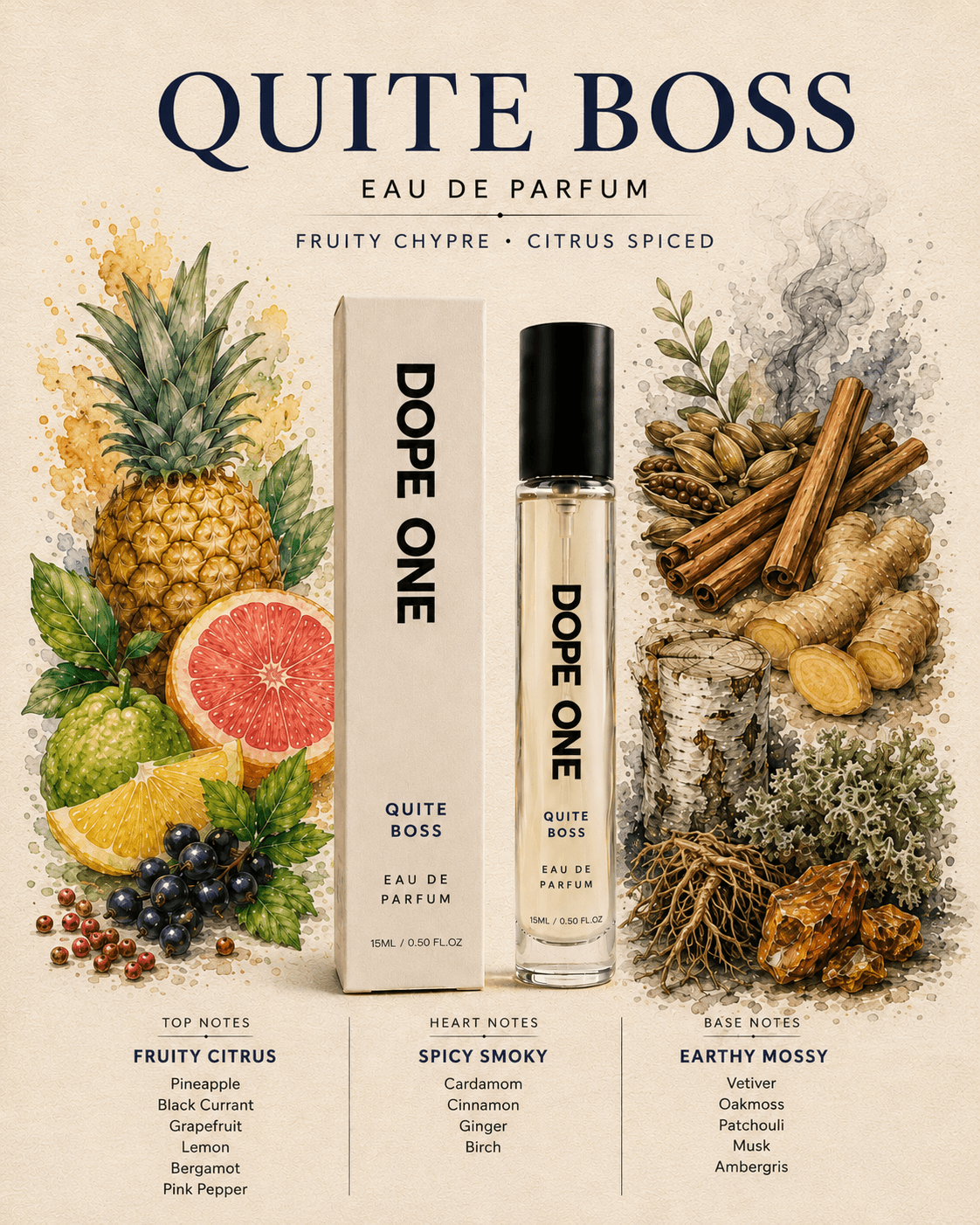
QUITE BOSS
Pineapple and pink pepper brightness over a cinnamon-birch heart, grounded by an oakmoss-vetiver base.
₹419
View →
'What are you wearing?' — asked by people who couldn't name a single fragrance house. That's the whole point of this DNA. Hours two through five are the sweet spot: the opening's energy still present, the loudness gone, everything composed.
₹419 · ₹1,319
The honest limitation: Quite Boss is a spice-forward composition overall, not a dedicated chypre. Its oakmoss sits quietly in the base rather than leading the structure, so if you want oakmoss as the headline note, the classics above remain the sharper choice.
Oakmoss in Perfumery: Quick Answers
A few of the most common questions people ask about oakmoss as a fragrance note, answered directly below.
The Bottom Line on Oakmoss
Oakmoss built an entire fragrance genre, then regulation forced that genre to be quietly rebuilt without much of the material that defined it. That's not a downgrade so much as perfumery doing what it's always done: finding a new way to keep an old idea alive.
Common questions
- What does oakmoss smell like in perfume?
- Damp, earthy, slightly mineral, with a leather-like undertone, like forest floor after rain.
- Why is oakmoss restricted in perfumery?
- EU regulation 2017/1410 caps atranol and chloroatranol content in oakmoss extracts due to skin sensitisation concerns, which is why most modern 'oakmoss' perfumes rely on reconstructed accords rather than the raw absolute.
- Is oakmoss banned in perfume?
- Not fully banned, but heavily restricted. Perfumers can still use oakmoss within strict allergen limits, and often supplement or replace it with synthetic facets like Evernyl.
- What is oakmoss made from?
- Oakmoss is a lichen, Evernia prunastri, that grows on oak and other trees, extracted as a concrete and absolute for use in perfumery.
- Does DOPE ONE have an oakmoss fragrance?
- Quite Boss genuinely carries oakmoss in its base, alongside vetiver, patchouli, musk, and ambergris, though it's a spice-forward composition overall rather than a dedicated chypre.
- What is a chypre perfume?
- A fragrance family built on a bright citrus top over a mossy, earthy base, historically anchored by oakmoss, named for the island of Cyprus.