Peony in Perfumery: The Flower That Doesn't Actually Have an Essential Oil
Transparency: we formulate DOPE ONE OUD ODYSSEY. Every fragrance here, including ours, is judged on the same criteria: Indian heat performance, fabric longevity, and fidelity to the original's character. Where ours falls short, we say so.
Peony perfume smells fresh and rosy in almost every bottle on the shelf, and that consistency exists for a specific reason: there is no such thing as real peony essential oil to begin with.
What Peony Actually Is and the Vibe It Carries
The Chemistry
Peony, particularly Paeonia suffruticosa, the tree peony, has been studied through headspace technology, capturing the volatile molecules the living flower releases without extracting anything from the plant itself, since no commercially viable absolute exists. Perfumers reconstruct the scent using rose-adjacent alcohols, 2-phenylethanol and geraniol, alongside ionones and cyclamen aldehyde, which together recreate peony's fresh, rosy, slightly green and powdery character.
Because so many fragrance houses draw on the same small family of molecules, peony perfumes tend to smell more alike than most other florals in this series, less a signature ingredient than a shared, well-understood formula.
The General Perception
Peony reads as fresh, universally likeable, and slightly powdery, a floral that rarely polarises because it was engineered from the start to be broadly appealing. If peony were a moment, it would be a bouquet still wrapped in paper, fresh enough that nobody has decided yet whether it's rose or something else entirely.
Where Peony Comes From and How It Earned Its Place
Sourcing
There is no real sourcing industry for peony, since no absolute exists to source. The "peony note" is built entirely by perfumers and fragrance houses from the molecules described above, informed by headspace research on the living flower rather than any extraction process.
IFRA Reality
No unusual restriction on the peony accord as a whole, though ionones fall under standard labeling requirements as potential sensitisers above certain concentrations, a disclosure requirement rather than a usage ban.
How It Found Its Place in Perfumery
Peony became a defining note of the 2000s and 2010s "fresh floral" boom, appearing constantly in designer rose-and-peony combinations aimed at a broad, easy-to-wear market. Its reconstructed, rose-adjacent character made it a natural companion note rather than a standalone star.
Alternatives, If Peony Isn't for You
| Alternative | What You Get | What You Lose | Best When... |
|---|---|---|---|
| Rose | The genuine, extractable material peony's reconstruction actually leans on | Peony's lighter, fresher, more powdery-green edge | You want the real underlying material rather than the reconstructed version |
| Musk | The soft, powdery facet peony shares in fresh floral compositions | The actual floral character entirely | You liked peony's powdery softness more than its "flower" side |
The Indian Perspective on Peony
The Cultural Anchor
Peony has no meaningful commercial cultivation or cultural tradition in India. It's a temperate-climate flower, native to China and Central Asia, that needs cold winters most of India simply doesn't get.
Traditional Use
Unlike jasmine, tuberose, or rose, all of which are genuinely embedded in Indian floriculture, ritual use, and garland traditions, peony has no equivalent presence here. It remains a purely Western and East Asian import as a fragrance concept, without the kind of indigenous cultural anchor this series has found for most other florals.
The Modern Indian Context
Indian niche perfumery uses peony the same way most of the world does, as an imported, entirely reconstructed accord, with no domestic sourcing story or cultural resonance to draw on.
Who Loves Peony, and Who Doesn't
Why People Love It
- Fresh, universally likeable character that rarely polarises
- Reliable performer in mainstream "clean floral" and rose-and-peony compositions
- Pairs easily with almost anything without overwhelming a composition
- An easy, low-risk floral for wearers new to fragrance
Why They Won't
- Can read as generic or interchangeable across brands, since so many draw on the same reconstruction molecules
- Not for wearers who specifically want a "real" natural extract, since none exists commercially
- Lacks the distinctive character and depth of florals with genuine, extractable absolutes
- Rarely a standalone note; almost always a supporting player alongside rose or musk
The honest trade-off: peony rewards someone who wants an easy, broadly appealing floral and doesn't mind that the entire note is a careful reconstruction with no real flower behind it.
Pairings, Clashes and Real Fragrance Picks
What Peony Pairs With
Peony pairs naturally with rose, the genuine material its reconstruction leans on, and with musk, which extends its powdery softness into the base. It clashes with heavy, dark woods and resins, which tend to overwhelm its deliberately light, fresh character.
Real Fragrance Recommendations
| Fragrance | Peony's Role | Price Band (India, approx.) | Heat Performance | Best For |
|---|---|---|---|---|
| Jo Malone Peony & Blush Suede | A genre-defining peony-forward composition with a soft suede base | ~₹8,000-11,000/100ml | Light and fresh; wears well through Indian heat | Anyone wanting the definitive mainstream peony experience |
| Marc Jacobs Daisy | A fresh floral bouquet where peony supports jasmine and violet | ~₹6,000-8,500/100ml | Bright and easy in warm weather | An accessible, everyday entry point into fresh florals |
| Viktor & Rolf Flowerbomb | Peony as part of a dense floral bouquet alongside jasmine and rose | ~₹9,000-12,000/90ml | Heavier composition; can feel dense in high humidity | Fans of a richer, more layered floral bouquet |
| DOPE ONE Oud Odyssey | No peony in the formula, but rose in the top notes genuinely overlaps with the rose-derived molecules that build peony's reconstruction | ₹419 (15ml) / ₹1,319 (50ml) | Demanding and warm; not a fresh-floral daytime match despite the rose overlap | Anyone curious about the rose material behind peony's reconstruction, in a completely different, much heavier composition |
Where DOPE ONE Sits Closest to Peony
No current DOPE ONE SKU contains peony. The closest available register is Oud Odyssey, whose top notes genuinely include rose, the material peony's reconstruction leans on most heavily, even though peony itself isn't in the formula and Oud Odyssey's overall character is far heavier and darker than peony's fresh airiness.
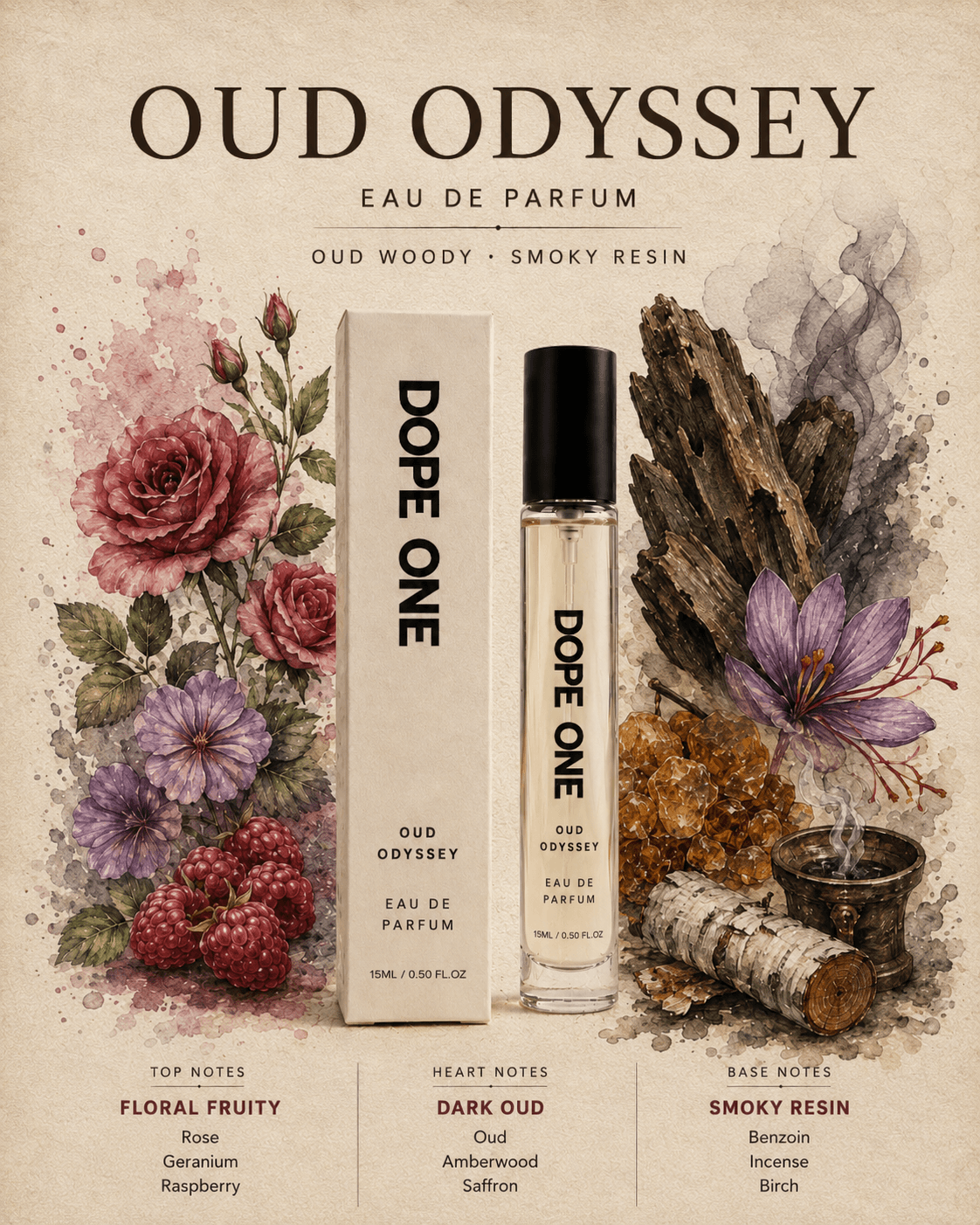
OUD ODYSSEY
Rose, geranium, and raspberry over oud, amberwood, and saffron, resting on benzoin, incense, and birch.
₹419
View →
Reactions split into exactly two camps: people who need to know what it is, and people startled that a fragrance can have this much character. Nobody ignores it. Next morning, the better question is what wasn't left on the collar.
The honest limitation: it's demanding, and it expects attention. Some days won't be the mood for it, and that isn't a flaw, it's an agreement, one that has nothing to do with peony's easy, fresh, low-commitment character.
Peony in Perfumery: Quick Answers
A few of the most common questions people ask about peony as a fragrance note, answered directly below.
The Bottom Line on Peony
Peony is a bouquet still wrapped in paper, fresh enough that nobody has decided yet whether it's rose or something else entirely, and that ambiguity exists because the note is always a careful reconstruction rather than a real extract. Knowing that explains why peony perfumes smell so consistent across brands, and why India's own floral perfumery tradition, built on jasmine, tuberose, and rose, has no equivalent for this specific flower.
Common questions
- What does peony smell like in perfume?
- Peony smells fresh, rosy, and airy, with a slightly green and powdery edge. It's built from rose-adjacent alcohols, ionones, and cyclamen aldehyde rather than extracted from the actual flower.
- Is peony perfume real or synthetic?
- Always a reconstructed accord. No commercially viable peony essential oil or absolute exists, so every peony note in perfumery is built from other molecules, mainly 2-phenylethanol, geraniol, ionones, and cyclamen aldehyde.
- Why doesn't peony have an essential oil?
- Peony flowers don't yield a usable extract through steam distillation or solvent extraction at any commercial scale. Perfumers instead studied the living flower's headspace, the volatile molecules it releases, and rebuilt the scent from other available materials.
- Is peony the same as rose?
- No, but they're closely related in perfumery. Peony's reconstruction leans heavily on rose-adjacent alcohols like 2-phenylethanol and geraniol, which is why peony perfumes often smell rosy, even though peony and rose are genuinely different flowers.
- What are the best peony perfumes?
- Jo Malone Peony & Blush Suede is the genre-defining mainstream peony fragrance. Marc Jacobs Daisy uses peony as a supporting note in a fresh floral bouquet, and Viktor & Rolf Flowerbomb includes it within a denser floral composition.
- Does peony grow in India?
- Not commercially or culturally. Peony is a temperate-climate flower native to China and Central Asia that needs cold winters most of India doesn't get, unlike jasmine, tuberose, or rose, all of which have genuine Indian cultivation and cultural traditions.