Rose in Perfumery: Kannauj's 400-Year Secret and the Note That Makes Oud Worth Wearing
Transparency: we formulate DOPE ONE Oud Odyssey. Every fragrance here, including ours, is judged on the same criteria: Indian heat performance, fabric longevity, and fidelity to the original's character. Where ours falls short, we say so.
Four tonnes of rose petals. That is what it takes to produce one kilogram of rose oil. The petals are hand-picked before dawn, when the oil content peaks; loaded into copper stills in Kannauj or Kazanlak or Isparta; and steamed for hours until the oil separates and rises to the surface. The yield is 0.02%. The cost is ₹10-25 lakh per kilogram depending on origin and extraction method. And yet rose is everywhere in perfumery; in the cheapest body spray and the most expensive attar, in department store florals and niche oud compositions, in the fragrance your grandmother wore and the one you reach for on date night. How does the most expensive perfume ingredient on earth appear in every price tier? The answer parallels vanilla and musk: the synthetic does the heavy lifting. But unlike vanilla and musk, the real thing genuinely smells better.
This article covers what rose actually is in perfumery, the difference between rose otto and rose absolute, why Kannauj's 400-year rose attar tradition is invisible to the fragrance industry, how the rose-oud pairing became the dominant architecture of Eastern perfumery, and which rose fragrances are worth wearing in India.
What Rose Actually Is in Perfumery
Two species of rose dominate perfumery: Rosa damascena (Damask rose) and Rosa centifolia (May rose or cabbage rose). Damask rose is grown primarily in Bulgaria, Turkey, and India. It produces a deep, rich, spicy-floral oil with honeyed and slightly green facets. Centifolia rose is grown in Grasse, France, and Morocco. It produces a lighter, fresher, more dewy rose with citrus undertones. Damask rose is the workhorse of Eastern and Middle Eastern perfumery. Centifolia rose is the signature of French haute parfumerie. The two smell recognisably different, like two instruments playing the same note.
Rose oil comes in two forms. Rose otto (or rose attar) is steam-distilled. It is pale yellow to greenish, intensely concentrated, and used at fractions of a percent in fine fragrance. Rose absolute is solvent-extracted. It is dark red to brown, richer, waxier, and contains the heavier molecules that distillation leaves behind, particularly phenyl ethyl alcohol (PEA, CAS 60-12-8), which gives rose its characteristic honey-rose warmth. Rose otto costs more. Rose absolute smells more complete. Most perfumers use both: otto for diffusion and brightness, absolute for depth and persistence.
The key molecule in rose is citronellol (CAS 106-22-9), accounting for 30-55% of the oil. Geraniol (CAS 106-24-1) provides the bright, sweet-rose character. Nerol (CAS 106-25-2) adds a fresher, citrus-rose dimension. Phenyl ethyl alcohol contributes the honeyed, wine-like warmth that makes rose smell like rose rather than geranium. The exact ratio of these molecules varies by origin, harvest year, and extraction method. Bulgarian rose is typically citronellol-dominant with a high geraniol content. Indian rose from Kannauj leans more towards phenyl ethyl alcohol, giving it a warmer, more honeyed profile than its European counterparts. The difference is small but distinct to a trained nose: Bulgarian rose sparkles. Indian rose glows.
Rose is the person who walks into the room and changes the temperature without saying a word. Not loud. Not demanding. Just present at a frequency that makes everything else feel slightly more alive. If oud is the person in the corner you keep glancing at and musk is the room itself, rose is the person everyone wants to sit next to. It does not announce itself. It is the reason the room got quieter when it arrived.
Kannauj: The World's Oldest Rose Perfume Tradition
IFRA and Rose: What Perfumers Cannot Ignore
Rose absolute contains naturally occurring methyl eugenol (CAS 93-15-2), a fragrance allergen restricted by IFRA to 0.01% in leave-on products for skin safety. This is not a flaw. It is a regulatory reality that any perfumer working with rose must navigate. The practical consequence: rose-heavy fragrances at high concentrations require careful calculation of methyl eugenol content relative to IFRA limits. This is why some rose perfumes smell weaker than their formula suggests: the perfumer may have been forced to cap the rose percentage and rely on synthetic extenders to maintain the rose character within regulatory boundaries.
Kannauj, a small city in Uttar Pradesh on the banks of the Ganga, has been distilling rose attar for over 400 years. The technique arrived with the Mughals, who brought Persian rose distillation knowledge to India. It never left. Kannauj's deg-bhapka method uses a copper still (deg) connected to a copper receiver (bhapka) via a bamboo pipe. Rose petals and water are heated in the deg. The steam carries the volatile oils through the bamboo pipe into the bhapka, which sits in a water bath. Sandalwood oil in the bhapka absorbs the rose volatiles. The process runs for 6-8 hours. The result is rose attar: pure rose oil co-distilled into sandalwood. It is the oldest continuous perfume production method still in use at commercial scale anywhere in the world.
India is the world's second-largest producer of rose oil after Turkey. The main growing regions are Kannauj, Hathras, and Etah in Uttar Pradesh; Pushkar and Ajmer in Rajasthan; and parts of Kashmir. Indian Damask rose blooms in March and April. The harvest window is roughly 25-30 days. Petals must be picked before sunrise, when the oil glands are fullest. A single picker harvests 8-12 kilograms of petals per morning. It takes 4,000 kilograms of petals to produce one kilogram of rose oil. That is roughly 350 picker-mornings per kilogram of oil. The cost is not arbitrary. It is physics and labour and time converted into rupees.
Despite this heritage, Indian rose oil is almost invisible in the global fragrance market. Bulgarian and Turkish rose otto command the brand names and the price premiums. Indian rose oil is exported to the same buyers but sold at a discount and often blended into "Bulgarian" lots. The perfumery industry does not market Kannauj rose the way it markets Grasse rose or Bulgarian rose. The attar tradition that invented the category is treated as a regional curiosity rather than the foundation of rose perfumery. This is slowly changing as Indian niche brands and a few foreign houses begin sourcing and labelling Indian rose explicitly. But the gap between what Kannauj produces and what the world knows is vast.
The Pairing That Defines Eastern Perfumery
Rose and oud is not a trend. It is an architecture. In the Middle Eastern and Indian perfume traditions, rose has been paired with oud for at least 800 years. The logic is structural: oud provides darkness, depth, and animalic weight. Rose provides light, lift, and floral radiance. Without rose, oud is too heavy, too dark, too much. It sits on the skin like a shadow. Rose opens the space. It gives oud a reason to be worn rather than just admired. The pairing is not "oud softened by rose." It is "rose strengthened by oud." The rose leads. The oud anchors. The composition becomes wearable.
This is why the rose-oud category dominates both Middle Eastern niche (Amouage, Roja, Ormonde Jayne) and the Indian attar tradition. The same pairing appears in traditional Kannauj rose-mitti attars and in a ₹40,000 bottle of Roja Amber Oud. The materials are different. The architecture is identical. Rose provides the opening statement. Oud provides the base. Sandalwood or benzoin smooths the transition between the two. This is the template behind Oud Odyssey, behind LV Ombre Nomade, behind every rose-oud composition that has ever worked.
For the rose-oud guide content, see our oud guide which maps the full pairing architecture across both Western and Eastern traditions.
If Rose Is Out of Reach
| Alternative | What You Get | What You Lose |
|---|---|---|
| Geranium (Bourbon) | Rose-adjacent: green, rosy-citrus, slightly minty. The closest natural alternative to rose. Used as a rose extender in commercial perfumery for over a century. | No honeyed depth. Geranium sparkles where rose glows. Distinct enough that rose lovers spot it immediately. |
| Peony Accord | Fresh floral with rose-like breadth but no rose cost. A structural alternative when budget is the constraint. | Thin by comparison. No longevity. Read as "generic floral" rather than rose. Best as a top-note illusion. |
| Hedione (Methyl Dihydrojasmonate) | A transparent jasmine molecule that creates rosy diffusion. The most elegant way to suggest rose without using rose. | No rose character. Hedione is an effect, not a substitute. It makes the composition feel rose-like without smelling of rose. |
| Synthetic Rose (PEA + Geraniol + Citronellol) | The molecular skeleton of rose at ₹500-2,000/kg. Used in 95% of commercial rose perfumes. Rose-shaped but not rose. | Flat. No complexity, no honeyed warmth, no development on skin. The difference between a photograph and a memory. |
How Rose Behaves on Indian Skin
| Season | What Rose Does | Verdict |
|---|---|---|
| Summer (35-45°C) | Rose otto's freshness evaporates within 30 minutes. Rose absolute's heavier molecules persist but can become jammy and overripe. Rose-oud compositions fare better; the oud provides structure that outlasts the rose top. | Evening only. Rose-oud pairings preferred. Soliflore rose dies fast. |
| Monsoon (80%+ RH) | Rose thrives in humidity. The phenyl ethyl alcohol honey note deepens. The green facets become more prominent. Rose absolute's waxy richness softens into something velvety. | Excellent. Rose's best Indian season by a wide margin. |
| Winter (5-20°C) | Rose performs at its most complete. Otto sparkles for hours. Absolute radiates warmth. The full complexity of a well-made rose composition becomes legible. | Excellent. Rose in its natural climate. Wear anything with rose. |
The Indian rule for rose: never wear a soliflore rose in summer. It will smell like wilted flowers within an hour. Rose-oud or rose-sandalwood pairings work year-round, with monsoon being the season where rose truly shines. The humidity activates the honeyed, wine-like facets of phenyl ethyl alcohol in a way that dry heat cannot. A good rose-oud composition worn in July rain is one of the finest things Indian perfumery can produce.
Which Rose Is Which
| Type | Smells Like | Cost/kg | Best Used In |
|---|---|---|---|
| Bulgarian Rose Otto | Bright, sparkling, spicy-floral. Citronellol-heavy. The reference rose. | ₹15-25 lakh | Fine fragrance. The opening sparkle that nothing else replicates. |
| Indian Rose Attar (Kannauj) | Warm, honeyed, slightly smoky. PEA-dominant. Co-distilled in sandalwood. | ₹10-18 lakh | Traditional attars. Eastern compositions. The heat-friendly rose. |
| Rose Absolute | Rich, dark, wine-like, slightly waxy. The "complete" rose. | ₹8-15 lakh | Base notes. The depth that rose otto alone cannot provide. |
| Rose Centifolia (Grasse) | Lighter, fresher, dewy, citrus-rose. Nerol-heavy. The French rose. | ₹12-20 lakh | French perfumery. Fresh rose soliflores. Chanel No. 5 territory. |
| Synthetic Rose (PEA, Geraniol, Citronellol) | Rose-like but flat. Recognisable as rose but lacks the complexity. | ₹500-2,000 | Every affordable rose perfume. The structural backbone. Not the soul. |
Rose in the Indian Imagination
Rose occupies a unique position in Indian culture: it is simultaneously sacred and everyday. Rose petals are offered in temples and scattered at weddings. Rose water flavours biryani in Lucknow and gulab jamun across the country. Rose attar is dabbed behind the ears before Friday prayers and gifted in cut-glass bottles at Diwali. Rose incense burns in the morning puja. The smell of rose is the smell of ceremony and comfort in equal measure: the most sacred flower and the most accessible fragrance, sometimes in the same bottle.
The Indian rose industry is a study in contradiction. India produces world-class rose oil. The world does not know it. Kannauj's attar makers produce rose oil that compares favourably to Bulgarian otto in blind evaluations. But "Bulgarian rose" has a century of marketing behind it, while "Indian rose" has none. The gap is not quality. It is branding. The same dynamic that kept Indian sandalwood undervalued for decades before Mysore became the global standard. Kannauj rose will follow the same arc. The quality is too good to stay invisible forever.
Rose 100ml attar from a Kannauj distiller costs ₹500-1,500 depending on concentration. The same quantity of rose absolute in a French niche perfume costs ₹30,000-50,000. The difference is not the rose. It is the bottle, the brand, the marketing, and the story. Indian consumers who understand this buy the attar. Everyone else buys the French bottle. Both contain rose. Only one tells you where it came from.
Who Rose Is For
Rose attracts the wearer who wants to smell like something specific rather than something generic. It is the note for someone who has decided that "floral" is not an insult and "romantic" is not a limitation. Rose wearers tend to be confident in a way that does not require announcement. They are not trying to blend in. They are not trying to stand out either. They are simply wearing what smells good to them and letting the world catch up.
The people who do not get along with rose usually have one of two complaints. The first is generational: rose is their grandmother's perfume, synonymous with vintage French florals that smelled like soap and powder and old cupboards. This is a cultural association, not a chemical one, and it is losing relevance as rose-oud and rose-amber compositions redefine the note's register. The second complaint is that rose is too recognizable. It announces itself in a way that modern fragrance drinkers, trained on woody-amber molecules and ambroxan, find disconcerting. Rose does not whisper. It does not pretend to be your skin. It is a flower. It knows it is a flower. For the wearer who wants their fragrance to be noticed and identified, this is the feature. For the wearer who wants their fragrance to be felt but not named, rose is the wrong choice.
| Who It Is For | Why It Works |
|---|---|
| Wearers who want to be recognized | Rose is unmistakable. The most identifiable note in perfumery. People know what rose smells like and will comment on it. If you want reactions, rose delivers. |
| Romantic occasions | Rose is the most culturally coded romantic flower. A rose fragrance signals effort and intentionality. Wearing rose on a date says this was chosen, not grabbed from a shelf. |
| Eastern / Middle Eastern wearers | Rose-oud and rose-sandalwood are the backbone of Middle Eastern and Indian perfumery. Rose is not a departure from the norm. It is the norm. |
| Who It Is Not For | Why It Fails |
|---|---|
| Wearers who dislike "floral" | Rose is the archetypal floral. If you associate florals with soap, shampoo, or generic feminine fragrance, rose will not change your mind. Start with rose-oud compositions rather than pure rose. |
| Indian summer daytime wear (soliflore) | Pure rose dies fast in Indian summer heat. The olfactory pyramid collapses within thirty minutes at 38°C. Wear rose-oud or rose-sandalwood instead, or save pure rose for monsoon and winter. |
| Wearers who want to smell like nothing | Rose does not do "your skin but better." It does "I am wearing rose." If the goal is a fragrance that people sense rather than identify, rose is the wrong tool. Reach for white musk or ambroxan. |
What Rose Plays Well With
Rose's defining strength is that it makes darkness wearable. Oud without rose is a monologue. Rose without oud is a greeting with no follow-through. Together they create the most durable pairing in Eastern perfumery: the rose opens, the oud anchors, and the space between them is where the composition lives. The oud guide covers the full oud end of the architecture.
Rose and sandalwood is the Indian classical pairing. Sandalwood provides the creamy base that makes rose feel like skin rather than flower. Rose lifts sandalwood out of its meditative stillness and gives it emotional range. This is the pairing behind Kannauj's entire attar tradition. Our sandalwood guide maps that architecture in full.
Rose and jasmine is the Indian floral axis. Jasmine pushes rose towards the indolic, night-blooming register. Rose keeps jasmine from becoming too animalic. Together they are the scent of an Indian summer night: heavy, sweet, persistent, impossible to ignore. The jasmine guide documents the full pairing.
What Does Not Work With Rose
Rose and heavy patchouli can clash. Both are strong, identikit notes that fight for attention. Patchouli's earthy, medicinal depth competes with rose's floral radiance instead of complementing it. The result is neither rose-forward nor patchouli-forward.
Rose and blackcurrant can become jammy to the point of nausea. Both are fruity-floral notes that, when combined at high concentration, create a sweet, dense, syrupy character. The LV Ombre Nomade pairing works because oud and benzoin cut the jamminess. Without those anchors, rose-blackcurrant becomes edible rather than wearable.
Rose and strong citrus top notes do not age well. The citrus disappears within minutes, leaving a rose that now feels unsupported. The first ten minutes are beautiful. The next hour is a rose that knows its citrus support just left the room.
Five Rose Fragrances
| Fragrance | Rose Character | Price Band (India) | Heat Performance | Best For |
|---|---|---|---|---|
| Frederic Malle Portrait of a Lady | Turkish rose absolute at 8-10% of formula. Patchouli, incense, clove. The reference modern rose. | ₹28,000-31,000 | Patchouli base holds in heat. Rose top brightens in humidity. | The definitive rose. Winter. Evening. When you want to understand what rose can do. |
| Amouage Rose Incense | Rose + frankincense + myrrh. The Middle Eastern rose-oud template executed with exceptional materials. | ₹18,000-24,000 | Incense anchors the rose in heat. Built for Gulf temperatures. | Understanding the Eastern rose. Year-round in India. |
| Diptyque Eau Rose | The best rose soliflore. Damask and centifolia. Green, dewy, photorealistic rose on a stem. | ₹8,000-10,000 | Soliflore rose dies fast above 35°C. Monsoon and winter only. | Understanding pure rose. The reference for what rose actually smells like. |
| LV Ombre Nomade | Rose + oud + raspberry + benzoin. The reference rose-oud for the 2020s. Dark, smoky, unmistakable. | ₹35,000-38,000 | Oud and benzoin build heat-tolerant structure. Evening, winter, making a statement. | The rose-oud benchmark. What Oud Odyssey targets. |
| DOPE ONE Oud Odyssey | Indian rose + oud + benzoin. The Eastern rose-oud architecture built for Indian skin. | ₹419 / ₹1,319 | Oud-benzoin base built for Gulf/Indian temperatures. Rose thrives in humidity. | Indian evenings. Monsoon rose-oud. Year-round Eastern signature. |
Oud Odyssey: Where Rose Meets Darkness
Oud Odyssey is built on the rose-oud template that defines Eastern perfumery. Rose opens the door. Oud walks through. Benzoin smooths the space between them. Without rose, Oud Odyssey would be too dark to wear, a room with no windows. Without oud, it would be too floral, a window with no room. The rose-oud pairing is not a marketing concept. It is an architectural requirement. One does not work without the other. Both are present at concentration levels calibrated for Indian skin at 38°C.
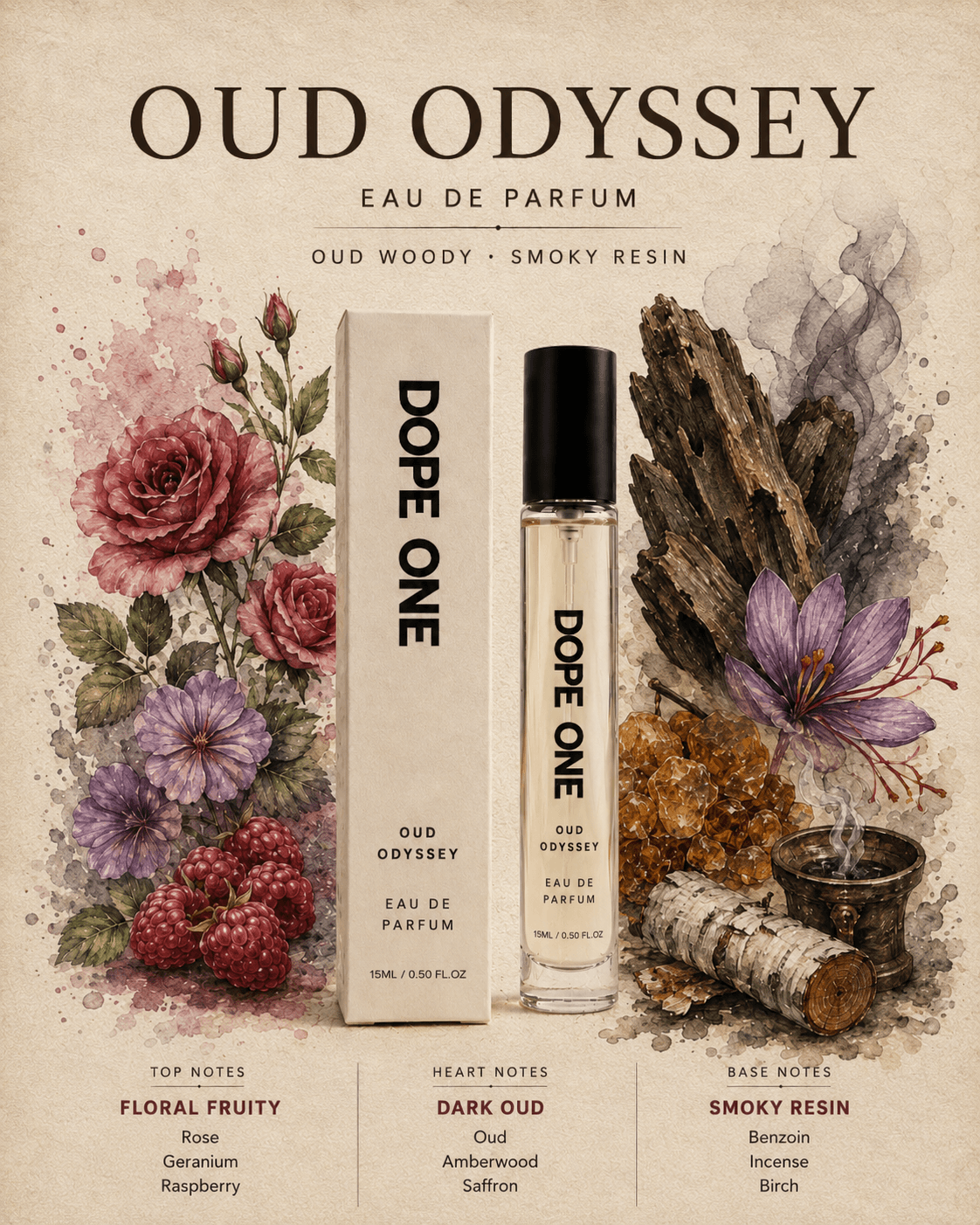
Oud Odyssey
Rose, oud, benzoin. The rose-oud architecture built for Indian skin.
₹419
View →
Oud Odyssey is the most expensive formulation in the DOPE ONE line. The materials are a level above: rose absolute, natural oud fractions, benzoin resinoid. This is not a rose soliflore. It is a rose-oud composed at concentrations that read as presence rather than announcement. The rose leads. The oud anchors. The benzoin softens the join. In Indian humidity, the rose opens fully, the oud recedes to a low rumble, and the composition becomes what it was designed to be: rose wearing oud, not oud wearing rose.
Reactions split into exactly two camps: people who need to know what it is, and people startled that a fragrance can have this much character. Nobody ignores it. Next morning, the better question is what wasn't left on the collar.
Oud Odyssey is ₹419. The rose costs more than every other ingredient in the composition combined. It shows.
Common Questions About Rose in Perfumery
What is the difference between rose otto and rose absolute?
Rose otto is steam-distilled. It is light, bright, sparkling, and used for the opening of a fragrance. Rose absolute is solvent-extracted. It is dark, rich, wine-like, and used for depth and persistence. Otto costs more. Absolute smells more complete. Most high-quality rose perfumes use both: otto for the first impression, absolute for the dry-down.
Why is rose oil so expensive?
Rose petals yield roughly 0.02% oil by weight. Four tonnes of hand-picked petals produce one kilogram of oil. The harvest window is 25-30 days per year. Petals must be picked before dawn. Bulgarian rose otto trades at ₹15-25 lakh/kg. Indian rose attar from Kannauj at ₹10-18 lakh/kg. The cost is labour and physics, not marketing.
Is Indian rose as good as Bulgarian rose?
The quality is comparable. The character is different. Bulgarian rose is typically citronellol-dominant with a high geraniol content; it sparkles. Indian rose from Kannauj leans more towards phenyl ethyl alcohol, giving it a warmer, more honeyed profile. In blind evaluations, Indian rose oil compares favourably. The gap is branding, not quality.
Why are rose and oud always paired together?
Because they solve each other's problems. Oud is too dark to wear alone. Rose is too light to command a room alone. Together, rose provides the lift and oud provides the anchor. The pairing is structural, not cultural; it works for the same reason a drum and a melody work. The oud guide covers the full architecture.
Does rose perfume work in Indian heat?
Pure rose soliflores die fast above 35°C. Rose-oud and rose-sandalwood pairings work year-round, with monsoon being rose's best Indian season. Humidity activates the honeyed, wine-like facets of phenyl ethyl alcohol. The rule: never wear a rose soliflore in Indian summer. Always pair it with oud, sandalwood, or incense.
The Flower That Costs More Than Gold and Smells Better
A field in Kannauj at 4 AM in March. The roses are blooming. Women and men move through the rows with headlamps, picking petals into cloth sacks. By 8 AM the picking stops; the sun is up, the oil content has dropped, the window is closed. The petals are loaded into copper deg stills. Sandalwood oil waits in the bhapka receiver. By evening, the first drops of rose attar have separated. The yield from the morning's harvest: perhaps ten grams of oil. The cost when it reaches a bottle of Oud Odyssey: roughly half the cost of the fragrance.
Rose is worth it. Not because it is rare, though it is. Not because it is expensive, though it is. Because nothing else in perfumery does what rose does at the intersection of oud and skin and humidity. The synthetic molecules are good enough for the background. The real thing is needed when rose is the composition, not a participant. That is when you pay for rose. And that is when rose pays you back.
Common questions
- What is the difference between rose otto and rose absolute?
- Rose otto is steam-distilled: light, bright, sparkling. Rose absolute is solvent-extracted: dark, rich, wine-like. Otto costs more. Absolute smells more complete. Most quality rose perfumes use both.
- Why is rose oil so expensive?
- Rose petals yield 0.02% oil. 4 tonnes of hand-picked petals per kg of oil. Harvest window: 25-30 days/year. Bulgarian otto: ₹15-25 lakh/kg. Indian Kannauj attar: ₹10-18 lakh/kg. The cost is labour and physics.
- Is Indian rose as good as Bulgarian rose?
- Quality is comparable. Character differs: Bulgarian rose sparkles (citronellol-dominant), Indian rose glows (phenyl ethyl alcohol-dominant, warmer, more honeyed). The gap is branding, not quality.
- Why are rose and oud always paired together?
- They solve each other's problems. Oud is too dark alone. Rose is too light to command a room alone. Rose provides lift, oud provides anchor. The pairing is structural: it works for the same reason drums and melody work together.
- Does rose perfume work in Indian heat?
- Pure rose soliflores die fast above 35°C. Rose-oud and rose-sandalwood pairings work year-round. Monsoon is rose's best Indian season; humidity activates the honeyed facets. Rule: never wear a soliflore rose in summer. Always pair it.