Myrrh in Perfumery: The Resin That Isn't Meant to Be Noticed
Transparency: we formulate DOPE ONE OUD ODYSSEY. Every fragrance here, including ours, is judged on the same criteria: Indian heat performance, fabric longevity, and fidelity to the original's character. Where ours falls short, we say so.
Most people who say they can smell myrrh in a perfume are actually smelling everything myrrh helped keep alive underneath it.
What Myrrh Actually Is and the Vibe It Carries
The Chemistry
Myrrh comes from Commiphora myrrha, a resin-producing tree native to the Horn of Africa and the Arabian Peninsula. Its defining molecule is furanoeudesma-1,3-diene, but the bigger story chemically is that myrrh oil is unusually rich in sesquiterpenes, heavier, slow-evaporating compounds that make it an effective fixative. In practice, that means myrrh's most common job in a composition isn't to be smelled directly, it's to extend how long everything else in the bottle lasts on skin.
The General Perception
Myrrh reads as warm, balsamic, and slightly medicinal, with a dry, resinous depth that feels ancient and a little mysterious. If myrrh were a moment, it would be the low hum underneath a composition, felt more than consciously noticed.
Where Myrrh Comes From and How It Earned Its Place
Sourcing
Raw myrrh resin is cleaned of impurities and then distilled, either by steam or CO2 extraction, to yield the essential oil used in perfumery.
IFRA Reality
Myrrh oil carries standard IFRA usage guidelines typical of resinous naturals, well understood and broadly permitted at fine-fragrance concentrations.
How It Found Its Place in Perfumery
Myrrh has been used since ancient Egypt, valued in embalming and temple incense long before modern perfumery existed, and it carried that association into fragrance as a note that signals gravity and history rather than everyday freshness. It's a frequent anchor in incense and amber-family compositions.
Alternatives, If Myrrh Isn't for You
| Alternative | What You Get | What You Lose | Best When... |
|---|---|---|---|
| Frankincense | A brighter, more citric-cathedral resinous quality | Myrrh's darker, more medicinal, fixative-heavy depth | You want incense character without the darker balsamic weight |
Frankincense is a genuinely different resin from a different tree genus, not just a lighter version of myrrh, despite the two being constantly paired together. Our frankincense guide covers it directly.
The Indian Perspective on Myrrh
The Cultural Anchor
India has no domestic Commiphora myrrha harvest, all myrrh used here is imported. There is a close botanical relative, though: Commiphora wightii, known as guggul, grown in Rajasthan and Gujarat and used in Ayurveda, but it's a genuinely different species with its own distinct resin, not a stand-in for myrrh itself.
Traditional Use
Guggul has a long Ayurvedic history for its own therapeutic and ritual uses, but that tradition runs parallel to, not through, myrrh's perfumery role.
The Modern Indian Context
Indian fragrance use of myrrh follows the same imported, resin- distillation supply chain used globally, no domestic material substitutes for it.
Who Loves Myrrh, and Who Doesn't
Why People Love It
- Reads as ancient, grounded, and quietly mysterious
- A genuinely effective natural fixative that extends wear time
- Anchors incense and amber-family compositions with real depth
- Carries a sense of history few synthetic notes can replicate
Why They Won't
- Can read as too medicinal or dark for wearers wanting brightness
- Rarely the headline note, easy to overlook if you're expecting a bold statement
- Natural myrrh's aroma varies with climate, harvest, and storage
- Frequently confused with frankincense despite being a distinct material
The honest trade-off: myrrh rewards someone who wants depth and longevity working quietly underneath a composition, not a note that announces itself.
Pairings, Clashes and Real Fragrance Picks
What Myrrh Pairs With
Myrrh pairs naturally with oud and other deep, resinous woods, both of which share its slow, grounded character. It clashes with sharp, bright citrus notes that fight its medicinal depth.
Benzoin and amber sit closest to myrrh in the balsamic register, one a genuine resin, the other a fantasy accord built to imitate the effect.
Real Fragrance Recommendations
| Fragrance | Myrrh's Role | Price Band (India, approx.) | Heat Performance | Best For |
|---|---|---|---|---|
| Amouage Opus VI | Myrrh anchors the base alongside sandalwood and cypriol, under a frankincense-pepper top | ~₹16,000-25,000/100ml | Rich and heavy; performs best in cooler weather or evening wear | Wearers wanting a serious, resin-forward statement |
| Le Labo Myrrhe 55 | Myrrh paired with black tea and cistus for a smoky, tea-like depth | ~₹45,000-55,000/100ml (Shanghai City Exclusive, released only in September each year) | Warm and long-wearing; balances well in moderate heat | Wearers wanting an accessible, everyday myrrh introduction |
| Serge Lutens La Myrrhe | A myrrh-anise composition built around the resin's medicinal edge | ~₹15,000-20,000/100ml | Distinctive and long-lasting; best for cooler weather | Wearers wanting myrrh's darker, more medicinal character front and centre |
DOPE ONE does not currently carry a myrrh-forward fragrance. None of the notes in the current lineup genuinely include it, so the honest answer for myrrh specifically is to look at the options above.
Where DOPE ONE Sits Closest to Myrrh
There isn't a genuine match. If you still want to explore the brand while myrrh isn't in the lineup, Oud Odyssey is the closest resinous territory available, its base genuinely includes benzoin and incense from the same resin family, but not myrrh itself. Named honestly here rather than stretched into a claim it doesn't support.
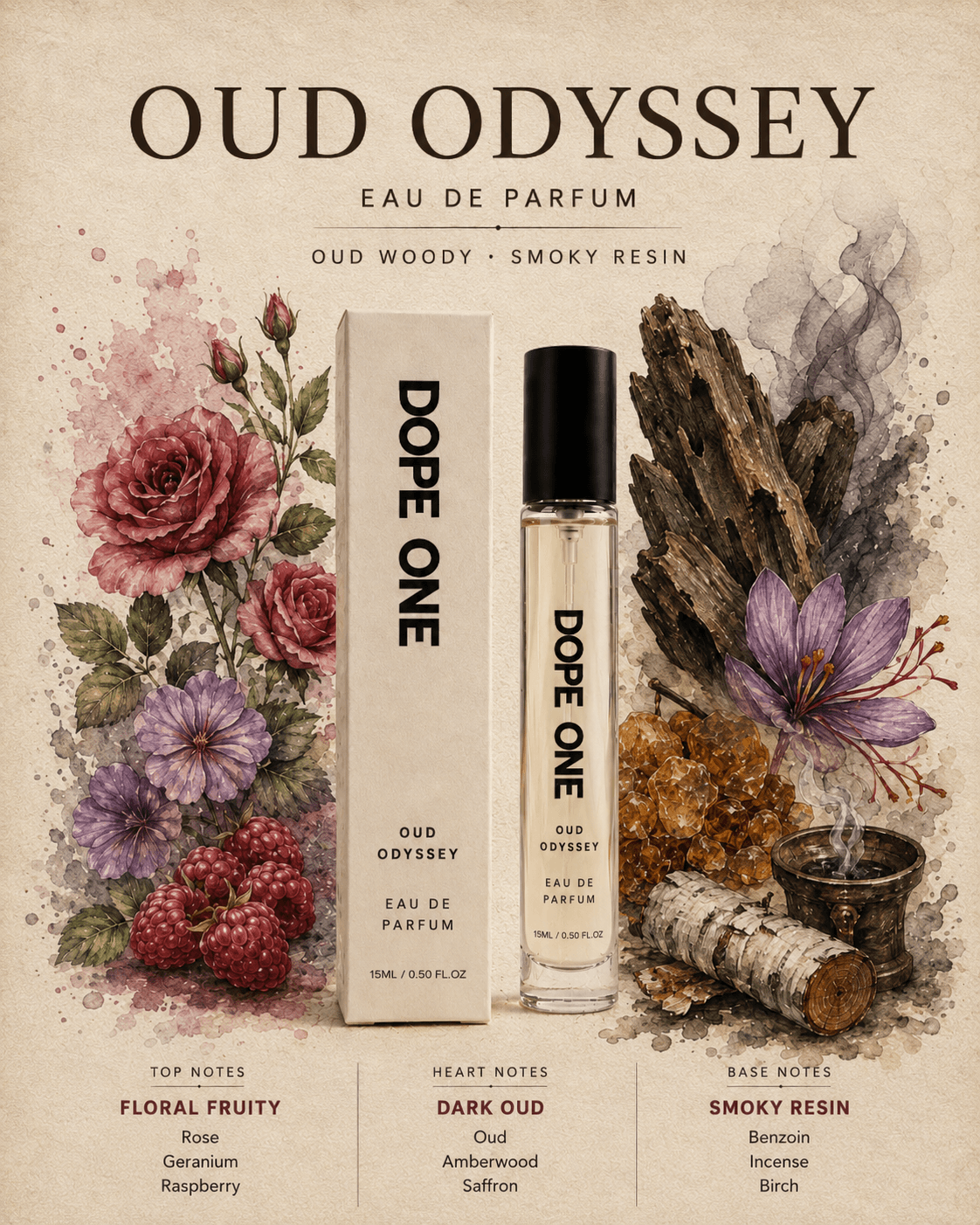
OUD ODYSSEY
Dark oud-rose core with benzoin and incense in the base, not a myrrh fragrance.
₹419
View →
Reactions split into exactly two camps: people who need to know what it is, and people startled that a fragrance can have this much character. Nobody ignores it. Next morning, the better question is what wasn't left on the collar.
The honest limitation: Oud Odyssey is a genuinely different resinous direction, not a myrrh substitute. If myrrh specifically is what you're after, the external picks above are the more honest answer than anything currently in the DOPE ONE lineup.
Myrrh in Perfumery: Quick Answers
A few of the most common questions people ask about myrrh as a fragrance note, answered directly below.
The Bottom Line on Myrrh
Myrrh in a bottle is the low hum underneath a composition, felt more than consciously noticed. That quiet role isn't a weakness, it's precisely why myrrh has been valued for thousands of years: a fixative that keeps everything else around it alive longer.
Common questions
- What does myrrh smell like in perfume?
- Warm, balsamic, and slightly medicinal with a dry, resinous depth that feels ancient and grounded rather than bright or sweet.
- Is myrrh perfume made from real myrrh resin?
- Often, yes, natural myrrh oil is distilled from Commiphora myrrha resin via steam or CO2 extraction, though modern perfumery also uses reconstructed accords for consistency since natural myrrh varies with climate and harvest.
- Why is myrrh used as a fixative in perfumery?
- Because it's unusually rich in sesquiterpenes, heavier, slow-evaporating compounds that extend how long other notes in a composition last on skin, rather than needing to be smelled prominently itself.
- Is myrrh the same as frankincense?
- No. They're different resins from different tree genera. Frankincense reads brighter and more citric-cathedral, while myrrh carries a darker, more medicinal, fixative-heavy depth, despite the two being constantly paired together.
- Does DOPE ONE have a fragrance close to myrrh?
- Not currently. None of the notes in the existing lineup genuinely include myrrh. Oud Odyssey is the closest resinous territory available, with benzoin and incense in its base, but it's not a myrrh substitute.
- What pairs well with myrrh in perfumery?
- Myrrh pairs naturally with oud and other deep, resinous woods, both of which share its slow, grounded character. It clashes with sharp, bright citrus notes.