Oud in Perfumery: The Wood That Owns the Room, From Indian Attars to Modern Niche
Transparency: we formulate DOPE ONE Oud Odyssey. Every fragrance here, including ours, is judged on the same criteria: Indian heat performance, fabric longevity, and fidelity to the original's character. Where ours falls short, we say so.
Before oud was a luxury fragrance note, it was a chip of infected wood burning on a charcoal disc in a Gulf majlis. Before it was Tom Ford's bestselling line, it was the smell of a Mumbai mosque during Ramadan. Before Western perfumery discovered it in the 2000s, Indian attar houses in Kannauj had been distilling agarwood for four hundred years.
Oud is not a trend. It is the oldest prestige fragrance material on earth, and the subcontinent, from Assam's agarwood plantations to Dubai's perfume souks, is its ancestral home. Western media covers oud as an exotic discovery. This article starts from where oud actually lives.
What Oud Actually Is
Oud is the dark, resin-saturated heartwood of Aquilaria trees infected by a specific mould, typically Phialophora parasitica. The tree, under attack, produces a dense aromatic resin as a defence mechanism. Over years, this resin transforms ordinary pale wood into dense, dark, fragrant agarwood. Without the infection, there is no oud. A healthy Aquilaria tree is just a tree.
The chemistry is sesquiterpenoid-heavy: agarofuran, agarospirol, dihydroagarofuran, and dozens of other compounds that form through the tree's stress response. Natural oud oil can contain over 150 identifiable molecules. Synthetic oud accords, what you smell in most designer fragrances, use a handful: typically a cypriol base, some variation of kephalis or ambrocenide for the woody-amber bite, and trace quantities of cresols or guaiacol for the animalic edge. The accord costs roughly 1/100th of the real oil and can be made to smell however the perfumer wants: medicinal, leathery, smoky, barnyard, or clean.
Real oud oil costs ₹15,000 to ₹50,000 per tola (roughly 12ml) for mid-grade Indian agarwood. The highest-grade sinking-grade oud from wild Aquilaria trees in Assam can exceed ₹2,00,000 per tola. Synthetic oud accord: roughly ₹150-300 for the equivalent aromatic impact. Most people have never smelled real oud. What they know as "oud" is the accord, and that is not a problem unless someone is charging them oud-oil prices for it.
Oud is the friend who walks into the party and does not need to say a word. Rose whispers. Citrus shakes hands. Oud simply occupies the room, dark, assured, completely convinced of its own presence. If vanilla is a hug and cardamom is a nod across the table, oud is the person in the corner you keep glancing at, wondering what they know.
Where Oud Comes From, and How It Found the West
The Aquilaria tree grows across Southeast Asia and the northeastern Indian subcontinent: Assam, Manipur, Tripura, Bangladesh, Myanmar, Thailand, Vietnam, Cambodia, and parts of Indonesia. Indian agarwood, called agaru in Sanskrit, has been documented in Ayurvedic texts for over 3,000 years, used as incense, medicine, and perfume. The Arthashastra (circa 300 BCE) lists agaru among the most valuable aromatic commodities in the Mauryan empire.
By the 8th century, Arab traders had established the oud route from Assam through the Gulf to Baghdad and Damascus. The Hindi wordagar became oud in Arabic. The Gulf's majlis culture, burning agarwood chips to perfume guests' clothing, turned oud into a hospitality ritual. By the 1600s, Kannauj's attar distilleries were producing oud-based attars for Mughal courts. This is the prehistory that Western fragrance marketing skips entirely: oud did not debut in a Tom Ford bottle. It travelled on Arab dhows from Kochi to Muscat six centuries before a single Parisian perfumer knew what to do with it.
The Western perfume industry discovered oud properly in the late 1990s. YSL M7 (2002, perfumer: Jacques Cavallier) was the first major Western designer oud, it flopped commercially but became a cult reference. Tom Ford Oud Wood (2007) made oud accessible to the American and European male consumer: clean, smoky, minimal barnyard. By 2012, every major niche house had an oud. By 2020, oud was so saturated as a marketing term that "oud" on a bottle meant nothing about what was inside it.
Today, most oud in commercial perfumery is synthetic, and that is not a secret. The synthetic oud accord is a legitimate perfumery tool that gives perfumers control over the oud profile and allows them to create oud fragrances at ₹3,000 instead of ₹30,000. The question is not "is this real oud." The question is "does this smell good, and was the price honest about what it is."
How Many Types of Oud Are There?
There is no single official count because oud is not classified on one axis. Agarwood is sorted along three separate systems at once: where it grew, how the infection was triggered, and how much resin soaked into the wood. Any real answer to "how many types" has to cover all three.
By region: Indian oud (called Hindi oud in the trade, mostly from Assam, Manipur, and Tripura) is heavier, darker, and more animalic than most. Cambodian oud, from Trat and Koh Kong provinces, is sweeter and more balanced, often considered the most versatile for perfumery. Vietnamese oud carries the rarest and most expensive grade in the world, Kyara (sometimes spelled Kynam), prized for a smooth, almost creamy sweetness and commanding some of the highest prices of any natural perfumery material on earth. Malaysian and Indonesian oud, from Kalimantan and Papua, tend to run sharper and more medicinal. None of these is "the real oud." They are five different regional dialects of the same infected wood.
By cultivation: Wild agarwood comes from trees that caught the mould infection naturally in the forest, over years or decades, with no human intervention. It is scarce, largely CITES-restricted, and commands the highest prices. Cultivated (inoculated) agarwood comes from plantation trees deliberately infected by growers, usually with a fungal or chemical trigger, to speed up resin formation. Almost everything sold commercially today, including most of what reaches Indian and Gulf markets, is cultivated. Wild oud is closer to a museum piece than a shopping option.
By grade: Within any region or cultivation method, agarwood is further graded by how much resin has saturated the wood, usually into four to six bands depending on the trader: low-resin chips that barely register on a warm hand, mid-grade wood used for most incense and oil distillation, and the rare sinking-grade agarwood, so dense with resin it sinks in water, reserved for the most expensive oils and attars. A single tree can yield chips across several grades depending on which part of the trunk the resin reached.
So the honest count: five major producing regions, two cultivation methods, and roughly four to six resin grades, multiplying out to dozens of named "types" in the trade, none of which map cleanly onto what is inside a bottle of Tom Ford Oud Wood or LV Ombre Nomade. Commercial perfumery mostly skips this entire taxonomy and works from a synthetic accord instead, which is the subject of the alternatives below.
If Oud Is Too Much
Oud's animalic-barnyard dimension, the thing that makes some wearers feel like they are wearing something ancient and powerful, is exactly what makes other people feel like they smell like a stable. If you want oud's darkness and presence without that edge, here is what does a similar job.
| Alternative | What You Get | What You Lose |
|---|---|---|
| Cypriol (Nagarmotha) | Dark, earthy, smoky, oud's shadow without the animalic dimension. A fraction of the cost. | Less complexity, less gravitas |
| Patchouli (aged) | Dark, camphoraceous, woody. Aged patchouli carries real depth and presence. | Recognisably patchouli, not oud |
| Birch Tar | Smoky, leathery, intense, the "Russian leather" oud alternative. Sharp, assertive. | No sweetness, no resinous body |
| Vetiver (Haitian) | Earthy, rooty, grounded, oud's sibling who prefers soil to smoke. | Lighter, less commanding |
How Oud Behaves Through the Day
Oud is a base note. It does not open, it arrives. The first spray might be sharp, medicinal, even off-putting. That is not oud's fault. That is the top-note accompaniment rushing ahead of the oud itself, which takes fifteen to thirty minutes to settle into its actual character. Once it does, oud is the slowest-moving note in perfumery. It does not evolve so much as it deepens, hour by hour, like wood darkening with age.
| Season | What Oud Does | Verdict |
|---|---|---|
| Summer (35–45°C) | Animalic dimension amplifies significantly. Oud becomes louder, darker, more assertive. One spray reads like two. Projection doubles in peak heat. | Evening only. Indoor. AC environments. One spray maximum at 40°C. |
| Monsoon (80%+ RH) | Humidity softens the animalic edge. Oud becomes rounder, more resinous, less sharp. Best performance for rose-oud pairings, the damp air carries both notes further. | Excellent. Oud's best Indian season. |
| Winter (5–20°C) | Oud tightens. Less projection, closer to the skin, more intimate. The darkness is still there but it stays within a one-foot radius. Fabric longevity can exceed 24 hours. | Strong. Different character, intimate, not projecting. |
Longevity on Indian fabric: 12 to 18+ hours, sometimes into the next day. Oud is nearly impossible to wash out of cotton. If you spray it on a kurta collar, that collar will smell like oud until you dry-clean it. This is either a feature or a warning, depending on how you feel about commitment.
Oud's Real Home
If you grew up in India, you smelled oud before you knew it had a name. In the agarbatti your grandmother lit during evening puja, that dark, smoky, resinous base note under the sandalwood and florals was agarwood powder. In the dhoop at a Gurudwara, thick and meditative. In the perfumed handkerchief your uncle brought back from a Dubai business trip, the smell that lasted through three washes and still lingered at the edges. In the attar shop in Old Delhi's Chandni Chowk, where the shopkeeper dripped something dark and viscous from a glass bottle onto your wrist and you walked around for the rest of the day feeling like you had been initiated into something.
India's connection to oud is older than France's connection to perfumery itself. The agarwood forests of Assam and the Northeast are the source of some of the finest oud in the world, not a recent plantation investment, but a trade that predates the Mughals. Kannauj's attar distilleries have been producing oud attars since at least the 1600s, using the traditional deg-bhapkamethod: copper stills, cow-dung fires, slow condensation over sandalwood base oil. The result is an oud that smells nothing like a French niche fragrance, heavier, more monolithic, completely unapologetic.
The irony: India produces some of the world's best oud. Gulf buyers have known this for centuries. But the Indian consumer often discovers oud through a Western brand, Tom Ford, LV, or a Dubai duty-free impulse purchase. The oud that grew up in their own backyard was never marketed to them as something desirable. It was just agarbatti. It was just the attar their father wore on Fridays. The shift from "this is what temples smell like" to "this is what wealth smells like" happened through Western marketing, not through Indian brands telling their own story.
There is also the Gulf-to-India oud pipeline that no Western article covers. Ajmal Perfumes, founded in Assam, headquartered in Dubai, is possibly the world's largest oud fragrance brand. Indian consumers buy Ajmal oud perfumes in quantities that would make a French niche house's sales director weep. But Ajmal does not get name-checked in Allure or Vogue. The oud conversation, as far as Western media is concerned, starts with Tom Ford and ends with Maison Francis Kurkdjian. India knows better. It always has.
Who Oud Is For, and Who It Is Really Not
Oud attracts the wearer who wants presence without performance. Not someone trying to get compliments, oud gets a different reaction: respect. It is the note for someone who is okay with smelling intimidating. For the person who wants their fragrance to say "I am here" rather than "do you like me."
The people who do not get along with oud usually have one of two complaints. The first is the barnyard, the animalic dimension that some noses read as stable, faecal, or medicinal. They are not wrong. Real oud, especially Hindi-style oud from Assam, has a fermented quality that Western noses often find challenging. The second complaint is simply that oud is too much. It fills a room. It announces itself. If you want to smell clean, fresh, and approachable, oud is the wrong tool for the job, and no amount of "but it dries down beautifully" will fix the fact that the first hour is a confrontation.
In Indian heat, oud's polarising factor multiplies. At 25°C, oud is dark and interesting. At 40°C, oud is a weapon. The barnyard note amplifies, the projection doubles, and what was "assertive" in an air-conditioned room becomes "aggressive" on a humid street. Oud is a winter and monsoon note in India. Summer oud requires one spray maximum, indoors only, and the self-awareness to understand that you are making a statement whether you meant to or not.
What Oud Plays Well With, and What It Overpowers
Oud's defining trait as a perfumery material is that it makes everything around it sit down and be quiet. It is not a team player in the conventional sense, oud does not blend, it leads. The successful oud pairings are the ones where the partner note has enough personality to hold its own.
Rose and oud is the classic, the pairing that defines an entire fragrance subgenre. Rose brings brightness and floral lift; oud brings darkness and weight. Together they create a tension that neither achieves alone. LV Ombre Nomade is the modern reference for this architecture.
Oud and saffron is the Gulf combination, warm spice meeting dark resin. Saffron's leathery, slightly medicinal quality does not compete with oud; it echoes it. The result is layered and complex without shouting. Ajmal's bestseller catalog is built on this pairing.
Oud and benzoin is the soft landing, benzoin's vanilla-like sweetness rounds out oud's sharp edges without neutralising its character. The result is oud that your office can tolerate. If you find oud intimidating, start with oud-benzoin compositions. Our benzoin guide explores this pairing in detail. That resin-and-warmth register more broadly is the oriental family, worth its own dedicated buyer's roundup.
What oud overpowers: light citruses, delicate white florals, clean aquatics, and anything described as "fresh." Oud is not interested in sharing the stage with something it can crush in the first ten minutes.
Five Oud Fragrances Worth Wearing
| Fragrance | Oud's Role | Price Band (India) | Heat Performance | Best For |
|---|---|---|---|---|
| LV Ombre Nomade | Rose-oud architecture. Dark, smoky, enormous projection. The modern reference standard. | ₹35,000–38,000 | Loud in heat. Evening and AC only at 35°C+. Monsoon is its ideal season. | Evening, winter, monsoon. Making an entrance. |
| Tom Ford Oud Wood | Clean synthetic oud, the gateway. Minimal barnyard. Approachable, woody, warm. | ₹17,500–23,000 | Lighter concentration fades faster in humidity. Reapply at the 4-hour mark. | Office, daytime, first oud purchase. |
| Ajmal Amir One | Saffron-oud, Gulf-style. Rich, layered, unmistakably Middle Eastern. Long-lasting. | ₹11,000–15,000 | Built for Gulf heat. Handles Indian summers better than most Western ouds. | Indian weddings, festive occasions, year-round evening. |
| MFK Oud Satin Mood | Rose-oud-vanilla. Sweet, velvety, gourmand oud. The softest entry point. | ₹24,000–26,000 | Vanilla warmth amplifies in heat. Can become cloying above 35°C. | Date night, winter, indoor occasions. |
| DOPE ONE Oud Odyssey | Rose-oud, sourced and blended to hold projection at 38°C where the reference architecture compresses. | ₹419 (15ml) / ₹1,319 (50ml) | Built for 38°C. Oud's darkness balanced for Indian evenings without over-projecting. | Indian evenings, monsoon, winter, year-round statement wear. |
Oud Odyssey: Rose-Oud, Calibrated for India
LV Ombre Nomade is the reference rose-oud. It is also built for European weather: spray it at a Delhi wedding in July and the projection becomes a public announcement. At DOPE ONE, we source oud and rose materials from established international suppliers, chosen for market reputation rather than price, and asked a simpler question of the blend itself: could the same rose-oud pairing project without shouting, its darkness holding shape at 38°C instead of swelling into aggression?
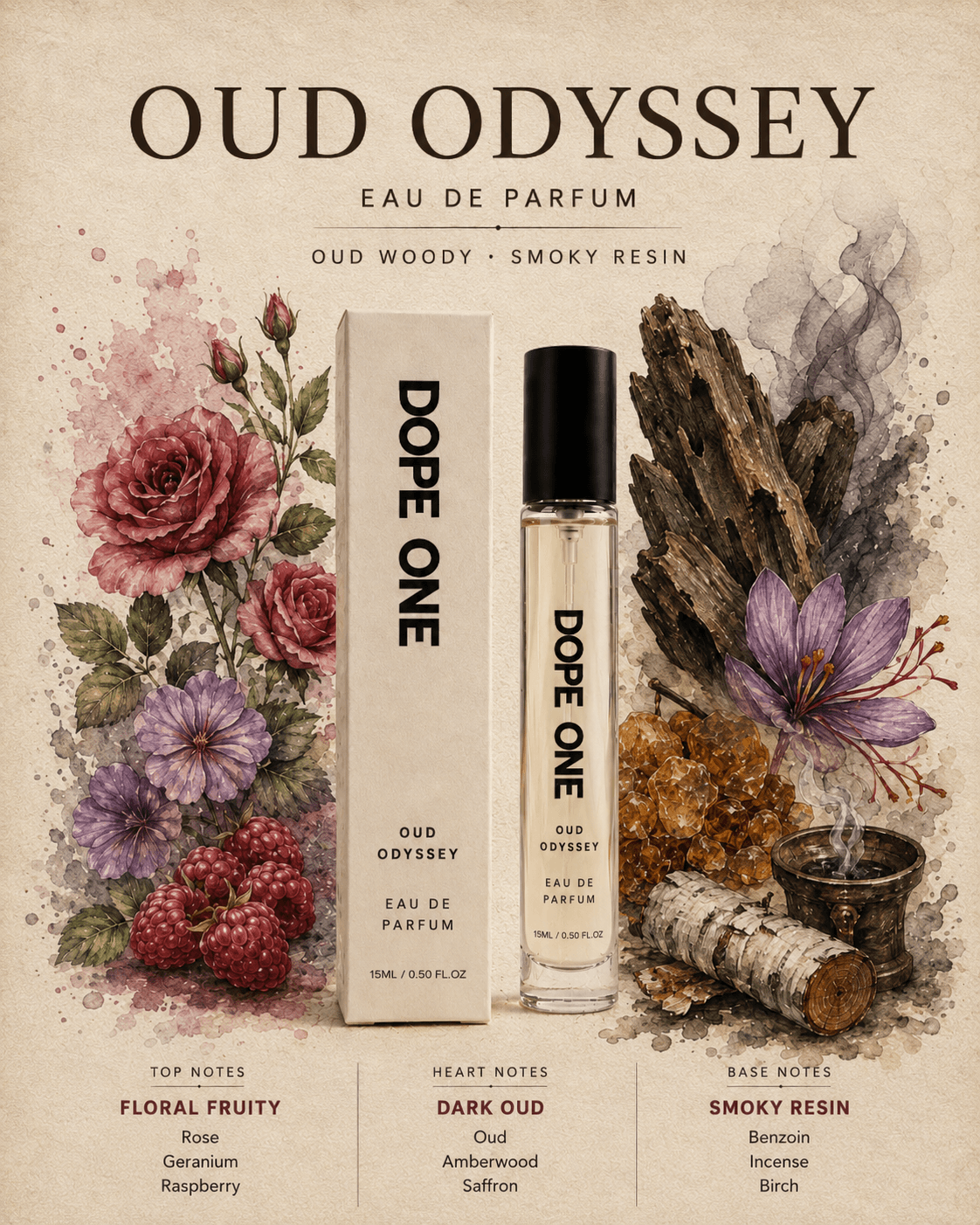
Oud Odyssey
Rose-oud, sourced and blended for Indian subtropical heat.
₹419
View →
Getting the blend right took several iterations. Early versions were either too aggressive, the oud dominated and the rose vanished by hour two, or too polite, losing the gravitas that makes oud worth wearing in the first place. The version that shipped is calibrated for Indian evenings: rose and oud arriving at the same time, neither pushing the other out, the projection holding at arm's length instead of filling the entire banquet hall.
Reactions split into exactly two camps: people who need to know what it is, and people startled that a fragrance can have this much character. Nobody ignores it. Next morning, the better question is what wasn't left on the collar.
Oud Odyssey is not a summer-afternoon fragrance and will not pretend to be. Evenings, monsoons, winter, that is its territory. For the wearer who wants oud's presence without oud's aggression in Indian heat, this is the answer we arrived at.
Oud Odyssey is ₹419 for 15ml, ₹1,319 for 50ml. No further argument.
Common Questions About Oud in Perfumery
What is oud and why is it so expensive?
Oud is the resinous heartwood of Aquilaria trees infected by a specific mould. The infection triggers the tree to produce a dark, aromatic resin as a defence mechanism. This process takes years, sometimes decades. Wild oud from old-growth trees is exceptionally rare, most Aquilaria species are CITES-protected and wild harvesting is restricted. Real oud oil costs ₹15,000 to ₹2,00,000 per tola depending on grade. Most oud in commercial fragrances is a synthetic accord at roughly 1/100th the cost.
How many types of oud are there?
Oud splits along three axes rather than one number: five major producing regions (Indian, Cambodian, Vietnamese, Malaysian, Indonesian), two cultivation methods (wild and plantation-inoculated), and roughly four to six resin grades within each. The rarest and most expensive is Vietnamese Kyara. The most common in Indian and Gulf markets is cultivated Cambodian or Hindi oud, mid-grade.
What does oud smell like?
Real oud is dark, woody, resinous, and slightly animalic. Think: damp forest floor, old leather, smouldering agarwood chips, a hint of something almost medicinal. Synthetic oud accords can range from clean and woody (Tom Ford Oud Wood) to smoky and intense (LV Ombre Nomade) to sweet and velvety (MFK Oud Satin Mood). There is no single "oud smell", it depends entirely on the source material and the accord construction.
Is oud in designer fragrances real?
Almost never, and that is not a secret. Most designer and niche oud fragrances use synthetic oud accords. Real oud oil at the concentrations used in a commercial EDP would push the retail price past ₹50,000. The synthetic accord is a legitimate perfumery tool that allows oud fragrances to exist at accessible prices. The thing to watch for: brands charging oud-oil prices for what is clearly an accord. Price should be honest about what is inside the bottle.
Which is the best oud perfume for men in India?
Tom Ford Oud Wood is the gateway, clean, accessible, office-safe. LV Ombre Nomade is the performance reference, enormous projection but expensive and loud in Indian heat. Ajmal Amir One is built for Gulf heat and handles Indian summers better than most Western ouds. For Indian subtropical conditions specifically, DOPE ONE Oud Odyssey pairs rose with oud, sourced and blended to hold its structure at 38°C without over-projecting.
Is oud perfume good for Indian summer?
Oud is challenging in peak Indian summer. At 35°C and above, oud's animalic dimension amplifies significantly, one spray can read like two, and the projection can become aggressive. Evenings and air-conditioned environments are wearable. Monsoon is oud's best Indian season: humidity softens the sharp edges and carries the darker notes further without over-projecting. Winter is strong but more intimate. If you want a year-round oud, choose a composition with lighter synthetic accords (like Tom Ford Oud Wood) and apply sparingly in summer.
The Note That Arrives and Stays
Oud is not a note you choose casually. It is a commitment, to darkness, to presence, to smelling like something that cannot be ignored. India has grown it, traded it, burned it, and worn it for three millennia. Western perfumery discovered it thirty years ago and built an entire luxury category around it. The best oud fragrances today, whether a ₹36,000 Louis Vuitton or a DOPE ONE bottle sourced and blended for 38°C, are not improving on oud. They are just giving an ancient material a modern architecture.
The oud that grew in Assam was always enough. It just took the world a few thousand years to notice.
Common questions
- What is oud and why is it so expensive?
- Oud is the resinous heartwood of Aquilaria trees infected by a specific mould. The infection triggers production of a dark, aromatic resin over years or decades. Real oud oil costs ₹15,000 to ₹2,00,000 per tola. Most commercial oud fragrances use synthetic accords at roughly 1/100th the cost.
- How many types of oud are there?
- Oud splits along three axes: five major producing regions (Indian, Cambodian, Vietnamese, Malaysian, Indonesian), two cultivation methods (wild and plantation-inoculated), and four to six resin grades within each. Vietnamese Kyara is the rarest and most expensive; cultivated Cambodian or Hindi oud at mid-grade is the most common in Indian and Gulf markets.
- What does oud smell like?
- Real oud is dark, woody, resinous, and slightly animalic, like damp forest floor, old leather, and smouldering agarwood. Synthetic accords range from clean and woody (Tom Ford Oud Wood) to smoky and intense (LV Ombre Nomade) to sweet and velvety (MFK Oud Satin Mood). There is no single oud smell.
- Is oud in designer fragrances real?
- Almost never, and that is not secret. Most designer and niche oud fragrances use synthetic accords. Real oud at EDP concentrations would push retail past ₹50,000. The synthetic accord is legitimate. What matters is whether the price is honest about what is inside the bottle.
- Which is the best oud perfume for men in India?
- Tom Ford Oud Wood is the accessible gateway. LV Ombre Nomade is the performance reference but loud in Indian heat. Ajmal Amir One handles Indian summers better than most Western ouds. DOPE ONE Oud Odyssey pairs rose with oud, sourced and blended for Indian subtropical conditions.
- Is oud perfume good for Indian summer?
- Oud amplifies in peak Indian summer, one spray reads like two, and the animalic edge becomes aggressive. Evenings and AC environments are wearable. Monsoon is oud's best Indian season. Winter is strong but intimate. For year-round oud, choose lighter synthetic accords and apply sparingly in summer.