Frankincense in Perfumery: The Resin That Smells Different Depending on Where It Grew
Transparency: we formulate DOPE ONE I AM A JIN. Every fragrance here, including ours, is judged on the same criteria: Indian heat performance, fabric longevity, and fidelity to the original's character. Where ours falls short, we say so.
Frankincense smells like church incense to most people, but that's only one version of it. The same resin, harvested from a different Boswellia species in a different country, can smell as bright and citrusy as an orange peel, and mixing up which one you're getting is why "frankincense perfume" means such wildly different things to different people.
What Frankincense Is and the Vibe It Carries
The Chemistry
Frankincense, also called olibanum, is a resin tapped from Boswellia trees. Different species produce genuinely different profiles: Somalian and Omani resin (Boswellia sacra, sometimes labeled carterii) is prized for a bright, lemony, piney top; Indian resin (Boswellia serrata) leans greener and more balsamic.
Key aromatic compounds include alpha-pinene and limonene, the bright, citrusy-piney facets, and incensole acetate, the warm, balsamic dry-down. Extraction is via steam distillation of the hardened resin tears, or CO2 extraction for a richer, more complete profile. There's no unusual IFRA restriction on frankincense or olibanum oil at standard use levels, so the real perfumer's choice is which origin and extraction method suits the composition.
The General Perception
Resinous, warm, quietly sacred, capable of reading bright and citrusy or deep and smoky depending on the source. If frankincense were a place, it would be a dim, incense-warmed room with a shaft of bright light cutting through it.
Where Frankincense Comes From and How It Earned Its Place
Sourcing
Somalia, Oman, and Yemen are the classic sources of Boswellia sacra resin, prized for centuries and historically traded along the same incense routes referenced in ancient texts. India has its own native frankincense tree, Boswellia serrata, commonly called salai or Indian frankincense, found across central India. Naturals here vary meaningfully in quality by harvest and grading, tears are graded by size, colour, and purity, which is part of why frankincense fragrances range so widely in price and character.
IFRA Reality
No standout restriction on olibanum oil at standard fragrance-industry use levels. The creative constraint is origin and dosage: too little and it reads as a vague, generic spice, too much can tip into a literal candle-smoke effect.
How It Found Its Place in Perfumery
Frankincense has been burned and worn for millennia, referenced in ancient religious and trade texts long before modern perfumery existed. In fine fragrance, it became a signature base note for incense-chypre and oriental compositions built around a resinous, smoky heart, though it's just as often used the way I AM A JIN uses it, as one supporting layer of complexity in a bright, modern citrus-tea composition rather than the headline note.
Alternatives, If Frankincense Isn't for You
| Alternative | What You Get | What You Lose | Best When... |
|---|---|---|---|
| Myrrh | A darker, more medicinal, slightly bitter resin character | Frankincense's brighter, citrus-adjacent lift | You want a heavier, more solemn resin |
| Benzoin | A sweeter, vanilla-like resin warmth | Frankincense's dry, piney complexity | You want resinous sweetness over dry incense character |
| Labdanum | A leathery, ambery resin depth | Frankincense's lighter, more lifted top | You want a darker, more animalic resin |
| Guaiac wood | A dry, smoky wood character without true resin | Frankincense's actual resinous, tear-like texture | You want smoke and dryness without a religious/incense association |
None of these are frankincense. That's the point.
How Frankincense Behaves Through the Wear
Dry-Down Behavior
Frankincense typically sits in the base, sometimes bridging from the heart if the extract is lighter and brighter. As a composition dries down, the citrusy top facets from Somalian or Omani resin fade first, leaving the deeper, balsamic core behind. Indian resin's greener, balsamic character is present from the start and simply deepens over time rather than shifting dramatically.
Weather Performance in Indian Climate
| Season | What Frankincense Does | Verdict |
|---|---|---|
| Summer (35-45°C) | The resinous base holds its shape in heat, though brighter citrus-forward frankincense types can feel more welcome than heavier, smokier ones | Wearable, lighter frankincense types preferred |
| Monsoon (80%+ humidity) | Humidity can deepen frankincense's balsamic weight, making heavier types feel heavier still | Wearable in moderation, lighter types hold up better |
| Winter (5-20°C) | Cool air lets frankincense's warm, resinous character sit close to the skin and read at its most complex | Ideal, especially for deeper, more balsamic frankincense compositions |
The Indian Perspective on Frankincense
The Cultural Anchor
India has its own genuine frankincense tradition. Boswellia serrata, known as salai or Indian frankincense, grows across central India and has been used for centuries, independent of the Somalian or Omani resin most Western perfumery history references.
Traditional Use
In Ayurveda, Boswellia serrata resin, sometimes called shallaki, is used medicinally, particularly for joint and inflammatory conditions, and the resin is also burned as dhoop in Hindu temple worship and daily household ritual. Unlike sandalwood, which has an equally strong perfumery tradition, frankincense's Indian identity has stayed more medicinal and devotional than aromatic-commercial.
The Modern Indian Context
Indian niche fragrance houses tend to use frankincense as a supporting resinous base note in oriental or gourmand compositions rather than a headline note, and most Indian noses associate its smell with temple dhoop and havan smoke well before they associate it with perfume.
Who Loves Frankincense, and Who Doesn't
Why People Love It
- Reads warm, complex, and quietly sacred without being sweet or loud
- The origin split gives it real range, from bright and citrusy to deep and smoky, depending on the source
- Deeply familiar to Indian noses through temple dhoop and havan, giving it an unusually strong scent memory for a niche note
- Ages well in a composition, deepening rather than souring over time
Why They Won't
- Can read as too closely tied to religious or funerary associations for some wearers, making it feel heavy rather than elegant
- Lower-quality synthetic versions can smell flat, smoky, or medicinal rather than genuinely resinous
- Some wearers find any incense note overwhelming regardless of quality
- The origin distinction is invisible on most labels, so buyers often can't predict which version they're getting
The honest trade-off: frankincense rewards someone who wants a genuinely complex, resinous base note with real historical weight, but only if they know enough to seek out the origin and quality that suits them, since the label rarely tells you which.
Pairings, Clashes and Real Fragrance Picks
What Frankincense Pairs With
Frankincense pairs naturally with oud, both dense, complex base notes that reinforce a composition's depth, and with myrrh, a classic paired-resin combination going back millennia. It clashes with light, fresh aquatic notes, where frankincense's resinous weight can feel mismatched against something meant to feel clean and airy.
Both resins have their own guides, the myrrh one for the warmer, balsamic sibling and the incense one for the broader smoke category frankincense usually stands in for.
Real Fragrance Recommendations
| Fragrance | Frankincense's Role | Price Band (India, approx.) | Heat Performance | Best For |
|---|---|---|---|---|
| Amouage Fate | Frankincense anchors a dense, resinous oriental composition | ~₹18,000-24,000/100ml | Heavy and resinous; better suited to cooler months in Indian heat | Anyone wanting frankincense as an unapologetic centerpiece |
| Comme des Garçons Avignon | An iconic, near-literal "church incense" frankincense composition | ~₹9,000-12,000/50ml | Smoky and resinous; holds its shape but reads heavy in peak summer | Fans of frankincense's purest, most devotional interpretation |
| Armani Privé Bois d'Encens | Frankincense paired with dry woods for an elegant, restrained incense accord | ~₹28,000-32,000/100ml | More restrained than Avignon, wears reasonably well through heat | Anyone wanting frankincense with a lighter, more polished touch |
| Les Couvent des Minimes Eau de Missions | An accessible, budget-tier frankincense-forward eau built around church and monastery associations | ~₹2,500-4,000/100ml | Lighter concentration, wears easily even in warm weather | Anyone wanting an affordable entry into frankincense fragrances |
| DOPE ONE I AM A JIN | Olibanum adds elegant, resinous complexity beneath a bright citrus-tea top | ₹419 (15ml) / ₹1,319 (50ml) | The bright citrus top carries the fragrance through Indian heat while the olibanum base keeps it from feeling thin | Anyone who wants frankincense as a supporting note, not a heavy centerpiece |
Where DOPE ONE Uses Frankincense
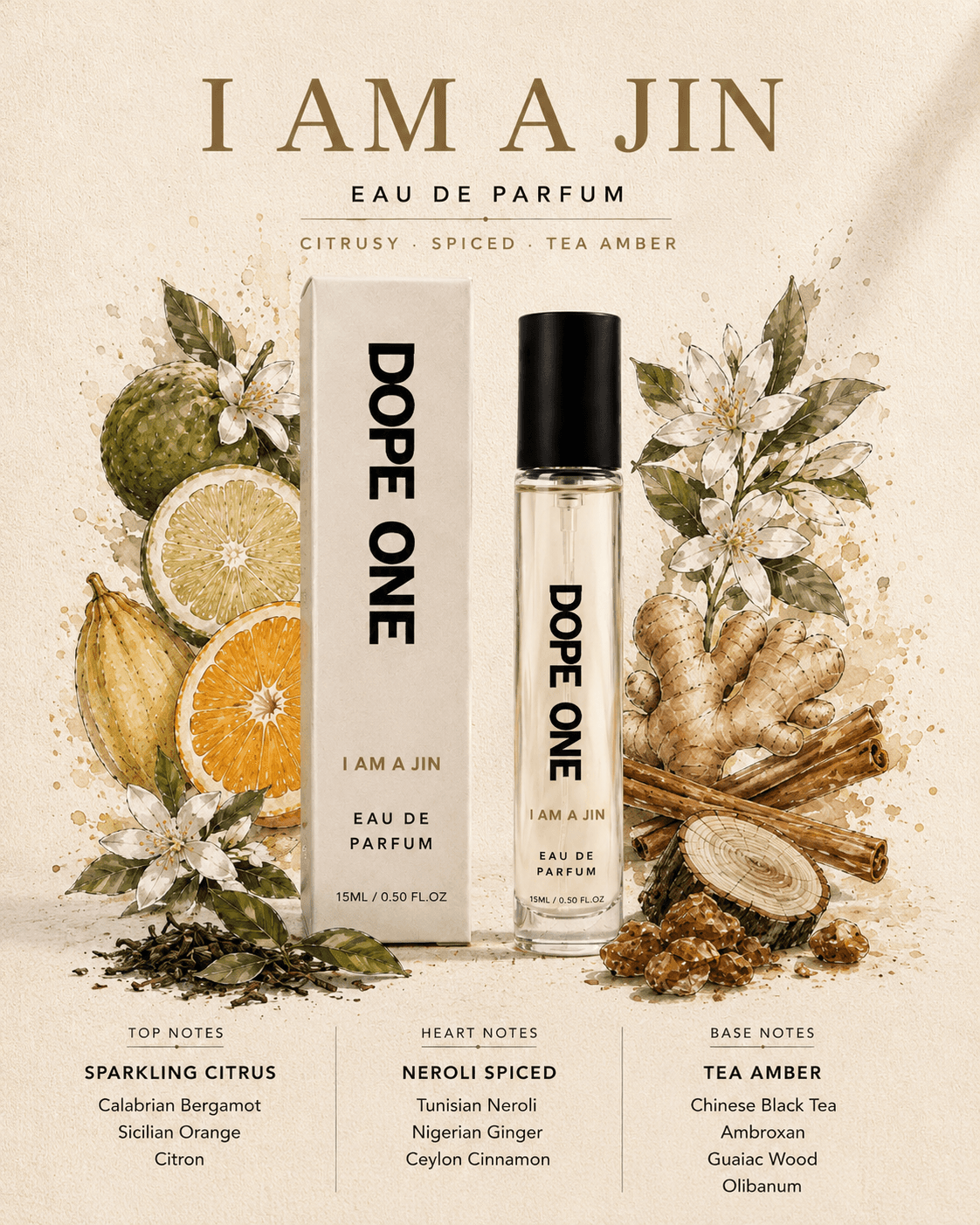
I AM A JIN
Sparkling citrus, neroli, ginger-spice, and black-tea guaiac-wood depth.
₹419
View →
Nobody in India compliments a fragrance. They register it — a second glance, a face that changes as you pass. I've stopped waiting for the sentence and learned to read the pause. By dinner this sits on the skin; next morning it's still on yesterday's tee when I pull it on.
The honest limitation: this isn't a gym fragrance, that's its own register with its own dedicated picks. If you'll be sweating hard ten minutes after spraying, buy for that job, this one is built for arriving at a desk smelling put-together, with the olibanum working quietly underneath, not announcing itself, closer to the office-wear brief than anything sweat-facing.
Frankincense in Perfumery: Quick Answers
A few of the most common questions people ask about frankincense as a fragrance note, answered directly below.
The Bottom Line on Frankincense
Frankincense isn't one note, it's a resin whose character shifts with where it grew, bright and citrusy from Somalia and Oman, greener and more balsamic from India. Knowing that split tells you more about whether you'll like a "frankincense perfume" than the word itself ever could. In I AM A JIN, it's a quiet layer of complexity, not the headline.
Common questions
- What does frankincense smell like in perfume?
- Frankincense in perfume can smell two different ways depending on origin. Somalian and Omani resin reads bright, lemony, and piney. Indian resin (Boswellia serrata) leans greener and more balsamic. Both share a warm, resinous, quietly sacred quality at their core.
- Is frankincense a top note or a base note?
- Frankincense typically sits in the base, though lighter, brighter extracts can bridge from the heart. It usually persists through the dry-down, with the citrusy top facets fading first and a deeper, balsamic core remaining.
- What's the difference between Somalian and Indian frankincense?
- Somalian and Omani frankincense comes from Boswellia sacra and is prized for a bright, lemony, piney profile. Indian frankincense comes from Boswellia serrata, native to central India, and leans greener and more balsamic. Most fragrance labels don't specify which one is used.
- What are the best frankincense perfumes?
- Amouage Fate and Comme des Garçons Avignon lean into frankincense as a dense, unapologetic centerpiece. Armani Privé Bois d'Encens offers a more restrained, elegant take. Les Couvent des Minimes Eau de Missions is a genuine budget-friendly entry point. Which is 'best' depends on how much frankincense intensity you want.
- Is frankincense perfume good for summer?
- Lighter, brighter frankincense compositions (citrus-forward or paired with tea and neroli) wear reasonably well in Indian summer. Heavier, smokier frankincense fragrances tend to feel more suited to cooler months, since the resinous weight can feel oppressive in peak heat.
- Does frankincense smell like incense?
- Frankincense resin is one of the most common materials burned as incense, so the association is genuine, not accidental. In perfume, though, frankincense is usually refined into an essential oil or extract, giving a cleaner, more wearable version of the same warm, resinous character rather than literal smoke.
Related guides
- Oud in Perfumery: The Wood That Owns the Room, From Indian Attars to Modern Niche
- Incense in Perfumery: The Note That Isn't Actually One Ingredient
- Best Perfume for the Gym in India: Fresh, Clean Scents Tested for Heat and Sweat
- Best Perfume for Office Wear in India: Restraint That Lasts the Workday
- Myrrh in Perfumery: The Resin That Isn't Meant to Be Noticed