Saffron in Perfumery: The Spice That Smells Nothing Like Your Kitchen
Transparency: we formulate DOPE ONE Oud Odyssey. Every fragrance here, including ours, is judged on the same criteria: Indian heat performance, fabric longevity, and fidelity to the original's character. Where ours falls short, we say so.
It takes roughly 150,000 crocus flowers to produce a single kilogram of dried saffron threads. The spice retails between two and four lakh rupees per kilogram in India. And most perfumes labelled "saffron" contain zero actual saffron. The molecule perfumers chase, safranal, is IFRA-restricted to 0.012% in a finished fragrance. What they use instead, and what it actually smells like on skin, is a different conversation from the one the marketing is having.
What Saffron Is and the Vibe It Carries
The Chemistry
Saffron comes from Crocus sativus, a member of the Iridaceae (iris) family. Only the three red stigmas of each flower are used. The plant does not reproduce from seed in cultivation; every field is planted corm by corm, by hand. Harvesting happens at dawn, before the sun degrades the aromatic compounds in the stigmas.
Natural saffron absolute is obtained through solvent extraction or supercritical CO2 extraction. The yield is negligible even by perfumery standards. The key odorant molecule is safranal (2,6,6-trimethyl-1,3-cyclohexadiene-1-carboxaldehyde), which produces the characteristic leathery, hay-like, slightly metallic profile that defines saffron in fragrance.
Synthetic alternatives dominate modern perfumery. Safraleine, a proprietary Givaudan molecule, delivers a saffron-leather accord without the regulatory constraints of natural safranal. Ethyl safranate provides a spicier, more fruity saffron facet. The cost difference is stark: natural saffron absolute runs approximately three to five lakh rupees per kilogram, while synthetic alternatives cost five to fifteen thousand for equivalent aromatic impact.
IFRA classifies safranal as a dermal sensitiser. Current restrictions cap it at 0.012% in fine fragrance (Category 4). In practical terms, a perfumer can still use natural saffron extract, but must calculate the safranal contribution precisely and often supplement with synthetics to reach the desired intensity without exceeding the limit.
The Vibe
Saffron in perfumery is the note that wears a suit to a kitchen. It is leathery, metallic, warm, and never sweet. If cardamom is the note that starts a conversation, saffron is the one that walks in after everyone is seated and says nothing. The room adjusts to it. There is a weight to saffron that has nothing to do with projection and everything to do with presence. It smells like someone who has been somewhere expensive and does not feel the need to mention it.
Where Saffron Comes From and How It Entered Perfumery
Sourcing
Iran produces over 90% of the world's saffron, primarily from the Khorasan province. Kashmir's Pampore valley produces saffron with the highest safranal concentration per thread, commands two to three times the Iranian price, and holds a GI (Geographical Indication) tag. Spain's La Mancha region, once a major producer, has declined significantly. Greece's Kozani cooperative remains a smaller but respected source.
For a perfumer, origin matters less than the extraction method. CO2 extraction preserves more of the volatile aromatics than traditional solvent methods. But at current prices, most formulators bypass naturals entirely. The economics of saffron in perfumery are the economics of substitution: use enough safranal-type synthetics to capture the character, reserve the natural for the marketing story, and build the rest with Safraleine or ethyl safranate.
IFRA Reality
The 0.012% restriction on safranal in fine fragrance is one of the tighter IFRA limits. For a 100ml bottle of eau de parfum at 20% concentration, the total safranal across the entire formula cannot exceed a fraction of a gram. This is why Safraleine exists. Givaudan engineered it specifically to deliver saffron character at higher concentrations without tripping the safranal limit. When a perfume lists "saffron" in its notes, what you are most likely smelling is Safraleine, ethyl safranate, or a custom accord, not threads from Pampore.
How Saffron Found Its Place in Perfumery
Saffron has been part of perfumery for far longer than its recent Western niche popularity suggests. Mughal courts used kesar in attar formulations alongside rose and sandalwood. Middle Eastern perfumery has paired saffron with oud and rose for centuries, a combination that remains the signature of Gulf fragrance culture.
The Western breakthrough came in two waves. Byredo released Black Saffron in 2012, stripping the note bare against leather and black violet. Then Maison Francis Kurkdjian's Baccarat Rouge 540 arrived in 2015 and changed the conversation entirely: its airy, metallic, ambroxan-saffron structure became arguably the most influential niche fragrance of the decade. Before BR540, saffron was a Gulf and attar ingredient. After it, saffron was a global talking point.
Alternatives: If Saffron Is Not for You
These serve similar functions with different characters. Each gives you part of what saffron does, but none gives you all of it.
| Alternative | What You Get | What You Lose | Best When... |
|---|---|---|---|
| Turmeric/curcumin accords | Earthy warmth, golden tone | The leathery bite, the metallic edge | You want warmth without the animalic suggestion |
| Hay absolute | Sweet, dry grassiness | The spicy-metallic complexity | You want the "dried" quality without the intensity |
| Leather accord (Suederal) | The soft suede side | The spice, the honeyed warmth | You want saffron's leathery facet isolated |
| Immortelle (Helichrysum) | Honeyed, curry-like warmth | The sharp metallic opening, the leather | You want something warmer and more forgiving |
None of these are saffron. That is the point.
How Saffron Evolves on Skin
Through the Wear
Saffron most commonly sits at the heart of a composition, but its metallic-spicy sharpness often reads as a top note in the opening. The first minutes are the most confrontational: a medicinal, slightly iodine-like bite that either hooks you or puts you off. Within twenty minutes, the hay-leather quality emerges. That is the saffron that stays.
The dry-down is warm, honeyed, and slightly animalic. Saffron does not fade so much as change register. In the opening it announces. By the third hour it inhabits. It threads through a composition rather than occupying a single position, which is why perfumers use it as a bridge between bright top notes and deep bases.
In heat, saffron does something unusual for a spice: the leathery side amplifies while the sweetness stays controlled. Body heat wakes saffron up instead of flattening it. Most spice notes go syrupy above 35 degrees Celsius. Saffron goes sharper, more metallic, more present.
Weather Performance in India
| Season | What Saffron Does | Verdict |
|---|---|---|
| Summer (35-45 degrees C) | Leathery facet amplifies; metallic edge sharpens. Does not collapse into sweetness like cardamom or cinnamon. Holds structure but projects harder. | Wearable evenings; potent daytime. Dose carefully. |
| Monsoon (80%+ RH) | Humidity softens the metallic bite. Hay-leather quality becomes more suede-like. Does not go cloying. | Wearable. One of saffron's better seasons in India. |
| Winter (5-20 degrees C) | Sits closer to skin. The full hay-leather-honey triad unfolds slowly. Needs body heat to project. | Ideal. Builds patiently. |
The Indian Perspective on Saffron
The Cultural Anchor
Kesar. The word itself carries weight in an Indian household. It is the spice that went into milk before a wedding, into tilak before a puja, into the small locked box in the kitchen that children were told not to touch. Every Indian nose knows saffron before they know they know it: from kesar doodh at bedtime, from the strand of colour in a kheer, from the packet of Kashmiri kesar their grandmother kept wrapped in cloth and foil. The challenge for Indian wearers is not recognising saffron in perfume. It is accepting that it smells nothing like the kitchen version.
Traditional Use
Ayurveda classifies saffron as a cooling herb despite its perceived warmth, used in kumkumadi tailam and other facial preparations for its complexion-enhancing properties. In temples, kesar-chandan paste (saffron and sandalwood) is applied during deity abhishekam. In Kannauj, the perfume capital of Uttar Pradesh, artisans have been distilling kesar attar into sandalwood oil using the deg-bhapka method for centuries. This is not a new ingredient in Indian perfumery. It is one of the oldest.
The Modern Indian Context
Kannauj attar houses still produce kesar attar, though volumes have declined as sandalwood costs have risen. Indian niche houses are experimenting with saffron-oud combinations, drawing on the same pairing that Gulf perfumery has used for generations. India sits at the intersection of two saffron-perfumery traditions: the Kannauj attar heritage and the Gulf oud-rose-saffron school. For an Indian consumer, saffron in perfume is not exotic. It is familiar from two directions at once.
Who Loves Saffron and Who Does Not
Why People Love It
First, the "expensive" quality. Saffron reads as luxury without decoration. There is no sweetness to soften it, no freshness to lighten it. It simply smells costly. Second, the heat performance. Where most spice notes collapse into syrup above 35 degrees, saffron holds its structure and sharpens. Third, the complexity. Saffron shifts from metallic to honeyed to suede through a single wear, giving the wearer a fragrance that evolves rather than fading. Fourth, cultural familiarity. For Indian and Middle Eastern noses, saffron is a known quantity. It does not need explaining.
Why They Will Not
The medicinal opening is the first barrier. Saffron's initial minutes carry an iodine-like, almost antiseptic quality that reads as unpleasant to noses expecting something sweet or floral. The food association is the second: the name "saffron" triggers "biryani" for many Indian wearers, even though the perfumery note shares almost no character with the cooked spice. The intensity is the third. Saffron is not a background note. It does not blend in, and some people want invisible. And finally, the price. Genuine saffron-forward fragrances tend to sit in the niche bracket, and the cheaper alternatives are often synthetic approximations that miss the leather-metallic complexity entirely.
The Honest Trade-Off
Saffron is not a note for blending in. If you wear it, someone will register it. Whether that is a selling point or a problem depends entirely on you.
What Saffron Pairs With, What It Clashes With, and What to Try
The Interlinking Wheel
Saffron's strongest pairing is oud. The combination is the foundation of Gulf fragrance culture: saffron's leathery metallic warmth meeting oud's resinous, almost barnyard darkness. The two ingredients anchor each other. Saffron prevents oud from going feral. Oud prevents saffron from going thin.
Rose is saffron's second natural partner. Mughal perfumery built entire traditions on the saffron-rose-sandalwood triad. Saffron adds a metallic spine to rose's softness, turning a floral into something closer to jewellery.
Leather accords reinforce what saffron already suggests. Safraleine, the most common saffron synthetic, is technically a saffron-leather hybrid molecule. Pairing saffron with explicit leather notes doubles down on that suede quality. The leather guide explores why this combination handles Indian heat better than raw leather alone.
Saffron also works with amber, vanilla, benzoin, and incense, though each pairing shifts the balance: amber amplifies the warmth, vanilla sweetens it (use with caution), benzoin adds a balsamic depth, and incense pulls the composition toward something sacred. That whole register, resins, spice, vanilla-adjacent warmth, is the oriental family, and it has its own dedicated roundup worth reading.
Saffron clashes with sharp citrus notes. Bergamot, lemon, and grapefruit overwhelm saffron's subtlety and create a tonal mismatch. Aquatic and marine notes sit on the opposite end of the olfactory spectrum. And light musks tend to disappear under saffron's weight.
Saffron Fragrances Worth Trying
| Fragrance | Saffron's Role | Price Band (India) | Heat Performance | Best For |
|---|---|---|---|---|
| Baccarat Rouge 540 (Maison Francis Kurkdjian) | The "glowing saffron" benchmark. Saffron-amber-ambroxan creates an airy, radiant warmth that defined a decade of niche perfumery. | Approx. 22,000-26,000 for 70ml | Projects well in heat; ambroxan holds structure | Special occasion, statement fragrance |
| Black Saffron (Byredo) | Saffron stripped bare. Leather-saffron core with black violet and raspberry. No ornamentation. | Approx. 14,000-18,000 for 50ml | Moderate projection; better in cooler months | Saffron purists, understated luxury |
| Oud Satin Mood (Maison Francis Kurkdjian) | Gulf-style saffron-oud-rose. Opulent, creamy, unmistakably Middle Eastern in construction. | Approx. 24,000-28,000 for 70ml | Rich and long-lasting; humidity amplifies | Evening wear, Gulf-inspired luxury |
| Noir de Noir (Tom Ford) | Saffron as dark floral support. Saffron-rose-truffle creates earthy, almost soil-like depth. | Approx. 18,000-22,000 for 50ml | Sits close in heat; best autumn-winter | Dark floral lovers, cooler weather |
| DOPE ONE Oud Odyssey | Saffron bridges the raspberry opening into the oud-rose heart. Spice meeting dark resin, calibrated for Indian subtropical conditions. | ₹419 (15ml) / ₹1,319 (50ml) | Built for Indian heat. The smoky-oud holds shape in humidity. | Daily-wearable saffron-oud without the import price |
DOPE ONE Oud Odyssey: How Saffron Works Here
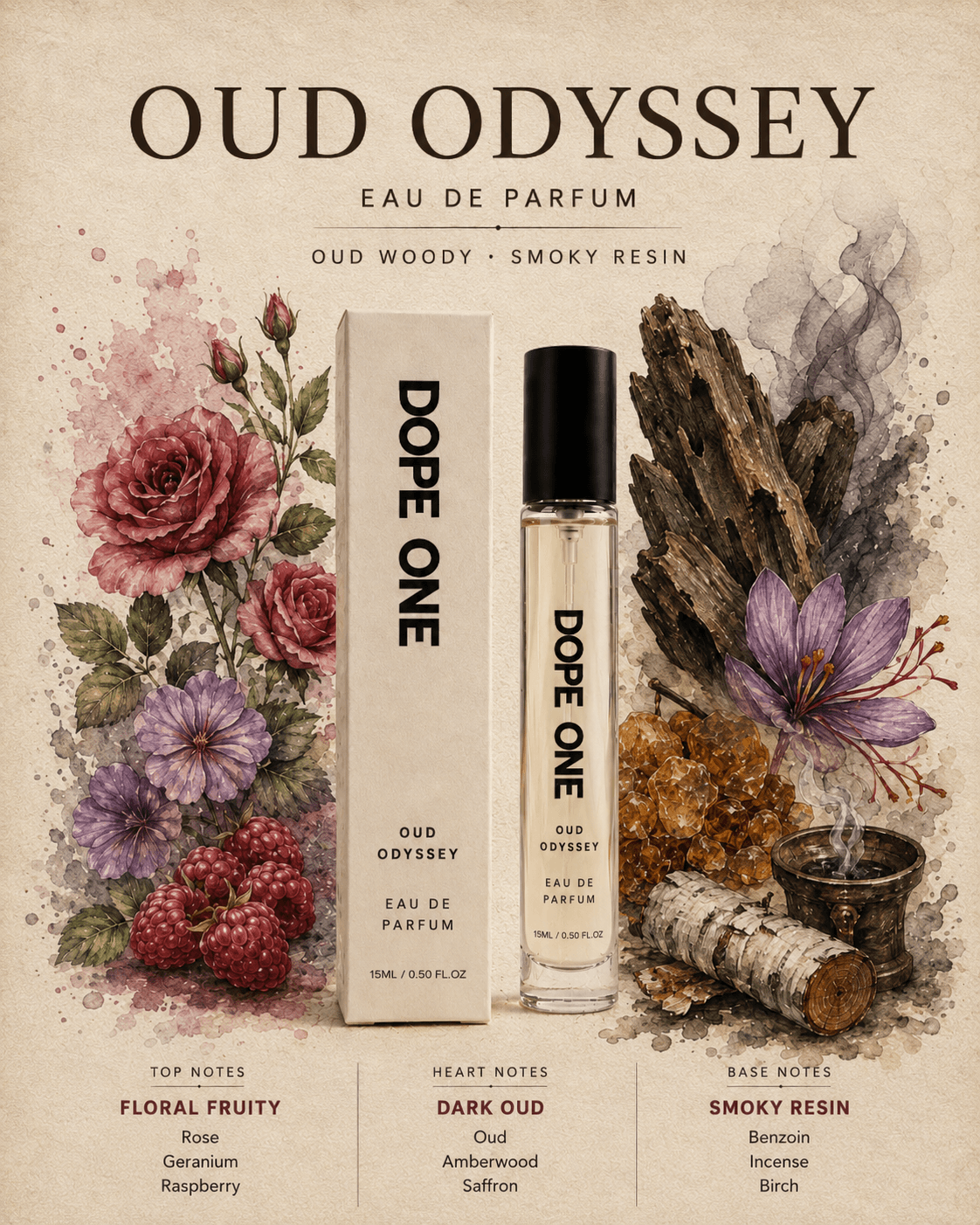
Oud Odyssey
Saffron-oud-rose, built to hold its shape in Indian heat.
₹419
View →
Oud Odyssey opens with raspberry and saffron. The saffron is the bridge note: it connects the bright, fruity-spicy opening to the dark oud-rose heart that sits underneath. Without the saffron, the transition from raspberry to oud would be abrupt. With it, the composition moves from warm to dark without a seam.
The base is benzoin, which adds a balsamic sweetness that softens the oud's edges without dulling them. Saffron remains present through the dry-down as a leathery undertone, giving the later hours a warmth that outlasts the opening's spice. In Indian subtropical conditions, the smoky-oud structure holds its shape where lighter compositions tend to collapse.
Reactions split into exactly two camps: people who need to know what it is, and people startled that a fragrance can have this much character. Nobody ignores it. Next morning, the better question is what wasn't left on the collar.
The honest limitation: Oud Odyssey is demanding. It expects your attention, and some days you will not be in the mood for it. That is not a flaw. It is an agreement between the wearer and the fragrance. Not for the gym, not for beginners, not for blending in.
If saffron-oud is what you are after and the import price is not, a 15ml bottle starts at ₹419.
The Note That Never Explains Itself
Saffron entered perfumery the same way it enters a room: without announcement, without apology, and without any intention of leaving early. It is not sweet. It is not fresh. It is not easy to like on first encounter. But it is the note that people return to once they have outgrown the need for everything to be pleasant. That weight without volume, that warmth without sweetness, that leather-metallic presence that sits on the skin like a second confidence: that is saffron. And nothing else does exactly what it does.
Common questions
- What does saffron smell like in perfume?
- Saffron in perfume smells leathery, metallic, and hay-like with a warm, slightly honeyed dry-down. It bears little resemblance to the kitchen spice. The key molecule, safranal, produces a distinctive spicy-leather profile. Most modern saffron perfumes use synthetic alternatives like Safraleine or ethyl safranate.
- Is saffron a top note or base note?
- Saffron most commonly sits as a heart (middle) note, bridging between top and base. Its metallic sharpness can read as a top note in the opening, while its leathery, hay-like depth persists into the base. It threads through a composition rather than occupying a single position.
- Why is saffron so expensive in perfumery?
- Natural saffron requires approximately 150,000 hand-picked crocus flowers per kilogram of dried threads, retailing at two to four lakh rupees per kg. In perfumery, saffron absolute costs even more. IFRA restricts the key molecule (safranal) to 0.012% in fine fragrance, so most perfumers use synthetic alternatives like Safraleine instead.
- What are the best saffron perfumes?
- Widely regarded saffron-forward fragrances include Baccarat Rouge 540 by MFK (the saffron-ambroxan benchmark), Black Saffron by Byredo (saffron stripped bare with leather), Oud Satin Mood by MFK (Gulf-style saffron-oud), and Noir de Noir by Tom Ford (saffron as dark floral support). DOPE ONE Oud Odyssey uses saffron as a bridge note in a raspberry-oud composition built for Indian heat.
- Is saffron perfume good for summer in India?
- Saffron handles Indian heat better than most spice notes. Where cardamom and cinnamon collapse into sweetness above 35 degrees, saffron's leathery side amplifies and its metallic edge sharpens. It holds its structure in humidity. Evenings are ideal; daytime requires careful dosing as projection increases with heat.
- What goes well with saffron in perfume?
- Saffron pairs exceptionally with oud (the classic Gulf combination), rose (the Mughal perfumery signature), and leather accords (Safraleine is itself a saffron-leather hybrid molecule). It also works well with amber, benzoin, vanilla, and incense. It clashes with sharp citruses, aquatic-marine notes, and light musks.
Related guides
- Oud in Perfumery: The Wood That Owns the Room, From Indian Attars to Modern Niche
- Rose in Perfumery: Kannauj's 400-Year Secret and the Note That Makes Oud Worth Wearing
- Best Oriental and Amber Perfumes in India: Warm Resins, Spice and Leather
- Leather in Perfumery: The Note That Has to Be Built, Not Extracted