Pine in Perfumery: One Note, Over 100 Species
Transparency: we formulate DOPE ONE EMERALD MOSS. Every fragrance here, including ours, is judged on the same criteria: Indian heat performance, fabric longevity, and fidelity to the original's character. Where ours falls short, we say so.
When a perfume lists "pine" as a note, it's naming one tree out of more than a hundred that could technically qualify.
What Pine Actually Is and the Vibe It Carries
The Chemistry
Pine belongs to the genus Pinus, in the Pinaceae family, with at least 111 known species. Its aroma is built on alpha-pinene chemotypes, the same terpene family behind turpentine's sharp, resinous edge. What makes pine smell noticeably sharper and more turpentine-like than fir or spruce isn't a vague "different tree" explanation, it's a measurable bornyl acetate deficit: fir and spruce carry more of that softer, sweeter compound, while pine leans harder into raw terpene bite.
The General Perception
Pine reads as fresh, resinous, and bracing, with a clean, forest-air quality that evokes cold mountain landscapes. If pine were a moment, it would be stepping outside into freezing, needle-sharp air.
Where Pine Comes From and How It's Used
Sourcing
Pine oil is typically steam-distilled from the needles and twigs of various Pinus species, with different regional species yielding subtly different aromatic profiles.
IFRA Reality
Pine oil follows standard IFRA usage guidelines typical of terpene-rich naturals, well understood and broadly permitted at fine-fragrance concentrations.
How It Found Its Place in Perfumery
Pine has long signaled cleanliness and the outdoors in fragrance, from classic barbershop colognes to modern aromatic-woody compositions, valued for cutting through a blend with immediate, recognizable freshness.
Alternatives, If Pine Isn't for You
| Alternative | What You Get | What You Lose | Best When... |
|---|---|---|---|
| Cedarwood | A softer, creamier woody warmth without pine's sharp terpene bite | Pine's cold, forest-air freshness and resinous edge | You want woody depth without pine's sharper, more medicinal character |
Our cedarwood guide covers the two woods sitting naturally in the same broader family.
The Indian Perspective on Pine
The Cultural Anchor
India has its own pine species relevant to fragrance and resin industries, chiefly Pinus roxburghii (chir pine), native to the Himalayan foothills across Himachal Pradesh and Uttarakhand, where it's tapped for resin used in turpentine and rosin production, a genuinely different regional source from the European or American pine species more commonly referenced in Western perfumery.
Traditional Use
Chir pine resin tapping is a long-running regional industry in the Himalayan belt, historically tied to turpentine and rosin manufacturing rather than fine fragrance specifically.
The Modern Indian Context
Indian fragrance use of pine, where it appears, typically draws on the same global steam-distillation supply chain, with the domestic chir pine resin industry running as a largely separate, parallel trade.
Who Loves Pine, and Who Doesn't
Why People Love It
- An immediately recognizable, clean forest-air freshness
- Cuts through a composition with sharp, cold-weather clarity
- Evokes genuine outdoor, mountain-landscape nostalgia
- Works well in aromatic-woody and classic barbershop-style blends
Why They Won't
- Can read as too sharp or medicinal for wearers wanting softness
- Its turpentine-adjacent edge isn't universally loved, some find it harsh
- Rarely the headline note in modern niche perfumery
- Different pine species genuinely smell different, so "pine" alone doesn't guarantee consistency
The honest trade-off: pine rewards someone who wants a sharp, cold-air freshness, not a soft or gourmand-leaning wood.
Pairings, Clashes and Real Fragrance Picks
What Pine Pairs With
Pine pairs naturally with vetiver, both sharing an earthy, grounded woodiness, and with oakmoss for a classic forest-floor register. It clashes with heavy gourmand sweetness, which dulls its sharp clarity.
Real Fragrance Recommendations
| Fragrance | Pine's Role | Price Band (India, approx.) | Heat Performance | Best For |
|---|---|---|---|---|
| Pino Silvestre | A classic Italian pine cologne built almost entirely around the note | ~₹2,500-4,000/100ml | Sharp and fresh; performs well in most weather, fades faster in humidity | Wearers wanting an accessible, classic pine introduction |
| Demeter Fragrance Pine | A true-to-nature single-note pine composition | ~₹3,000-4,500/100ml | Light and fresh; best in cooler weather | Wearers wanting the most literal pine-forest representation |
| Slumberhouse Norne | Pine and juniper woven into a dense, niche forest composition | Rare, US-only, 30ml at $180 (no standard Indian retail listing) | Rich and long-wearing; suits cooler climates best | Wearers wanting a darker, more artistic take on pine forest, and willing to import it |
DOPE ONE does not currently carry a pine-forward fragrance. None of the notes in the current lineup genuinely include it, so the honest answer for pine specifically is to look at the options above.
Where DOPE ONE Sits Closest to Pine
There isn't a genuine match. If you still want to explore the brand while pine isn't in the lineup, Emerald Moss is the closest woody-green territory available, its base genuinely includes cedarwood in a fougere structure, but not pine itself. Named honestly here rather than stretched into a claim it doesn't support.
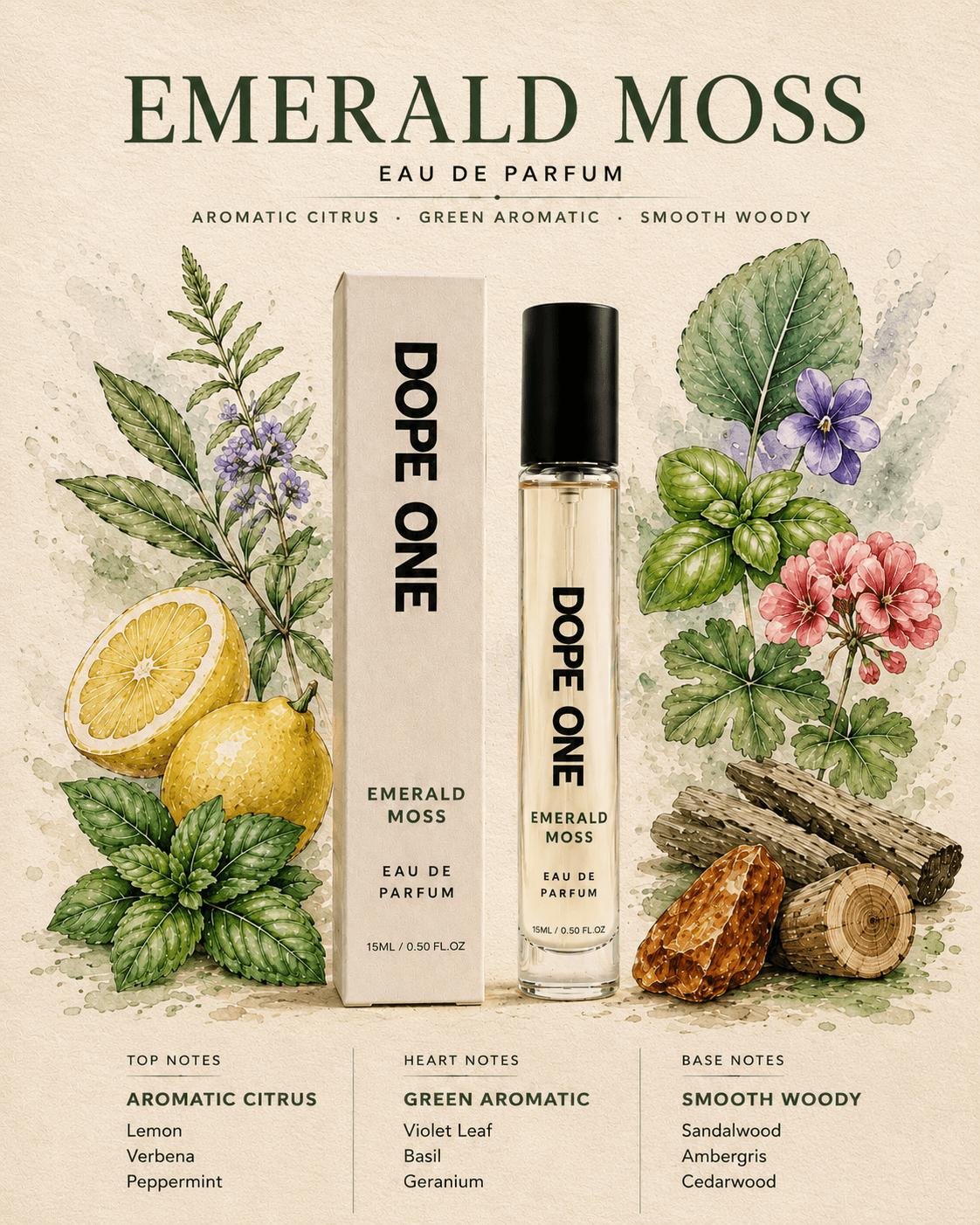
EMERALD MOSS
Green fougere structure with lavender, basil and violet leaf over cedarwood, ambergris, and woods, not a pine fragrance.
₹419
View →
A breeze catches your shirt outdoors and you suddenly understand why this style has survived for decades. It never announces you. People are simply more comfortable around you, and conversations run smoother, and nobody can say why.
The honest limitation: Emerald Moss is a genuinely different green-fougere direction, not a pine substitute. If pine specifically is what you're after, the external picks above are the more honest answer than anything currently in the DOPE ONE lineup.
Pine in Perfumery: Quick Answers
A few of the most common questions people ask about pine as a fragrance note, answered directly below.
The Bottom Line on Pine
Pine in a bottle is genuinely a stand-in for a whole genus of trees, and the sharpness that sets it apart from fir or cedar comes down to real, named chemistry, not just a different species label.
Pine is the most outdoor note in perfumery, and it reads as cool air rather than warm forest in almost every context. Our fresh-air scents for Indian summer heat covers where that impression holds.
Common questions
- What does pine smell like in perfume?
- Fresh, resinous, and bracing, with a clean, cold forest-air quality that evokes mountain landscapes.
- Why does pine smell different from fir or cedar?
- Because of a measurable bornyl acetate deficit. Fir and spruce carry more of that softer, sweeter compound, while pine leans harder into raw alpha-pinene terpene bite.
- Is pine oil natural or synthetic in perfumery?
- Both exist. Natural pine oil is steam-distilled from the needles and twigs of various Pinus species, though synthetic reconstructions are also common.
- What is alpha-pinene?
- A terpene compound that's the main building block of pine's sharp, resinous aroma, part of the same chemical family behind turpentine's characteristic smell.
- Does DOPE ONE have a pine fragrance?
- Not currently. None of the notes in the existing lineup genuinely include pine. Emerald Moss is the closest woody-green territory available, but it's not a pine substitute.
- What pairs well with pine in perfumery?
- Pine pairs naturally with vetiver and oakmoss, both sharing an earthy, grounded woodiness. It clashes with heavy gourmand sweetness.