Cedarwood in Perfumery: Why Three Different Woods Share One Name
Transparency: we formulate DOPE ONE Emerald Moss. Every fragrance here, including ours, is judged on the same criteria: Indian heat performance, fabric longevity, and fidelity to the original's character. Where ours falls short, we say so.
Ask three different perfumers what cedarwood smells like and you may get three different answers, and none of them would be wrong. "Cedarwood" on a fragrance pyramid can mean Atlas cedar from Morocco, Virginia cedar (the same wood pencils are made from), or Himalayan cedar, and the difference between them is bigger than most brands let on.
What Cedarwood Is and the Vibe It Carries
The Chemistry
Cedarwood isn't a single botanical source. Commercial "cedarwood" oil comes from several unrelated trees: Atlas cedar (Cedrus atlantica, Morocco), Virginia "cedar" (actually a juniper, Juniperus virginiana, USA), and Texas cedar (also a juniper). True Himalayan cedar (Cedrus deodara, deodar) is botanically closer to Atlas cedar than to either juniper.
Extraction is almost always steam distillation of wood chips or sawdust. Cedrol and thujopsene are the key aromatic compounds giving natural cedarwood its warm, slightly creamy texture; the synthetic alternative, iso cedryl acetate, is cleaner and more linear but reads flatter and less dimensional. There's no unusual IFRA restriction on cedarwood oil at standard use levels, so the real decision a perfumer makes is which cedar species, and whether natural or synthetic, suits the composition, not how much is legally allowed.
The General Perception
Dry, woody, quietly confident, closer to a freshly sharpened pencil or a cedar closet than to anything sweet. If cedarwood were a time of day, it would be a calm early morning. If it were a person, someone whose presence is felt more than announced.
Where Cedarwood Comes From and How It Earned Its Place
Sourcing
Atlas cedar comes from Morocco and the Atlas Mountains, warmer and creamier in character. Virginia cedar comes primarily from the southeastern United States, drier and more pencil-like. Himalayan cedar, deodar, grows across the western Himalayas, spanning parts of India, Nepal, and Pakistan, and leans more balsamic and resinous. Texas cedar shares Virginia's dry profile and comes from the American southwest. Naturals here are relatively affordable and consistent compared to rare florals, part of why cedarwood shows up as a workhorse base note across a huge range of price points, from mass-market colognes to niche houses.
IFRA Reality
No standout restriction on cedarwood oil at standard fragrance-industry use levels. The creative constraint is which species to choose and how to balance it, not a legal ceiling. Too little supporting material and cedar reads flat and one-dimensional; too much and it can tip into plain sawdust.
How It Found Its Place in Perfumery
Cedarwood has been used as a base note for over a century, prized for its affordability, stability, and ability to anchor a composition without demanding attention. Its most significant modern moment came through fougère and chypre structures built around a green, aromatic top layered over a woody-mossy base, exactly the architecture Emerald Moss itself follows, where cedarwood's job is to keep a bright, green opening from drifting into pure soap by the time it dries down.
Alternatives, If Cedarwood Isn't for You
| Alternative | What You Get | What You Lose | Best When... |
|---|---|---|---|
| Sandalwood | A creamier, sweeter, milkier wood | Cedarwood's dry, pencil-like sharpness | You want warmth and softness over structure |
| Vetiver | A smokier, earthier, more rooty depth | Cedarwood's clean, dry simplicity | You want something darker and more complex |
| Guaiac wood | A similarly dry, slightly smoky wood character | Cedarwood's lighter, more approachable price point | You want a rarer, more textured wood note |
| Iso E Super | A clean, radiant, almost skin-like woody effect | Any of cedarwood's actual tactile, sawdust-like texture | You want a modern, minimal wood impression instead of a literal one |
None of these are cedarwood. That's the point.
How Cedarwood Behaves Through the Wear
Dry-Down Behavior
Cedarwood is a genuine base note, one of the lowest-volatility materials commonly used in perfumery. It rarely shows up as a headline top or heart note; its job is to persist long after brighter notes have faded, giving a fragrance its final, lingering shape. As a composition dries down, cedarwood doesn't sharpen or soften dramatically, it simply endures, holding the structure that citrus, green, or floral notes built earlier in the wear.
Weather Performance in Indian Climate
| Season | What Cedarwood Does | Verdict |
|---|---|---|
| Summer (35-45°C) | Low volatility means cedarwood holds its shape even as heat accelerates the fragrance's brighter top notes | Wearable, one of the more heat-stable notes in this series |
| Monsoon (80%+ humidity) | Humidity doesn't distort cedarwood much; it stays dry and structured while surrounding notes can turn heavy | Wearable, a reliable anchor in humid conditions |
| Winter (5-20°C) | Cool air lets cedarwood's dry, woody character sit closer to the skin and read clearly | Ideal, cedarwood's clarity is easiest to appreciate in cool weather |
The Indian Perspective on Cedarwood
The Cultural Anchor
India has its own cedar: deodar (Cedrus deodara), native to the western Himalayas across Himachal Pradesh, Uttarakhand, and Jammu & Kashmir. Deodar is deeply significant architecturally and culturally there, used in temple construction and traditional houses, but it has essentially no presence in Indian perfumery or attar-making the way sandalwood does.
Traditional Use
Deodar's Indian role has historically been structural and symbolic, temple carving, timber, sacred groves, rather than aromatic. Unlike sandalwood, there's no equivalent tradition of extracting and wearing deodar's scent, which is part of why cedarwood reads as a foreign, imported note to most Indian noses despite India having its own genuine cedar tree.
The Modern Indian Context
Indian niche fragrance houses use cedarwood mostly as a supporting base note in Western-style fougère, chypre, or woody compositions rather than as a standalone spotlight note, reflecting that it's a workhorse material imported into local formulations rather than a note with its own local identity.
Who Loves Cedarwood, and Who Doesn't
Why People Love It
- Reads clean, dry, and confident without being loud or sweet
- Extremely stable through wear, especially valuable in hot, humid climates
- Affordable and versatile, letting it anchor everything from budget colognes to niche compositions
- Pairs well with almost everything, rarely clashing outright with other materials
Why They Won't
- Can read as generic or "safe" compared to rarer woods like oud or sandalwood
- The dry, sawdust-adjacent facet can feel unglamorous if overdosed or used without support
- Doesn't offer much personality on its own, it needs a strong top or heart to feel worth wearing
- Some wearers simply find "woody" fragrances in general less interesting than florals or gourmands
The honest trade-off: cedarwood rewards someone who wants quiet structure and heat-stability over a note that demands attention on its own. It's the scaffolding, not the headline.
Pairings, Clashes and Real Fragrance Picks
What Cedarwood Pairs With
Cedarwood pairs naturally with vetiver, both dry, earthy woods that reinforce rather than compete, and with sandalwood, since cedarwood's dry sharpness balances sandalwood's creamy sweetness the way Emerald Moss's own base leans on both together. It clashes with heavy, sweet gourmands, where cedarwood's dryness can read as odd against overt sweetness rather than complementing it.
Cedarwood also sits naturally alongside oakmoss, which brings the damp forest-floor register cedarwood's dryness lacks, and pine, which sharpens the same coniferous edge from a different genus.
Real Fragrance Recommendations
| Fragrance | Cedarwood's Role | Price Band (India, approx.) | Heat Performance | Best For |
|---|---|---|---|---|
| Jo Malone Oud & Bergamot | Virginia cedar anchors the dry-down under a bright citrus-oud top | ~₹16,000-18,000/100ml | Cedarwood base holds firm as the citrus top fades in heat | Anyone wanting cedar as a clean, dry finish under bright citrus |
| Le Labo Santal 33 | Atlas cedarwood built into an iconic modern woody-leather base | ~₹19,000-24,000/50ml | Very heat-stable, the low-volatility base barely shifts in hot weather | Fans of cedarwood's cleanest, most contemporary interpretation |
| Terre d'Hermès | Cedarwood and vetiver form the earthy, woody backbone of the whole composition | ~₹8,000-11,000/100ml | Holds structure well, one of the more heat-reliable classics | Anyone wanting cedarwood paired with genuine earthy depth |
| Bath & Body Works Mahogany Teakwood | An accessible, budget-tier woody accord with a dry cedar undertone | ~₹4,500-5,500/100ml | Moderate; the accord is linear and fades evenly rather than dramatically | Anyone wanting an easy, affordable entry into woody fragrances |
| DOPE ONE Emerald Moss | Cedarwood anchors the fougère's drydown, keeping the green opening from collapsing into soap | ₹419 (15ml) / ₹1,319 (50ml) | Base holds its structure through Indian heat long after the citrus-mint top has faded | Anyone who wants a classic green fougère that doesn't fall apart by afternoon |
Where DOPE ONE Uses Cedarwood
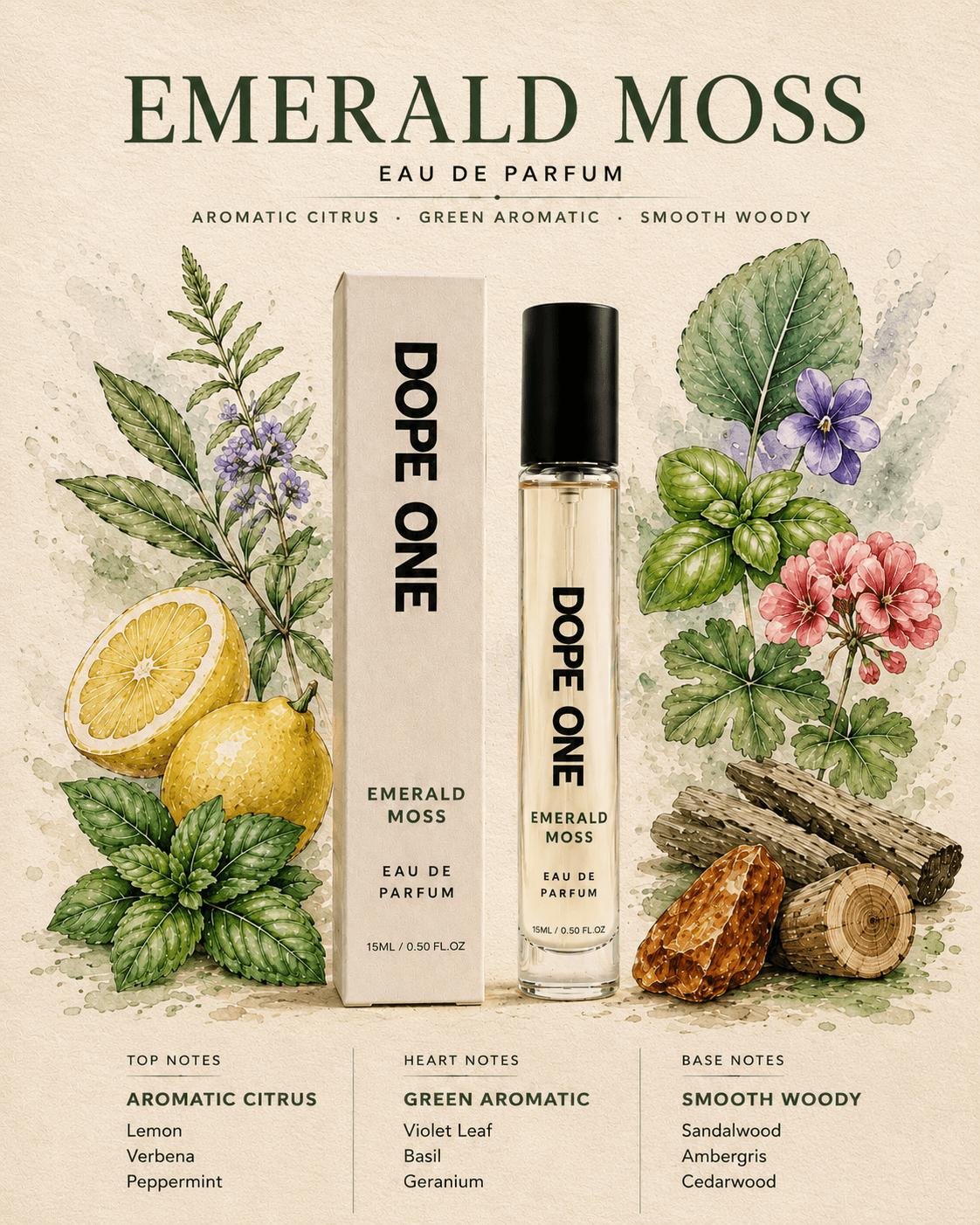
Emerald Moss
Classic green fougere structure with refined woods and barbershop clarity.
₹419
View →
A breeze catches your shirt outdoors and you suddenly understand why this style has survived for decades. It never announces you. People are simply more comfortable around you, and conversations run smoother, and nobody can say why.
The honest limitation: this will not raise its voice. If you want your arrival announced before you enter, look elsewhere in the shelf, because the cedarwood in this base is built to be felt, not heard.
Cedarwood in Perfumery: Quick Answers
A few of the most common questions people ask about cedarwood as a fragrance note, answered directly below.
The Bottom Line on Cedarwood
Cedarwood isn't one note, it's a family of related woods that only share a name. Knowing whether a fragrance leans on warm Atlas cedar, dry Virginia cedar, or balsamic Himalayan cedar tells you more about how it will actually wear than the word "cedarwood" on its own ever could. In Emerald Moss, that choice is a clean, structural base built to be felt more than announced.
Cedarwood is dry rather than heavy, and dry woods behave very differently from resinous ones once the air is warm. Our dry woods in the Indian summer guide puts that difference to work.
Common questions
- What does cedarwood smell like in perfume?
- Cedarwood in perfume smells dry, woody, and quietly warm, closer to a freshly sharpened pencil or a cedar closet than to anything sweet. The exact character shifts by species: Atlas cedar is warmer and creamier, Virginia cedar is drier and more pencil-like, and Himalayan cedar leans balsamic and slightly sweet.
- Is cedarwood a top note or base note?
- Cedarwood is almost always a base note, one of the lowest-volatility materials commonly used in perfumery. It rarely appears as a headline top or heart note; its job is to persist after brighter notes fade and give a fragrance its final, lingering shape.
- What's the difference between Atlas, Virginia, and Himalayan cedarwood?
- Atlas cedar, from Morocco, is warmer and creamier. Virginia cedar, actually a juniper from the southeastern United States, is drier and more pencil-like. Himalayan cedar, deodar, grows across the western Himalayas and leans more balsamic and resinous. All three get labeled simply 'cedarwood' on most fragrance pyramids despite being genuinely different materials.
- What are the best cedarwood perfumes?
- Jo Malone Oud & Bergamot and Terre d'Hermès use cedarwood as a dry, structural base note under brighter tops. Le Labo Santal 33 builds an entire modern signature around Atlas cedarwood. Bath & Body Works Mahogany Teakwood offers an accessible, budget-tier entry point. Which is 'best' depends on whether you want cedarwood as a quiet anchor or the main event.
- Is cedarwood perfume good for summer?
- Yes. Cedarwood's low volatility means it holds its structure well even as Indian heat accelerates a fragrance's brighter top notes, making it one of the more heat-stable base notes in this series, unlike lighter citrus or floral notes that burn off quickly.
- Does cedarwood smell like sandalwood?
- No, though they're often paired together. Cedarwood is drier, sharper, and more aromatic, adding structure and lift to a blend. Sandalwood is creamier, sweeter, and milkier, softening and rounding out a composition. Cedar provides backbone; sandalwood adds smoothness.
Related guides
- Best Summer Perfumes for Men in India (2026): What Survives the Heat
- Vetiver in Perfumery: Khus, the Root That Cools Indian Summers
- Sandalwood in Perfumery: Mysore's Protected Wood and What Replaced It
- Oakmoss in Perfumery: The Lichen That Built Chypre, Then Got Banned
- Pine in Perfumery: One Note, Over 100 Species