Sandalwood in Perfumery: Mysore's Protected Wood and What Replaced It
Transparency: we formulate DOPE ONE Emerald Moss. Every fragrance here, including ours, is judged on the same criteria: Indian heat performance, fabric longevity, and fidelity to the original's character. Where ours falls short, we say so.
Mysore sandalwood is the most desirable perfume ingredient India produces and the most protected. The tree is Santalum album, a hemi-parasite native to the southern Deccan plateau. It takes fifteen to twenty years to mature. The heartwood, which contains the oil, develops only in trees older than twelve years. The oil yield is 4-8% of heartwood weight. The trade is controlled by the Karnataka Forest Department through a government auction system that was established precisely because the tree was being driven to extinction by illegal logging. A kilogram of government-auctioned Mysore sandalwood oil can fetch ₹80,000 to ₹2,00,000 depending on age and santalol content. The same amount of Australian sandalwood oil costs ₹15,000-25,000. Synthetic santalol costs ₹2,000-5,000. Each is useful. Only one is irreplaceable.
This article covers what makes Mysore sandalwood different from every other sandalwood, why India's government controls the supply, the molecule that defines it, and how sandalwood behaves in Indian heat.
What Sandalwood Actually Is in Perfumery
Sandalwood oil is steam-distilled from the heartwood of Santalum album, a hemi-parasitic tree that grows by attaching its roots to host plants. The oil consists primarily of alpha-santalol (CAS 115-71-9) and beta-santalol (CAS 77-42-9), two sesquiterpene alcohols that together account for 80-95% of the oil. Alpha-santalol provides the creamy, milky, woody character that defines Mysore sandalwood. Beta-santalol adds a warm, sweet, slightly balsamic undertone. The ratio between them is roughly 3:1 in high-quality Mysore oil. Australian sandalwood (Santalum spicatum) has a lower alpha-santalol content and higher concentrations of farnesol and globulol, giving it a sharper, more woody-acrid character. New Caledonian sandalwood (Santalum austrocaledonicum) sits between the two.
The key difference between Mysore and other sandalwoods is not whether they contain santalol. Most sandalwood species do. The difference is the alpha-santalol concentration and purity. Mysore sandalwood can reach 45-55% alpha-santalol. Australian sandalwood rarely exceeds 25-30%. The remaining oil consists of different sesquiterpenes that shift the character away from creamy milk towards dry wood. The synthetic alternatives (Javanol, Polysantol, Sandalore, Scentenal) replicate aspects of the santalol molecule but miss the creamy depth entirely.
Sandalwood is the person who walks into the room and makes everything settle. Not quiet. Settled. The volume drops. The pace slows. If leather is the note that takes up space and musk is the note that fills it, sandalwood is the note that makes the space feel worth being in. It is the oldest trick in Indian perfumery and the hardest to replace.
How India Lost and Saved Sandalwood
Sandalwood has been used in Indian perfumery for over 2,500 years. The mention of sandalwood appears in the Atharva Veda, where it is prescribed as a cooling paste for fever and inflammation. Sandalwood paste has been applied at Indian temples and weddings for millennia. Sandalwood attar, co-distilled with rose or jasmine in Kannauj, is the foundation of the Indian attar tradition.
The modern story begins in the 1950s. Mysore sandalwood had been harvested commercially for decades under the Mysore kingdom. By independence, the natural forest population was declining rapidly. The Karnataka Forest Department took control of sandalwood harvesting and established the government auction system that continues today. In theory, this protected the tree from extinction. In practice, it created a black market for sandalwood smuggling that continues to cost the Indian exchequer millions annually.
| Source | Alpha-Santalol | Cost/kg | Character |
|---|---|---|---|
| Mysore Sandalwood (India) | 45-55% | ₹80,000-2,00,000 | Creamy, milky-woody, irreplaceable. The reference. Government-auctioned. |
| Australian Sandalwood | 25-30% | ₹15,000-25,000 | Sharper, drier, more woody-acrid. The commercial workhorse. |
| New Caledonian Sandalwood | 30-40% | ₹25,000-40,000 | Between Indian and Australian. Softer than spicatum, less creamy than album. |
| Javanol (Synthetic) | N/A | ₹8,000-12,000 | Powerful sandalwood-musk hybrid. Ten times stronger than natural. Used at 0.1-0.5%. |
| Polysantol (Synthetic) | N/A | ₹5,000-8,000 | Clean, transparent sandalwood. Closest to the creamy character but lacks depth. |
The 1990s were the low point. A surge in sandalwood smuggling led to the arrest of several high-profile smugglers. The government responded by tightening controls, which reduced the legal supply and drove prices even higher. The Indian perfumery industry switched to Australian sandalwood and synthetics out of necessity. Today, most Indian perfume brands do not use Mysore sandalwood in any meaningful concentration. The price makes it commercially unviable unless it is the hero note. Emerald Moss uses sandalwood at a concentration that reads as creamy-woody without requiring the Mysore-grade pricing.
If Sandalwood Is Out of Reach
| Alternative | What You Get | What You Lose |
|---|---|---|
| Javanol | Powerful sandalwood-musk-suede character. Used in modern niche as the primary sandalwood replacer. Incredible diffusivity. | No creamy-milky depth. Javanol is sandalwood's silhouette, not its body. |
| Polysantol | The cleanest synthetic sandalwood. Transparent, woody, slightly floral. Used in fine fragrance for a sandalwood lift. | Thin. Polysantol smiles where Mysore sandalwood meditates. No richness. |
| Cashmeran | Warm, woody-amber-musk. A structural alternative that provides the warmth role of sandalwood without any wood character. | No sandalwood character at all. Warm but unrecognisable as wood. |
| Cedarwood Atlas + Vanillin | A dry-woody + sweet combination that creates a sandalwood-adjacent impression. The classic low-budget sandalwood replacer. | The woody character is cedar (sharp, dry) rather than sandalwood (creamy, milky). Vanillin bridges the gap but does not close it. |
How Sandalwood Behaves on Indian Skin
| Season | What Sandalwood Does | Verdict |
|---|---|---|
| Summer (35-45°C) | Sandalwood's creamy warmth becomes slightly sticky. The milky character can turn into something heavier than intended. Australian sandalwood handles heat better than Mysore; it is drier and less rich. | Good. Sandalwood is one of the most heat-tolerant woods. Prefer lighter applications. |
| Monsoon (80%+ RH) | Humidity activates sandalwood's creamy notes. The milky-woody character becomes more prominent. The best Indian season for sandalwood-heavy compositions. | Excellent. Sandalwood thrives in humidity. |
| Winter (5-20°C) | Full sandalwood performance. The creamy richness becomes fully legible. A sandalwood base radiates gently in cold air. | Excellent. Sandalwood's natural climate. |
The Indian rule for sandalwood: it is the most forgiving wood in Indian heat. It does not become cloying the way vanilla or tobacco does. It does not burn off the way citrus does. Sandalwood in Indian summer stays close and warm, which is exactly the right behaviour for a base note. The only caution is Mysore sandalwood at high concentration, which can become too creamy in humidity.
Who Sandalwood Is For
Sandalwood attracts the wearer who wants to smell like a person rather than a product. It is the note for someone who has figured out that the best fragrance is the one that makes people lean in rather than step back. Sandalwood wearers tend to be settled in a way that does not require validation. They are not wearing fragrance to impress. They are wearing it to feel complete.
| Who It Is For | Why It Works |
|---|---|
| Year-round wearers | Sandalwood works in every Indian season. Summer, monsoon, winter, evening, morning. The most versatile woody base in perfumery. |
| Wearers who love Indian attars | Sandalwood is the base of the Indian attar tradition. If you love Kannauj attars, you love sandalwood. |
| Meditative and quiet wearers | Sandalwood's creamy warmth is not an announcement. It is a presence. Quiet, steady, complete. |
| Who It Is Not For | Why It Fails |
|---|---|
| Wearers who dislike woody scents | Sandalwood is woody. If wood is not your register, sandalwood will not convert you. Prefer vanilla or amber. |
| Wearers who want projection | Sandalwood sits close. It does not fill a room. It creates a personal space. If you want to be noticed from across a room, sandalwood is not the tool. |
| Wearers who associate wood with "old" | Sandalwood has a generational association with "aunty" perfumes and temple incense. Modern sandalwood compositions (woody-modern, sandalwood + aquatic) have broken this, but the association persists. |
What Sandalwood Plays Well With
Sandalwood is the most forgiving base note in perfumery. It pairs well with almost everything and improves every composition it touches. The only notes that actively clash with sandalwood are sharp, piercing citruses that overwhelm the creamy character.
Sandalwood and violet leaf is the Emerald Moss architecture. Violet leaf provides the green, metallic top. Sandalwood provides the creamy base that prevents the green from reading as astringent. The pairing is the foundation of Green Irish Tweed and its descendants. Our violet leaf guide is forthcoming.
Sandalwood and rose is the Kannauj attar pairing. Rose adds luminosity to the sandalwood base. Sandalwood adds depth to the rose. Together they have powered India's attar tradition for over four centuries. Our rose in perfumery guide covers the full architecture.
Sandalwood and lemon is the fresh-creamy pairing behind Emerald Moss. Lemon's sharp citrus cuts the wood; sandalwood rounds the lemon. The result is a green composition that wears like a soft shirt rather than a green spray. Our lemon guide covers why that top note fades first.
What Does Not Work With Sandalwood
Sandalwood and aggressive citruses (lime, bitter orange) clash. The sharp citrus top note overwhelms the delicate creamy-woody character. Sandalwood and strong animalic notes (castoreum, heavy muscenone) can become musty. The warmth of both amplifies in the same register, creating a heavy, almost stale character.
Five Sandalwood Fragrances Worth Wearing
| Fragrance | Sandalwood Type | Price Band (India) | Heat Performance | Best For |
|---|---|---|---|---|
| Serge Lutens Santal de Mysore | Mysore sandalwood-dominant. The reference sandalwood soliflore. Creamy, warm, spicy. | ₹20,000-25,000 | Creamy warmth handles heat well. The most Indian-friendly high-end sandalwood. | Understanding what Mysore sandalwood smells like. The reference. |
| Tam Dao (Diptyque) | New Caledonian sandalwood + cedar + cypress. The modern reference sandalwood. Cleaner, drier, more austere. | ₹9,000-11,000 | Clean and dry. Good heat tolerance. Best sandalwood for Indian summer. | Understanding sandalwood without the creamy depth. Year-round. |
| Creed Green Irish Tweed | Sandalwood + violet leaf + lemon. The reference green-fougere. Sandalwood is the creamy base, not the lead. | ₹20,000-25,000 | Green top burns fast. Sandalwood base persists. Evening and cooler months. | Understanding the sandalwood-as-base architecture. Reference for Emerald Moss. |
| Mysore Sandal Soap (Karnataka Soaps) | Pure Mysore sandalwood oil. The most affordable way to experience real Mysore sandalwood. Not a perfume but a reference. | ₹150-300 | N/A (soap). But the smell is the real thing. | Understanding real Mysore sandalwood. Every Indian should try this once. |
| DOPE ONE Emerald Moss | Sandalwood + violet leaf + lemon. The green-fougere architecture built for Indian wear. | ₹419 / ₹1,319 | Lemon top and sandalwood base create a balanced heat-friendly composition. | Year-round green wear. Understanding sandalwood as the creamy base beneath green top notes. |
Regulatory Considerations
Sandalwood oil has no significant IFRA restrictions. It is one of the safest raw materials in perfumery, with no known skin sensitisation at typical usage levels. The supply restriction is not regulatory. It is botanical and political: Mysore sandalwood takes fifteen years to mature and is controlled by a government that auctions limited quantities. Sandalwood oil is not IFRA-limited. It is nature-limited.
Emerald Moss: Green, Creamy, Indian
Emerald Moss is the most straightforward sandalwood composition in the DOPE ONE line: lemon sharpness on top, violet leaf for the green character, sandalwood in the base for creaminess. It is the Green Irish Tweed architecture, rebuilt for Indian skin that stays warm rather than cool. The sandalwood concentration in Emerald Moss is calibrated to provide the creamy-woody base without crossing into the heavy, sticky territory that Mysore sandalwood can reach in Indian humidity.
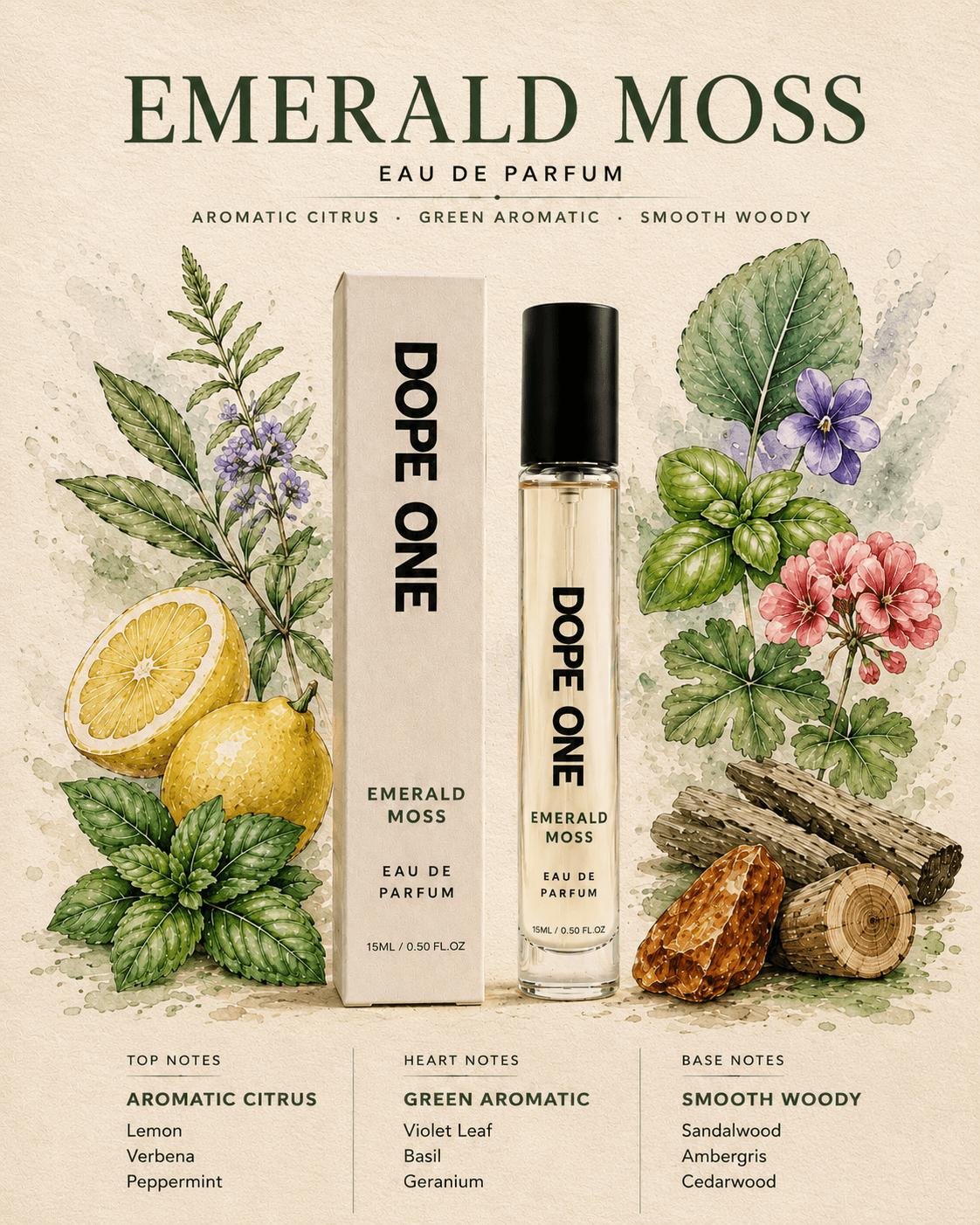
Emerald Moss
Lemon, violet leaf, sandalwood. Green Irish Tweed architecture for Indian wear.
₹419
View →
Emerald Moss does not use a single gram of Mysore sandalwood. The cost would make the fragrance unaffordable at its price point. Instead, it uses a blend of Australian sandalwood oil and synthetic santalol boosters to create a creamy-woody base that reads as sandalwood-complete without the sticker price. This is the same approach used by every green fragrance in its category. The difference is that Emerald Moss is honest about what it uses and what it does not.
A breeze catches your shirt outdoors and you suddenly understand why this style has survived for decades. It never announces you. People are simply more comfortable around you, and conversations run smoother, and nobody can say why.
Emerald Moss is ₹419. The sandalwood in it is not from Mysore. It still smells better than most green fragrances on the Indian market. Honesty is part of the formula.
Common Questions About Sandalwood in Perfumery
What is the difference between Mysore and Australian sandalwood?
Mysore sandalwood (Santalum album) has 45-55% alpha-santalol, giving it a creamy, milky-woody character. Australian sandalwood (Santalum spicatum) has 25-30%, giving it a sharper, drier, more woody-acrid character. Mysore is the reference. Australian is the commercial workhorse. Both are useful. Only one is irreplaceable.
Why is Mysore sandalwood so expensive?
The tree takes 15-20 years to mature for oil production. The oil yield is 4-8% of heartwood weight. The Karnataka Forest Department controls all legal harvest through a government auction system. Smuggling is rampant. A kilogram of legal Mysore sandalwood oil trades at ₹80,000-2,00,000. The price reflects time, rarity, and government control.
Is sandalwood perfume wearable in Indian summer?
Yes. Sandalwood is one of the most heat-tolerant woods in perfumery. It does not become cloying like vanilla or tobacco. It stays close and warm. The only caution is high-concentration Mysore sandalwood in humidity, which can become too creamy. Australian and synthetic sandalwoods handle heat without issue.
What is the best sandalwood perfume?
Serge Lutens Santal de Mysore (reference soliflore), Diptyque Tam Dao (modern reference), Creed Green Irish Tweed (green-fougere architecture), Mysore Sandal Soap by Karnataka Soaps (the cheapest way to smell real Mysore sandalwood), DOPE ONE Emerald Moss (green-fougere built for Indian wear).
Does India still produce Mysore sandalwood?
Yes. Karnataka, Tamil Nadu, and Kerala produce limited quantities under government control. The annual legal harvest is a fraction of what it was in the 1950s. India also replants sandalwood trees through government forestry programs, but the fifteen-year maturity cycle means today's plantings will not yield oil until the late 2030s. The current supply is finite and carefully managed.
The Tree That Took Democracy
Sandalwood is the only perfume ingredient regulated by a government auction system. It is the only tree whose harvesting involves armed guards, forensic audits, and international smuggling networks. It is the only wood whose price is determined as much by policy as by perfumery. India grew it for millennia, nearly lost it, and now manages what remains.
The sandalwood you smell in a Kannauj attar, in a French niche perfume, or in a DOPE ONE bottle is the same species and the same story. Fifteen years to grow. Four to eight percent yield. A government auction. A smuggler's risk. And the most beautiful wood India has ever produced.
Common questions
- What is the difference between Mysore and Australian sandalwood?
- Mysore (Santalum album) has 45-55% alpha-santalol, creamy and milky. Australian (Santalum spicatum) has 25-30%, sharper and drier. Mysore is the reference. Australian is the workhorse.
- Why is Mysore sandalwood so expensive?
- The tree takes 15-20 years to mature. 4-8% oil yield. Karnataka Forest Department controls all legal harvest through government auctions. ₹80,000-2,00,000/kg. Price reflects time, rarity, and regulation.
- Is sandalwood perfume wearable in Indian summer?
- Yes. Most heat-tolerant wood in perfumery. Not cloying like vanilla or tobacco. High-concentration Mysore can be too creamy in humidity. Australian and synthetics handle heat without issue.
- What is the best sandalwood perfume?
- Serge Lutens Santal de Mysore (reference), Diptyque Tam Dao (modern reference), Creed Green Irish Tweed (green-fougere), Mysore Sandal Soap by Karnataka Soaps (cheapest real Mysore), DOPE ONE Emerald Moss (built for India).
- Does India still produce Mysore sandalwood?
- Yes, limited quantities under government control in Karnataka, Tamil Nadu, Kerala. Annual legal harvest is a fraction of 1950s levels. Replanting programs exist, but 15-year maturity means no new oil until late 2030s.