Incense in Perfumery: The Note That Isn't Actually One Ingredient
Transparency: we formulate DOPE ONE Oud Odyssey. Every fragrance here, including ours, is judged on the same criteria: Indian heat performance, fabric longevity, and fidelity to the original's character. Where ours falls short, we say so.
The word "perfume" comes from the Latin per fumum, through smoke. Almost nothing sold today under the note "incense" contains any actual smoke. What perfumers label incense is usually frankincense resin, sometimes myrrh, occasionally a synthetic accord built to approximate the smell of a censer nobody lit. What that catchall actually means, and how to tell which version you are smelling, is worth knowing before you buy the next fragrance that promises "smoky."
What Incense Is and the Vibe It Carries
The Chemistry
"Incense" is not a botanical name. It is a fragrance-pyramid catchall for the smell of burning resin, most often standing in for frankincense (olibanum, harvested from Boswellia trees) and sometimes myrrh (from Commiphora trees). Both are resin "tears" that harden after being cut from the bark.
Natural extraction happens through steam distillation or supercritical CO2 extraction of the resin. CO2 extraction preserves more of the resin's terpene and balsamic fractions than steam distillation, at a higher cost, producing a rounder, less harsh material than the distilled essential oil.
The key facets run from a dry, mineral, slightly citrusy-green top (from the terpene fraction) into a smoky, balsamic, church-like base. Synthetic incense accords combine materials like Iso E Super, cade oil for a smoky-leather edge, and styrax or benzoin-type balsams to approximate the effect without sourcing real resin. Most drugstore and mass-market "incense" fragrances are built entirely this way.
IFRA does not cap incense with a hard percentage the way it caps a molecule like safranal. The restriction targets oxidised olibanum oil specifically: unstabilised, aged resin oil oxidises into a stronger skin sensitiser, so a perfumer working with real olibanum has to source antioxidant-stabilised or hydrocarbon-fraction material to stay compliant. That practical hurdle is part of why so many "incense" notes on the market are synthetic accords rather than the resin itself: a synthetic accord behaves the same way in every batch.
The Vibe
Incense in perfumery is the note that makes a room feel like it has history, even a room built last year. It is dry, smoky, and slightly cold, the opposite of a warm gourmand hug. If it were a person, it would be the one who says nothing for the first ten minutes of a conversation and somehow ends up running it.
Where Incense Comes From and How It Entered Perfumery
Sourcing
Frankincense comes primarily from Somalia, Oman's Dhofar region, and Ethiopia. Omani Hojari frankincense is considered the highest grade: pale, resinous, and more citrusy than heavier commercial grades. Somali frankincense is the most common commercially traded material, darker and heavier in character. Myrrh comes mainly from Somalia and Ethiopia, harvested from a related but distinct tree.
Cost sits well below saffron or oud per kilogram for standard-grade resin, but CO2-extracted, high-grade Hojari material carries a real premium over the synthetic incense accords most commercial fragrances use instead.
IFRA Reality
The practical constraint on natural olibanum is oxidation, not concentration. A perfumer has to source antioxidant-stabilised or hydrocarbon-fraction material to stay within IFRA guidance, since aged or improperly stored resin oil oxidises into a stronger sensitiser. This is a sourcing and formulation discipline more than a hard ceiling, which is exactly why consistency-minded brands lean on synthetic incense accords: a natural material that behaves differently batch to batch is harder to guarantee at scale.
How Incense Found Its Place in Perfumery
Incense is arguably older than perfumery itself. Ancient Egypt burned frankincense in temple ritual and used it in embalming practices. It travelled the historic incense trade routes from the Arabian peninsula and the Horn of Africa into Mediterranean and later European liturgical use, which is why so much incense perfumery in the West still reads as "churchy."
The modern niche breakthrough came from Comme des Garçons' Incense Series, especially Avignon in 2002, which took liturgical incense out of the church and put it directly on skin as a fragrance in its own right, with almost no floral or gourmand softening. Serge Lutens' Encens et Lavande and Andy Tauer's Incense Extrême pushed the natural olibanum percentage higher than most mainstream releases dared. Before this wave, incense was a supporting base note. After it, incense became a genre of its own.
Alternatives: If Incense Is Not for You
These serve similar functions with different characters. Each gives you part of what incense does, but none gives you all of it.
| Alternative | What You Get | What You Lose | Best When... |
|---|---|---|---|
| Cade oil / birch tar | The smoky, leathery facet | The dry mineral coolness, the ritual quality | You want smoke without the "temple" association |
| Labdanum | Warm, amber-honeyed balsamic depth | The cold, dry, mineral edge that defines real incense | You want warmth over austerity |
| Benzoin | Sweet, vanillic, soft resin warmth | The smokiness entirely | You want a resin note that reads comforting, not solemn |
| Oud | Dark, resinous, animalic complexity | The specific dry-smoke clarity of incense | You want density and history without the church association |
None of these are incense. That is the point.
How Incense Evolves on Skin
Through the Wear
Incense typically opens with a bright, slightly citrusy-green lift, the terpene fraction of the resin announcing itself, before settling into its true identity as a base note: dry, smoky, mineral, and long-lasting. It does not sweeten with time the way vanilla or amber does. It stays dry and simply gets quieter.
In heat, incense holds its dry, mineral character rather than blooming outward or melting. It does not amplify the way saffron does, but it also does not collapse. It persists, close to skin, at a lower volume, which is a different kind of longevity than most notes offer.
Weather Performance in India
| Season | What Incense Does | Verdict |
|---|---|---|
| Summer (35-45 degrees C) | Stays dry and mineral rather than turning cloying. Does not bloom outward the way florals do, but holds its shape close to skin. | Wearable. Best worn expecting intimacy, not projection. |
| Monsoon (80%+ RH) | Humidity can flatten the bright terpene opening faster, pushing the composition into its smoky base sooner. Reads heavier, closer to wet stone. | Wearable. Layer with something brighter if you want the top notes to last. |
| Winter (5-20 degrees C) | The dry, cool quality suits cooler air. Needs less body heat than warm resins like benzoin to project. | Ideal. One of incense's strongest seasons. |
The Indian Perspective on Incense
The Cultural Anchor
Dhoop and agarbatti. Every Indian household has smelled some form of incense daily, from a lit dhoop stick during evening aarti to the box of agarbatti kept by the front door. This is the opposite of the Western "unfamiliar ritual" framing that most incense-fragrance writing leans on. For an Indian reader, incense is not exotic. It is Tuesday evening.
Traditional Use
Temple and home puja rely on dhoop and agarbatti as daily ritual, not occasional ceremony. Traditional practice also draws on guggul, a resin from a tree related to myrrh's family, burned for its purifying association. Havan offerings burn resin and wood directly, which is the most literal version of "through smoke" that exists.
The overlap with Western niche perfumery is real but rarely acknowledged. The same olfactory family, dry, resinous, smoky, that a temple visit produces is exactly what a bottle of Avignon or Incense Extrême is chasing in concentrated, wearable form.
The Modern Indian Context
Indian attar and dhoop makers have used resin-forward blends for generations, often layering frankincense-adjacent resins with sandalwood or oud. Modern Indian niche houses are beginning to bottle "temple" or "dhoop"-inspired accords as standalone fragrances rather than leaving incense as a background note in someone else's composition.
Who Loves Incense and Who Does Not
Why People Love It
First, the sense of history and gravity it brings. Incense reads as old and considered, never trendy. Second, the dryness. It offers a genuine break from the sweet gourmand and floral trends that dominate modern releases. Third, for Indian wearers specifically, it carries an instant, comforting familiarity that most Western "exotic" notes do not offer. Fourth, longevity: as a genuine base note, incense outlasts almost everything layered on top of it.
Why They Will Not
The "funeral" or "church" association is the first barrier some wearers cannot shake. The lack of sweetness or warmth is the second: people expecting a cozy resin get something austere instead. Low projection in heat is the third. Incense stays close to skin, which some wearers read as "not there" when they want to be noticed. And the fourth is confusion between real olibanum and synthetic incense accords, which leads to inconsistent expectations from bottle to bottle.
The Honest Trade-Off
Incense will not make you smell warm or sweet. If you want gravity instead of comfort, it delivers. If you wanted a hug in a bottle, you bought the wrong note.
What Incense Pairs With, What It Clashes With, and What to Try
The Interlinking Wheel
Incense's most natural pairing is oud. Both are dark, resinous, and historically paired in Gulf and Indian attar traditions. Incense adds a dry, mineral clarity that keeps oud's animalic depth from turning muddy, while oud gives incense a density it cannot build alone.
Myrrh is incense's closest sibling resin. The two are frequently blended into the same "church" accord, myrrh contributing a warmer, slightly medicinal balsamic note beside frankincense's drier smoke. Our myrrh guide covers this pairing directly.
Frankincense itself deserves a separate deep-dive, since "incense" on most fragrance pyramids is really shorthand for this specific resin. Our frankincense guide covers it on its own terms, apart from the broader incense category this article covers.
Incense also works well with benzoin, sandalwood, and birch, though each pairing shifts the balance: benzoin sweetens it, sandalwood smooths its dry edge, and birch pulls it toward leather.
Incense clashes with bright fruity-gourmand notes, whose sweetness fights its dryness, with aquatic and marine notes, which sit on the opposite end of the olfactory spectrum, and with heavy vanilla, which can drown its smoky clarity entirely.
Incense Fragrances Worth Trying
| Fragrance | Incense's Role | Price Band (India) | Heat Performance | Best For |
|---|---|---|---|---|
| Incense Series: Avignon (Comme des Garçons) | Nearly unadorned liturgical incense. The reference point every other incense fragrance gets measured against. | Approx. 9,000-12,000 for 50ml | Dry and stable in heat; does not bloom, stays close and consistent | Incense purists, minimalists |
| Passage d'Enfer (L'Artisan Parfumeur) | Incense softened with lily and musk. The wearable entry point into the genre. | Approx. 12,000-16,000 for 100ml | Moderate projection; the floral softening helps it read less austere in heat | First-time incense wearers |
| Encens et Lavande (Serge Lutens) | High natural-olibanum percentage paired with lavender for a herbal-smoky effect. | Approx. 10,000-14,000 for 50ml | Holds its dry character well; lavender keeps it from feeling heavy | Lavender lovers wanting a smokier edge |
| Incense Extrême (Tauer Perfumes) | CO2-extracted olibanum at high concentration. The driest, most mineral expression of the note. | Approx. 8,000-11,000 for 50ml | Very stable in heat; barely changes from open to dry-down | Wearers who want incense with nothing softening it |
| DOPE ONE Oud Odyssey | Incense deepens the resinous, smoky base under the oud-rose heart, calibrated for Indian subtropical conditions. | ₹419 (15ml) / ₹1,319 (50ml) | Built for Indian heat. The smoky base holds shape through humidity. | Wearers who want the temple-resin register without importing it |
DOPE ONE Oud Odyssey: How Incense Works Here
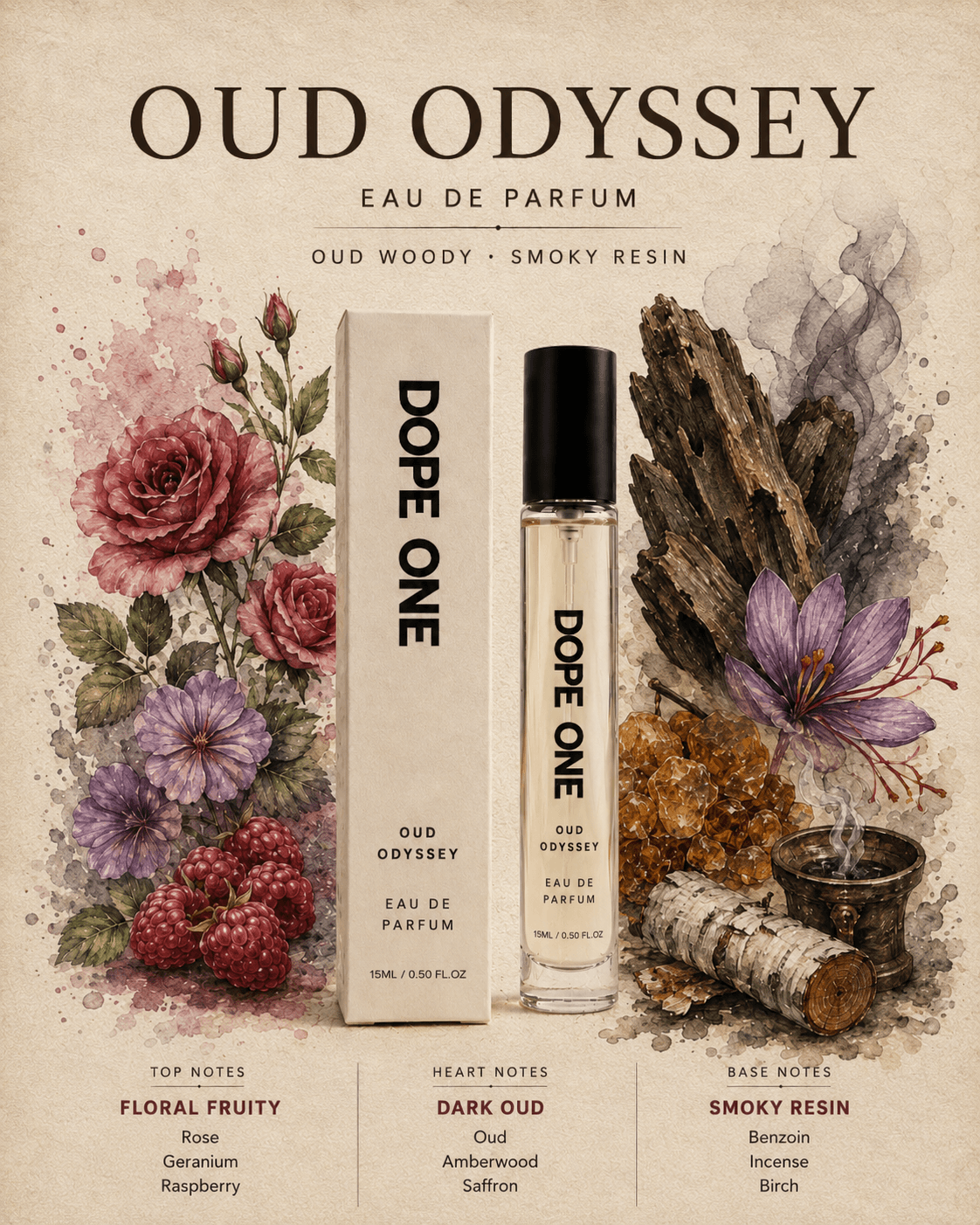
Oud Odyssey
Incense deepens the smoky-resin base, built to hold shape in Indian heat.
₹419
View →
Oud Odyssey's base settles into benzoin, incense, and birch. Incense is the note that keeps that base dry and smoky instead of letting benzoin's sweetness take over. It works quietly, underneath the oud-rose heart, giving the composition's later hours a resinous, almost temple-like weight that the opening's rose and geranium do not hint at.
The effect is deliberate: a fragrance that opens bright and floral, moves through oud's dark resinous heart, and closes on an incense-birch base that reads as history rather than sweetness. In Indian subtropical conditions, that dry base holds its shape where lighter, sweeter compositions tend to soften into something less distinct.
Reactions split into exactly two camps: people who need to know what it is, and people startled that a fragrance can have this much character. Nobody ignores it. Next morning, the better question is what wasn't left on the collar.
The honest limitation: Oud Odyssey is demanding. It expects your attention, and some days you will not be in the mood for it. That is not a flaw. It is an agreement between the wearer and the fragrance. Not for the gym, not for beginners, not for blending in.
If the temple-resin register is what you are after and the import price is not, a 15ml bottle starts at ₹419.
The Note That Was Never Meant to Be Bottled
Incense entered perfumery as smoke rising off burning resin, meant to be seen and inhaled once, then gone. Bottling it is a kind of contradiction: a scent originally defined by disappearing, made to last for hours on skin instead. That contradiction is exactly why it works. Dry, mineral, unhurried, incense does not try to be liked in the first ten minutes. It asks to be understood over the whole wear. For a note this old, that patience is the entire point.
Common questions
- What does incense smell like in perfume?
- Incense in perfume smells dry, smoky, and mineral with a slightly citrusy-green opening that settles into a balsamic, church-like base. It usually stands in for frankincense (olibanum) resin, sometimes myrrh, or a synthetic accord built from materials like Iso E Super and cade oil.
- Is incense a base note or top note?
- Incense is classified as a base note due to its low volatility and long persistence on skin. It can show a brief citrusy-green lift from the resin's terpene fraction early on, but its dry, smoky character is what remains through the dry-down and defines the note.
- What is the difference between incense and frankincense in perfume?
- On most fragrance pyramids, incense is shorthand for frankincense (olibanum) resin specifically, though it can also mean myrrh, copal, or a synthetic incense accord. Frankincense is one real ingredient; incense is a broader catchall for the smell of burning resin in general.
- What are the best incense perfumes?
- Widely regarded incense fragrances include Incense Series: Avignon by Comme des Garçons (near-unadorned liturgical incense), Passage d'Enfer by L'Artisan Parfumeur (incense softened with lily and musk), Encens et Lavande by Serge Lutens, and Incense Extrême by Tauer Perfumes. DOPE ONE Oud Odyssey uses incense to deepen its smoky, resinous base.
- Is incense perfume good for summer in India?
- Incense holds its dry, mineral character in Indian heat rather than blooming outward like florals or collapsing like some spices. It stays close to skin at a lower volume through summer, which reads as intimate rather than absent. It performs strongest in cooler, drier air.
- What goes well with incense in perfume?
- Incense pairs naturally with oud (a historic Gulf and Indian attar combination), myrrh (its closest sibling resin), benzoin, sandalwood, and birch. It clashes with bright fruity-gourmand notes, aquatic-marine notes, and heavy vanilla, all of which fight or drown its dry clarity.