Orange Blossom in Perfumery: One Flower, Three Completely Different Materials
Transparency: we formulate DOPE ONE SUN KISS. Every fragrance here, including ours, is judged on the same criteria: Indian heat performance, fabric longevity, and fidelity to the original's character. Where ours falls short, we say so.
Orange blossom smells like clean laundry to some people and like warm honeyed skin to others, and both are correct. The same flower, processed two different ways, produces genuinely different materials, and most perfumes never tell you which one they used.
What Orange Blossom Is and the Vibe It Carries
The Chemistry
Orange blossom comes from the flowers of the bitter orange tree (Citrus aurantium var. amara), which yields four distinct perfumery materials from one plant: neroli oil (steam distillation of the flowers), orange blossom absolute (solvent extraction of the flowers), orange blossom water absolute (solvent extraction of the leftover distillation waters), and petitgrain oil (steam distillation of the leaves and twigs, a different material entirely).
Neroli oil is dominated by linalool (roughly 26-48%) and linalyl acetate, giving it a transparent, green-citrus, almost soapy brightness. Orange blossom absolute captures the heavier molecules that distillation loses, methyl anthranilate, nerolidol, farnesol, and trace indole, giving it a darker, waxier, honeyed, faintly narcotic character. There's no unusual IFRA restriction on either material as naturals, though linalool and limonene are both EU-regulated allergens requiring label declaration above certain concentrations, a labeling detail rather than a usage ban.
The General Perception
Bright and clean on one side, honeyed and narcotic on the other, with every perfume built somewhere on the spectrum between the two. If orange blossom were a moment, it would be sunlit white petals that turn faintly warm and skin-like as the day goes on.
Where Orange Blossom Comes From and How It Earned Its Place
Sourcing
Tunisia is the world's leading producer, with the Cap Bon peninsula around Nabeul processing over 2,500 tonnes of orange blossoms a year, around 60% distilled locally. Morocco and Egypt follow. The harvest is hand-picked before sunrise, when volatile oil content peaks, and it takes roughly 850-1,000kg of flowers to yield just 1kg of neroli oil. That yield is why neroli oil carries a premium price, and why perfumers often blend it with the absolute or synthetic supporting materials rather than relying on the natural alone.
IFRA Reality
No standout restriction on neroli oil or orange blossom absolute as naturals. Linalool and limonene, both present in the material, are EU-regulated allergens requiring label declaration above trace concentrations, a labeling requirement rather than a usage ban.
How It Found Its Place in Perfumery
Orange blossom has centuries of history as a bridal and Mediterranean perfumery staple, tied to the classic Eau de Cologne structure through neroli's bright, transparent lift. Orange blossom absolute later extended that into deeper white-floral soliflores and ambers, where its narcotic weight could carry a composition's heart. DOPE ONE's Sun Kiss uses it the modern way, as one bright layer in a citrus-forward composition rather than the sole focus.
Alternatives, If Orange Blossom Isn't for You
| Alternative | What You Get | What You Lose | Best When... |
|---|---|---|---|
| Neroli (as a standalone note) | The bright, transparent, linalool-driven top facet alone | Orange blossom absolute's deeper honeyed, narcotic weight | You want the citrus-clean side without the heavier floral depth |
| Jasmine | A more overtly indolic, heady white-floral character | Orange blossom's cleaner, soapier brightness | You want a headier, more overtly sensual white floral |
| Tuberose | A creamier, heavier, more overtly narcotic white floral | Orange blossom's lighter, citrus-adjacent transparency | You want maximum richness and don't mind losing the fresh top |
| Magnolia | A greener, lighter, more lemon-tinged floral | Orange blossom's honeyed depth and narcotic facet | You want brightness without any honeyed weight |
None of these are orange blossom. That's the point.
How Orange Blossom Behaves Through the Wear
Dry-Down Behavior
Orange blossom typically opens bright, with the neroli facet (linalool and limonene) dominant immediately. After a few hours, the honeyed, narcotic depth from methyl anthranilate and trace indole emerges as the absolute facet takes over. After a few days on fabric, what remains is a warm, musky-floral, faintly animalic residue that lingers.
Weather Performance in Indian Climate
| Season | What Orange Blossom Does | Verdict |
|---|---|---|
| Summer (35-45°C) | The neroli-forward, brighter compositions stay clean and lifted in heat, while heavier absolute-forward versions can feel closer and more skin-like | Wearable, neroli-forward types preferred |
| Monsoon (80%+ humidity) | Humidity amplifies the honeyed, narcotic facet, making absolute-heavy compositions feel richer and heavier | Wearable in moderation, lighter neroli types hold up better |
| Winter (5-20°C) | Cool air lets the honeyed absolute facet sit close and read at its most complex without feeling overwhelming | Ideal, especially for absolute-forward, deeper orange blossom compositions |
The Indian Perspective on Orange Blossom
The Cultural Anchor
India doesn't have its own commercial orange blossom or neroli industry the way Tunisia and Morocco do, since the bitter orange cultivated for this purpose isn't a major Indian agricultural crop. What India does have is a long-standing tradition of using other white flowers, jasmine and mogra especially, in a strikingly similar cultural role: garlands, bridal wear, and daily adornment.
Traditional Use
Where Mediterranean brides have carried orange blossom for centuries as a symbol of purity, Indian brides and daily wearers turn to jasmine and mogra garlands for much the same purpose, worn in the hair and around the wrist. The cultural role orange blossom plays in the West, a white flower tied to weddings and purity, has a direct, independent parallel in India's own jasmine tradition rather than an imported one.
The Modern Indian Context
Indian niche perfumery tends to reach for jasmine or mogra before orange blossom or neroli specifically, since those are the white florals with genuine local sourcing and cultural resonance. Orange blossom in an Indian-market fragrance, like in Sun Kiss, usually arrives imported and blended into a broader citrus composition rather than as a standalone soliflore.
Who Loves Orange Blossom, and Who Doesn't
Why People Love It
- Reads clean and luminous on the neroli side, warm and honeyed on the absolute side, a genuinely wide range from one flower
- Deeply tied to a recognizable "clean, fresh" association that reads as universally likeable rather than polarising
- Performs well across a real range of compositions, from Eau de Cologne brightness to deep white-floral ambers
- The Tunisian sourcing story (hand-picked before sunrise, four materials from one tree) gives it real depth for anyone who wants to understand what they're wearing
Why They Won't
- The soap association some people have with orange blossom can read as generic rather than distinctive if the composition leans too hard on neroli alone
- The absolute's narcotic, honeyed facet can feel too heavy or too "skin" for wearers who want something crisper
- Cheaper compositions using only synthetic orange blossom accords can smell flat or one-dimensional next to the real three-material range
- Most labels don't specify which of the three materials was used, so buyers can't predict which version they're getting
The honest trade-off: orange blossom rewards someone who wants real range from a single ingredient, from clean brightness to honeyed depth, but the label rarely tells you which side of that range you're actually buying.
Pairings, Clashes and Real Fragrance Picks
What Orange Blossom Pairs With
Orange blossom pairs naturally with neroli, the same flower's lighter facet and a natural layering partner, with jasmine, which deepens its honeyed side, and with bergamot, the classic Eau de Cologne citrus partner for the neroli-forward reading. It clashes with heavy, dark woods and smoky resins, where orange blossom's clean brightness can feel mismatched against something meant to feel dense and shadowed.
Our neroli guide covers the lighter oil from the same flower, and our jasmine guide covers the white floral that deepens orange blossom's honeyed side.
Real Fragrance Recommendations
| Fragrance | Orange Blossom's Role | Price Band (India, approx.) | Heat Performance | Best For |
|---|---|---|---|---|
| Jo Malone Orange Blossom | A classic, accessible orange blossom cologne layered with iris, water lily, and vetiver | ~₹8,000-11,000/100ml | Light and clean; wears well through Indian heat | Anyone wanting an easy, wearable introduction to the note |
| Tom Ford Neroli Portofino | Neroli-forward citrus opening into an amber and orange blossom base | ~₹19,000-24,000/100ml | Bright top holds up well in heat; base adds depth without heaviness | Anyone wanting the neroli-forward, brighter reading done at a luxury level |
| Serge Lutens Fleurs d'Oranger | A dense, narcotic orange blossom soliflore layered with jasmine, rose, and musk | ~₹9,000-12,000/50ml | Rich and honeyed; better suited to cooler months in Indian heat | Fans of orange blossom's deepest, most absolute-forward interpretation |
| Prada Infusion de Fleur d'Oranger | A delicate, quiet orange blossom blended with tuberose, neroli, and jasmine sambac | ~₹6,000-8,000/50ml | Light concentration, wears easily even in warm weather | Anyone wanting an affordable, softer entry into orange blossom |
| DOPE ONE Sun Kiss | Orange blossom sits in the heart alongside neroli for a bright, vacation-energy citrus that stays vibrant | ₹419 (15ml) / ₹1,319 (50ml) | The citrus-forward structure carries well through Indian heat, staying clean rather than heavy | Anyone who wants orange blossom as part of a bright citrus composition, not a heavy soliflore |
Where DOPE ONE Uses Orange Blossom
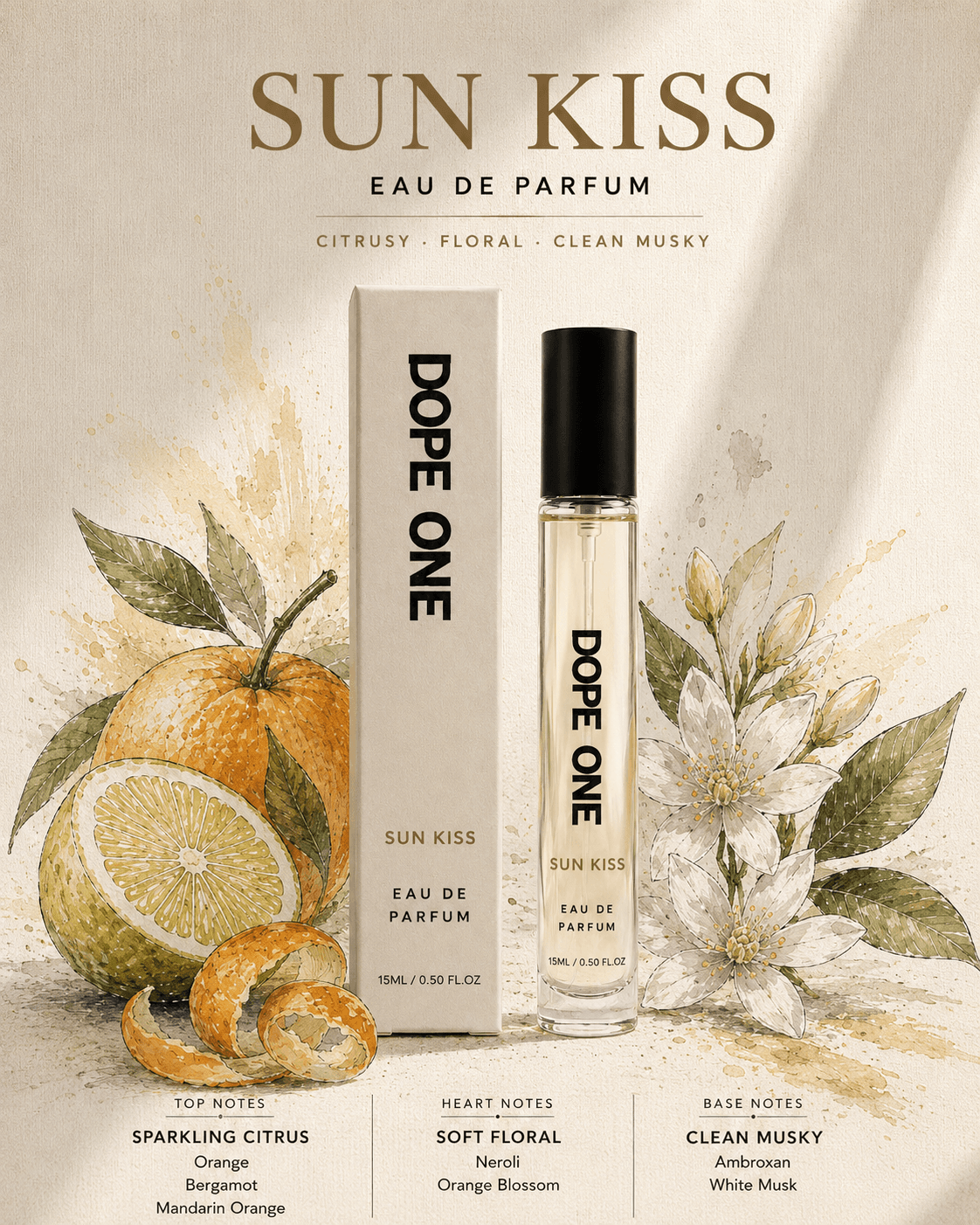
SUN KISS
Effervescent citrus lift over neroli, closing on white musk and solar amber.
₹419
View →
Every now and then a breeze catches your shirt and the citrus comes back to life — those moments are the whole reason to wear it. If Chilled Apricot is sitting under a tree with a cold fruit drink, Sun Kiss is jumping into a swimming pool on a hot afternoon.
The honest limitation: no darkness, no mystery, no statement, carefree is the entire design, and the first hours are its best ones. If the shelf is leather, oud, and spice, this will feel too easy, and that's the point of it.
Orange Blossom in Perfumery: Quick Answers
A few of the most common questions people ask about orange blossom as a fragrance note, answered directly below.
The Bottom Line on Orange Blossom
Orange blossom isn't one note, it's sunlit white petals that turn faintly warm and skin-like as the day goes on, the tension between brightness and depth that defines it. Knowing whether a perfume leans on neroli's clean lift or the absolute's honeyed weight tells you more about whether you'll like it than the words "orange blossom" on the label ever could. In Sun Kiss, it's a bright layer in a citrus composition, not the centerpiece.
Orange blossom carries more weight than its citrus relatives, which changes how it behaves once humidity enters the picture. Our what actually lasts through Indian summer works through that distinction properly.
Common questions
- What does orange blossom smell like in perfume?
- Orange blossom in perfume can smell two different ways depending on which material is used. Neroli oil is bright, clean, and almost soapy, dominated by linalool. Orange blossom absolute is darker, honeyed, and faintly narcotic, carrying methyl anthranilate and trace indole. Most perfumes sit somewhere between the two.
- Is orange blossom the same as neroli?
- They come from the same flower but aren't the same material. Neroli is the steam-distilled oil, bright and transparent. Orange blossom absolute is solvent-extracted and captures heavier, honeyed molecules that distillation loses. Both are genuinely 'orange blossom,' just processed differently.
- What's the difference between neroli oil and orange blossom absolute?
- Neroli oil is steam-distilled and dominated by linalool, giving a light, clean, citrus-green profile. Orange blossom absolute is solvent-extracted and captures methyl anthranilate, nerolidol, farnesol, and trace indole, giving a darker, waxier, more narcotic character. There's also orange blossom water absolute, a lesser-known byproduct that's earthier and less indolic than the standard absolute.
- What are the best orange blossom perfumes?
- Tom Ford Neroli Portofino and Jo Malone Orange Blossom lean into the brighter, neroli-forward side. Serge Lutens Fleurs d'Oranger goes for the deep, narcotic absolute reading. Prada Infusion de Fleur d'Oranger is a genuine budget-friendly, lighter entry point. Which is 'best' depends on which side of the neroli-to-absolute range you prefer.
- Is orange blossom perfume good for summer?
- Neroli-forward, brighter orange blossom compositions wear well in Indian summer heat, staying clean and lifted. Heavier, absolute-forward orange blossom fragrances can feel closer and more skin-like in high humidity, and tend to suit cooler months better.
- Where does the best orange blossom come from?
- Tunisia is the world's leading producer, with the Cap Bon peninsula around Nabeul processing over 2,500 tonnes of orange blossoms annually. Morocco and Egypt are also significant sources. Grasse in France has its own smaller, terroir-driven orange blossom tradition tied to historic perfumery.